

234
The Chemistry and Technology of Petroleum
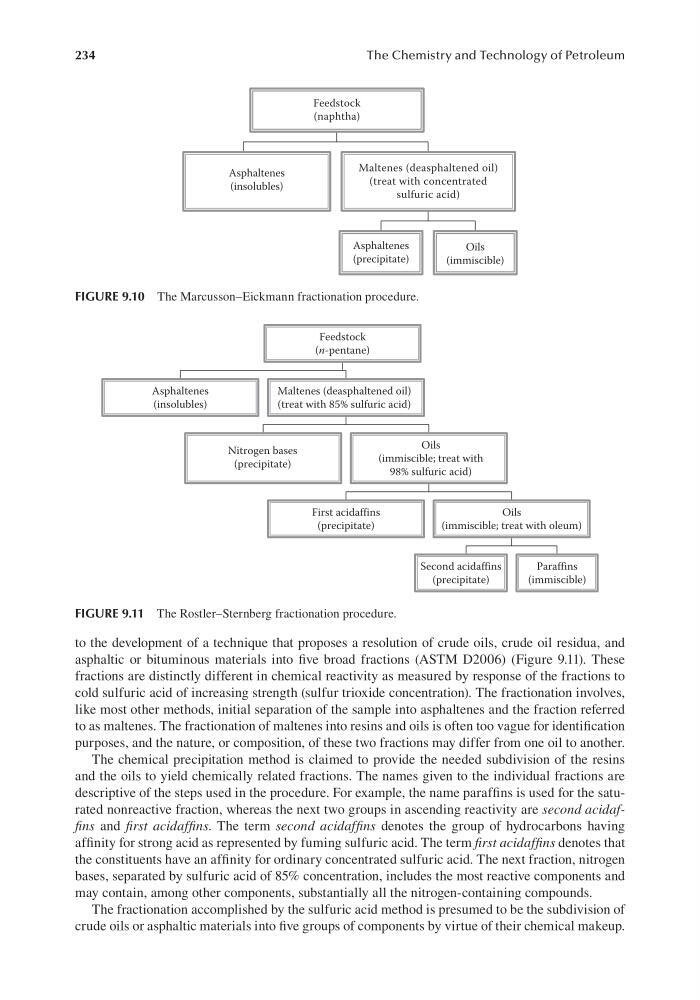
to the development of a technique that proposes a resolution of crude oils, crude oil residua, and
asphaltic or bituminous materials into five broad fractions (ASTM D2006) (Figure 9.11). These
fractions are distinctly different in chemical reactivity as measured by response of the fractions to
cold sulfuric acid of increasing strength (sulfur trioxide concentration). The fractionation involves,
like most other methods, initial separation of the sample into asphaltenes and the fraction referred
to as maltenes. The fractionation of maltenes into resins and oils is often too vague for identification
purposes, and the nature, or composition, of these two fractions may differ from one oil to another.
The chemical precipitation method is claimed to provide the needed subdivision of the resins
and the oils to yield chemically related fractions. The names given to the individual fractions are
descriptive of the steps used in the procedure. For example, the name paraffins is used for the saturated nonreactive fraction, whereas the next two groups in ascending reactivity are second acidaffins and first acidaffins. The term second acidaffins denotes the group of hydrocarbons having
affinity for strong acid as represented by fuming sulfuric acid. The term first acidaffins denotes that
the constituents have an affinity for ordinary concentrated sulfuric acid. The next fraction, nitrogen
bases, separated by sulfuric acid of 85% concentration, includes the most reactive components and
may contain, among other components, substantially all the nitrogen-containing compounds.
The fractionation accomplished by the sulfuric acid method is presumed to be the subdivision of
crude oils or asphaltic materials into five groups of components by virtue of their chemical makeup.
Asphaltenes
(insolubles)
Asphaltenes
(precipitate)
Oils
(immiscible)
Maltenes (deasphaltened oil)
(treat with concentrated
sulfuric acid)
Feedstock
(naphtha)
FIGURE 9.10 The Marcusson–Eickmann fractionation procedure.
Asphaltenes
(insolubles)
Nitrogen bases
(precipitate)
First acidaffins
(precipitate)
Second acidaffins
(precipitate)
Paraffins
(immiscible)
Oils
(immiscible; treat with oleum)
Oils
(immiscible; treat with
98% sulfuric acid)
Maltenes (deasphaltened oil)
(treat with 85% sulfuric acid)
Feedstock
(n-pentane)
FIGURE 9.11 The Rostler–Sternberg fractionation procedure.
The Chemistry and Technology of Petroleum
to the development of a technique that proposes a resolution of crude oils, crude oil residua, and
asphaltic or bituminous materials into five broad fractions (ASTM D2006) (Figure 9.11). These
fractions are distinctly different in chemical reactivity as measured by response of the fractions to
cold sulfuric acid of increasing strength (sulfur trioxide concentration). The fractionation involves,
like most other methods, initial separation of the sample into asphaltenes and the fraction referred
to as maltenes. The fractionation of maltenes into resins and oils is often too vague for identification
purposes, and the nature, or composition, of these two fractions may differ from one oil to another.
The chemical precipitation method is claimed to provide the needed subdivision of the resins
and the oils to yield chemically related fractions. The names given to the individual fractions are
descriptive of the steps used in the procedure. For example, the name paraffins is used for the saturated nonreactive fraction, whereas the next two groups in ascending reactivity are second acidaffins and first acidaffins. The term second acidaffins denotes the group of hydrocarbons having
affinity for strong acid as represented by fuming sulfuric acid. The term first acidaffins denotes that
the constituents have an affinity for ordinary concentrated sulfuric acid. The next fraction, nitrogen
bases, separated by sulfuric acid of 85% concentration, includes the most reactive components and
may contain, among other components, substantially all the nitrogen-containing compounds.
The fractionation accomplished by the sulfuric acid method is presumed to be the subdivision of
crude oils or asphaltic materials into five groups of components by virtue of their chemical makeup.
Asphaltenes
(insolubles)
Asphaltenes
(precipitate)
Oils
(immiscible)
Maltenes (deasphaltened oil)
(treat with concentrated
sulfuric acid)
Feedstock
(naphtha)
FIGURE 9.10 The Marcusson–Eickmann fractionation procedure.
Asphaltenes
(insolubles)
Nitrogen bases
(precipitate)
First acidaffins
(precipitate)
Second acidaffins
(precipitate)
Paraffins
(immiscible)
Oils
(immiscible; treat with oleum)
Oils
(immiscible; treat with
98% sulfuric acid)
Maltenes (deasphaltened oil)
(treat with 85% sulfuric acid)
Feedstock
(n-pentane)
FIGURE 9.11 The Rostler–Sternberg fractionation procedure.