

225
Fractional Composition
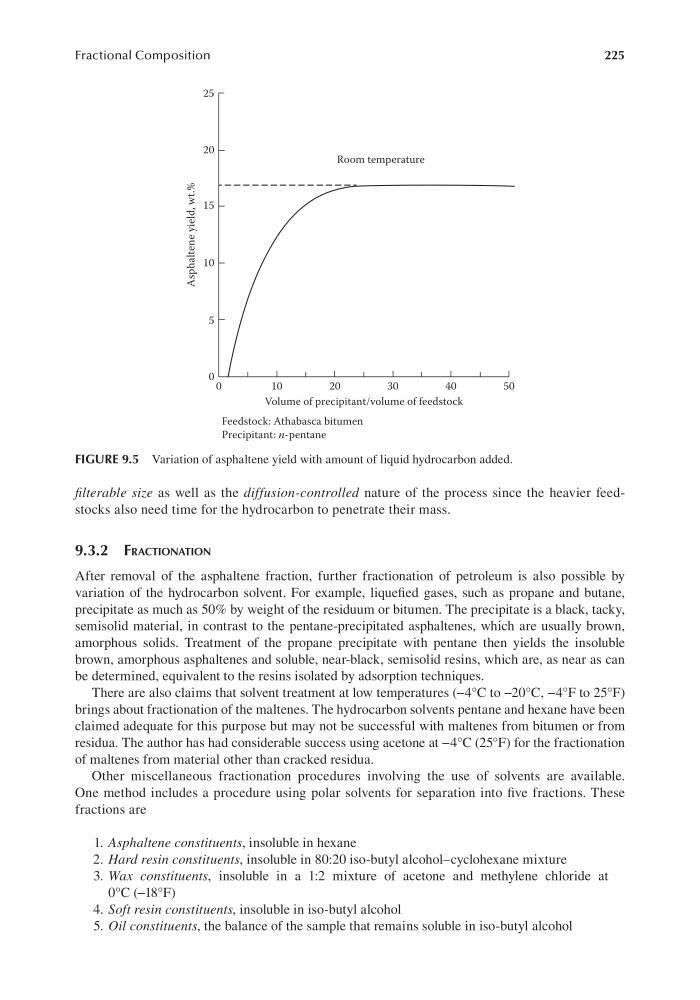
filterable size as well as the diffusion-controlled nature of the process since the heavier feedstocks also need time for the hydrocarbon to penetrate their mass.
9.3.2 FrACtIonAtIon
After removal of the asphaltene fraction, further fractionation of petroleum is also possible by
variation of the hydrocarbon solvent. For example, liquefied gases, such as propane and butane,
precipitate as much as 50% by weight of the residuum or bitumen. The precipitate is a black, tacky,
semisolid material, in contrast to the pentane-precipitated asphaltenes, which are usually brown,
amorphous solids. Treatment of the propane precipitate with pentane then yields the insoluble
brown, amorphous asphaltenes and soluble, near-black, semisolid resins, which are, as near as can
be determined, equivalent to the resins isolated by adsorption techniques.
There are also claims that solvent treatment at low temperatures (−4°C to −20°C, −4°F to 25°F)
brings about fractionation of the maltenes. The hydrocarbon solvents pentane and hexane have been
claimed adequate for this purpose but may not be successful with maltenes from bitumen or from
residua. The author has had considerable success using acetone at −4°C (25°F) for the fractionation
of maltenes from material other than cracked residua.
Other miscellaneous fractionation procedures involving the use of solvents are available.
One method includes a procedure using polar solvents for separation into five fractions. These
fractions are
1. Asphaltene constituents, insoluble in hexane
2. Hard resin constituents, insoluble in 80:20 iso-butyl alcohol–cyclohexane mixture
3. Wax constituents, insoluble in a 1:2 mixture of acetone and methylene chloride at
0°C (−18°F)
4. Soft resin constituents, insoluble in iso-butyl alcohol
5. Oil constituents, the balance of the sample that remains soluble in iso-butyl alcohol
Room temperature
Asphaltene yield, wt.%
0
0
5
10
15
20
25
10
20
30
40
50
Volume of precipitant/volume of feedstock
Feedstock: Athabasca bitumen
Precipitant: n-pentane
FIGURE 9.5 Variation of asphaltene yield with amount of liquid hydrocarbon added.
Fractional Composition
filterable size as well as the diffusion-controlled nature of the process since the heavier feedstocks also need time for the hydrocarbon to penetrate their mass.
9.3.2 FrACtIonAtIon
After removal of the asphaltene fraction, further fractionation of petroleum is also possible by
variation of the hydrocarbon solvent. For example, liquefied gases, such as propane and butane,
precipitate as much as 50% by weight of the residuum or bitumen. The precipitate is a black, tacky,
semisolid material, in contrast to the pentane-precipitated asphaltenes, which are usually brown,
amorphous solids. Treatment of the propane precipitate with pentane then yields the insoluble
brown, amorphous asphaltenes and soluble, near-black, semisolid resins, which are, as near as can
be determined, equivalent to the resins isolated by adsorption techniques.
There are also claims that solvent treatment at low temperatures (−4°C to −20°C, −4°F to 25°F)
brings about fractionation of the maltenes. The hydrocarbon solvents pentane and hexane have been
claimed adequate for this purpose but may not be successful with maltenes from bitumen or from
residua. The author has had considerable success using acetone at −4°C (25°F) for the fractionation
of maltenes from material other than cracked residua.
Other miscellaneous fractionation procedures involving the use of solvents are available.
One method includes a procedure using polar solvents for separation into five fractions. These
fractions are
1. Asphaltene constituents, insoluble in hexane
2. Hard resin constituents, insoluble in 80:20 iso-butyl alcohol–cyclohexane mixture
3. Wax constituents, insoluble in a 1:2 mixture of acetone and methylene chloride at
0°C (−18°F)
4. Soft resin constituents, insoluble in iso-butyl alcohol
5. Oil constituents, the balance of the sample that remains soluble in iso-butyl alcohol
Room temperature
Asphaltene yield, wt.%
0
0
5
10
15
20
25
10
20
30
40
50
Volume of precipitant/volume of feedstock
Feedstock: Athabasca bitumen
Precipitant: n-pentane
FIGURE 9.5 Variation of asphaltene yield with amount of liquid hydrocarbon added.