

198
The Chemistry and Technology of Petroleum
any particular crude oil. Nevertheless, sulfur compounds of one type or another are present in all
crude oils (Thompson et al., 1976). In general, the higher the density of the crude oil, the lower the
API gravity of the crude oil and the higher the sulfur content; the total sulfur in the crude oil can
vary from 0.04% w/w for light crude oil to about 5.0% for heavy crude oil and tar sand bitumen.
However, the sulfur content of crude oils produced from broad geographic regions varies with time,
depending on the composition of newly discovered fields, particularly those in different geological
environments.
The presence of sulfur compounds in finished petroleum products often produces harmful
effects. For example, in gasoline, sulfur compounds are believed to promote corrosion of engine
parts, especially under winter conditions, when water containing sulfur dioxide from the combustion may accumulate in the crankcase. In addition, mercaptans in hydrocarbon solution cause the
corrosion of copper and brass in the presence of air and also affect lead susceptibility and color stability. Free sulfur is also corrosive, as are sulfides, disulfides, and thiophenes, which are detrimental
to the octane number response to tetraethyllead. However, gasoline with a sulfur content between
0.2% and 0.5% has been used without obvious harmful effect. In diesel fuels, sulfur compounds
increase wear and can contribute to the formation of engine deposits. Although a high sulfur content
can sometimes be tolerated in industrial fuel oils, the situation for lubricating oils is that a high content of sulfur compounds in lubricating oils seems to lower the resistance to oxidation and increases
the deposition of solids.
The distribution of sulfur in the various fractions of crude oils has been studied many times,
beginning in 1891. Although it is generally true that the proportion of sulfur increases with the boiling point during distillation (Speight, 2000 and references cited therein), the middle fractions may
actually contain more sulfur than higher boiling fractions as a result of decomposition of the higher
molecular weight compounds during the distillation. High sulfur content is generally considered
harmful in most petroleum products, and the removal of sulfur compounds or their conversion to
less deleterious types is an important part of refinery practice. The distribution of the various types
of sulfur compounds varies markedly among crude oils of diverse origin, but fortunately some of
the sulfur compounds in petroleum undergo thermal reactions at relatively low temperatures. If
elemental sulfur is present in the oil, a reaction, with the evolution of hydrogen sulfide, begins at
about 150°C (300°F) and is very rapid at 220°C (430°F), but organically bound sulfur compounds
do not yield hydrogen sulfide until higher temperatures are reached. Hydrogen sulfide is, however,
a common constituent of many crude oils, and some crude oils with >1% sulfur are often accompanied by a gas having substantial properties of hydrogen sulfide.
Various thiophene derivatives have also been isolated from a variety of crude oils; benzothiophene derivatives are usually present in the higher boiling petroleum fractions. On the other hand,
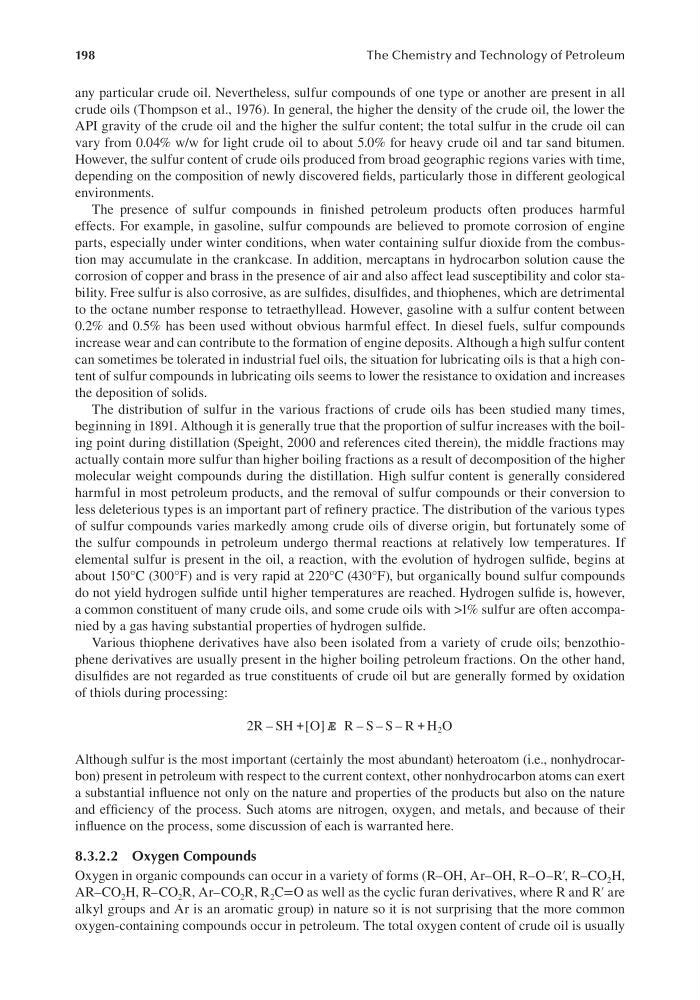
disulfides are not regarded as true constituents of crude oil but are generally formed by oxidation
of thiols during processing:
2R SH O
R S S R H O
2
–
[ ]
– – –
+
Æ
+
Although sulfur is the most important (certainly the most abundant) heteroatom (i.e., nonhydrocarbon) present in petroleum with respect to the current context, other nonhydrocarbon atoms can exert
a substantial influence not only on the nature and properties of the products but also on the nature
and efficiency of the process. Such atoms are nitrogen, oxygen, and metals, and because of their
influence on the process, some discussion of each is warranted here.
8.3.2.2 Oxygen Compounds
Oxygen in organic compounds can occur in a variety of forms (R–OH, Ar–OH, R–O–R′, R–CO 2 H,
AR–CO 2 H, R–CO 2 R, Ar–CO 2 R, R 2 C=O as well as the cyclic furan derivatives, where R and R′ are
alkyl groups and Ar is an aromatic group) in nature so it is not surprising that the more common
oxygen-containing compounds occur in petroleum. The total oxygen content of crude oil is usually
The Chemistry and Technology of Petroleum
any particular crude oil. Nevertheless, sulfur compounds of one type or another are present in all
crude oils (Thompson et al., 1976). In general, the higher the density of the crude oil, the lower the
API gravity of the crude oil and the higher the sulfur content; the total sulfur in the crude oil can
vary from 0.04% w/w for light crude oil to about 5.0% for heavy crude oil and tar sand bitumen.
However, the sulfur content of crude oils produced from broad geographic regions varies with time,
depending on the composition of newly discovered fields, particularly those in different geological
environments.
The presence of sulfur compounds in finished petroleum products often produces harmful
effects. For example, in gasoline, sulfur compounds are believed to promote corrosion of engine
parts, especially under winter conditions, when water containing sulfur dioxide from the combustion may accumulate in the crankcase. In addition, mercaptans in hydrocarbon solution cause the
corrosion of copper and brass in the presence of air and also affect lead susceptibility and color stability. Free sulfur is also corrosive, as are sulfides, disulfides, and thiophenes, which are detrimental
to the octane number response to tetraethyllead. However, gasoline with a sulfur content between
0.2% and 0.5% has been used without obvious harmful effect. In diesel fuels, sulfur compounds
increase wear and can contribute to the formation of engine deposits. Although a high sulfur content
can sometimes be tolerated in industrial fuel oils, the situation for lubricating oils is that a high content of sulfur compounds in lubricating oils seems to lower the resistance to oxidation and increases
the deposition of solids.
The distribution of sulfur in the various fractions of crude oils has been studied many times,
beginning in 1891. Although it is generally true that the proportion of sulfur increases with the boiling point during distillation (Speight, 2000 and references cited therein), the middle fractions may
actually contain more sulfur than higher boiling fractions as a result of decomposition of the higher
molecular weight compounds during the distillation. High sulfur content is generally considered
harmful in most petroleum products, and the removal of sulfur compounds or their conversion to
less deleterious types is an important part of refinery practice. The distribution of the various types
of sulfur compounds varies markedly among crude oils of diverse origin, but fortunately some of
the sulfur compounds in petroleum undergo thermal reactions at relatively low temperatures. If
elemental sulfur is present in the oil, a reaction, with the evolution of hydrogen sulfide, begins at
about 150°C (300°F) and is very rapid at 220°C (430°F), but organically bound sulfur compounds
do not yield hydrogen sulfide until higher temperatures are reached. Hydrogen sulfide is, however,
a common constituent of many crude oils, and some crude oils with >1% sulfur are often accompanied by a gas having substantial properties of hydrogen sulfide.
Various thiophene derivatives have also been isolated from a variety of crude oils; benzothiophene derivatives are usually present in the higher boiling petroleum fractions. On the other hand,
disulfides are not regarded as true constituents of crude oil but are generally formed by oxidation
of thiols during processing:
2R SH O
R S S R H O
2
–
[ ]
– – –
+
Æ
+
Although sulfur is the most important (certainly the most abundant) heteroatom (i.e., nonhydrocarbon) present in petroleum with respect to the current context, other nonhydrocarbon atoms can exert
a substantial influence not only on the nature and properties of the products but also on the nature
and efficiency of the process. Such atoms are nitrogen, oxygen, and metals, and because of their
influence on the process, some discussion of each is warranted here.
8.3.2.2 Oxygen Compounds
Oxygen in organic compounds can occur in a variety of forms (R–OH, Ar–OH, R–O–R′, R–CO 2 H,
AR–CO 2 H, R–CO 2 R, Ar–CO 2 R, R 2 C=O as well as the cyclic furan derivatives, where R and R′ are
alkyl groups and Ar is an aromatic group) in nature so it is not surprising that the more common
oxygen-containing compounds occur in petroleum. The total oxygen content of crude oil is usually