

197
Chemical Composition
Although their concentration in certain fractions may be quite small, their influence is important. For example, the decomposition of inorganic salts suspended in the crude can cause serious
breakdowns in refinery operations; the thermal decomposition of deposited inorganic chlorides with
evolution of free hydrochloric acid can give rise to serious corrosion problems in the distillation
equipment. The presence of organic acid components, such as mercaptans and acids, can also promote metallic corrosion. In catalytic operations, passivation and/or poisoning of the catalyst can be
caused by deposition of traces of metals (vanadium and nickel) or by chemisorption of nitrogencontaining compounds on the catalyst, thus necessitating the frequent regeneration of the catalyst
or its expensive replacement.
The presence of traces of nonhydrocarbons may impart objectionable characteristics in finished
products, such as discoloration, lack of stability on storage, or a reduction in the effectiveness of
organic lead antiknock additives. It is thus obvious that a more extensive knowledge of these compounds and of their characteristics could result in improved refining methods and even in finished
products of better quality. The nonhydrocarbon compounds, particularly the porphyrins and related
compounds, are also of fundamental interest in the elucidation of the origin and nature of crude
oils. Furthermore, a knowledge of their surface-active characteristics is of help in understanding
problems related to the migration of oil from the source rocks to the actual reservoirs.
8.3.2.1 Sulfur Compounds
Sulfur compounds are among the most important heteroatomic constituents of petroleum, and
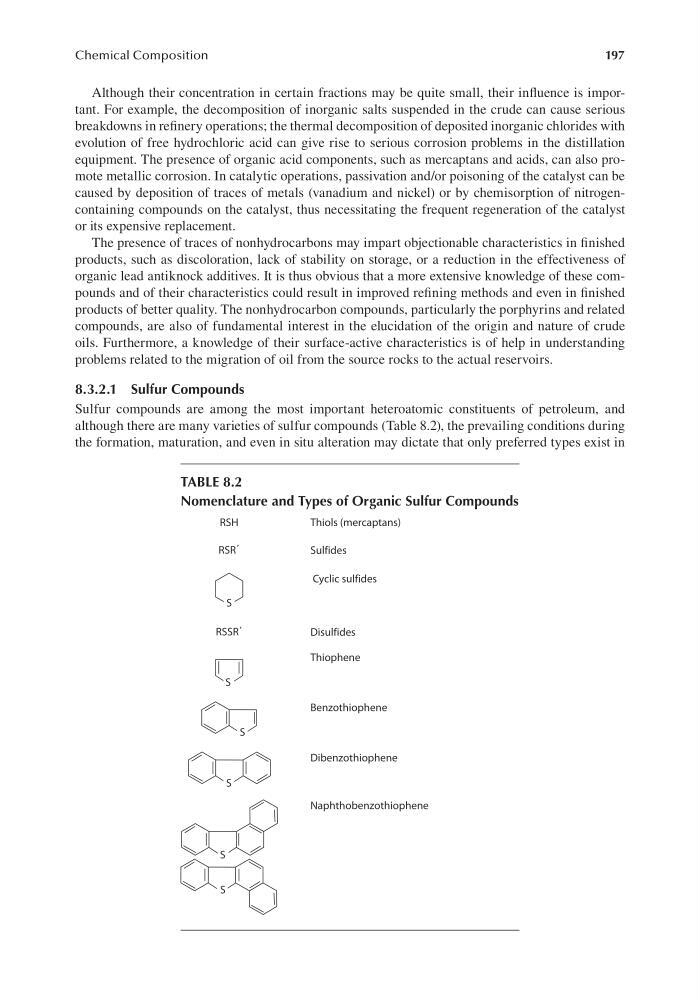
although there are many varieties of sulfur compounds (Table 8.2), the prevailing conditions during
the formation, maturation, and even in situ alteration may dictate that only preferred types exist in
TABLE 8.2
Nomenclature and Types of Organic Sulfur Compounds
S
Thiols (mercaptans)
Sulfides
RSH
S
S
S
S
S
RSR΄
RSSR΄
Cyclic sulfides
Disulfides
Thiophene
Benzothiophene
Naphthobenzothiophene
Dibenzothiophene
Chemical Composition
Although their concentration in certain fractions may be quite small, their influence is important. For example, the decomposition of inorganic salts suspended in the crude can cause serious
breakdowns in refinery operations; the thermal decomposition of deposited inorganic chlorides with
evolution of free hydrochloric acid can give rise to serious corrosion problems in the distillation
equipment. The presence of organic acid components, such as mercaptans and acids, can also promote metallic corrosion. In catalytic operations, passivation and/or poisoning of the catalyst can be
caused by deposition of traces of metals (vanadium and nickel) or by chemisorption of nitrogencontaining compounds on the catalyst, thus necessitating the frequent regeneration of the catalyst
or its expensive replacement.
The presence of traces of nonhydrocarbons may impart objectionable characteristics in finished
products, such as discoloration, lack of stability on storage, or a reduction in the effectiveness of
organic lead antiknock additives. It is thus obvious that a more extensive knowledge of these compounds and of their characteristics could result in improved refining methods and even in finished
products of better quality. The nonhydrocarbon compounds, particularly the porphyrins and related
compounds, are also of fundamental interest in the elucidation of the origin and nature of crude
oils. Furthermore, a knowledge of their surface-active characteristics is of help in understanding
problems related to the migration of oil from the source rocks to the actual reservoirs.
8.3.2.1 Sulfur Compounds
Sulfur compounds are among the most important heteroatomic constituents of petroleum, and
although there are many varieties of sulfur compounds (Table 8.2), the prevailing conditions during
the formation, maturation, and even in situ alteration may dictate that only preferred types exist in
TABLE 8.2
Nomenclature and Types of Organic Sulfur Compounds
S
Thiols (mercaptans)
Sulfides
RSH
S
S
S
S
S
RSR΄
RSSR΄
Cyclic sulfides
Disulfides
Thiophene
Benzothiophene
Naphthobenzothiophene
Dibenzothiophene