

191
Chemical Composition
are very rare indeed. It is therefore convenient to divide the hydrocarbon components of petroleum
into the following three classes:
1. Paraffins, which are saturated hydrocarbons with straight or branched chains, but without
any ring structure
2. Naphthenes, which are saturated hydrocarbons containing one or more rings, each of
which may have one or more paraffinic side chains (more correctly known as alicyclic
hydrocarbons)
3. Aromatics, which are hydrocarbons containing one or more aromatic nuclei, such as benzene, naphthalene, and phenanthrene ring systems, which may be linked up with (substituted) naphthene rings and/or paraffinic side chains
8.3.1.1 Paraffin Hydrocarbons
The proportion of paraffins in crude oil varies with the type of crude, but within any one crude oil,
the proportion of paraffinic hydrocarbons usually decreases with increasing molecular weight and
there is a concomitant increase in aromaticity and the relative proportion of heteroatoms (nitrogen,
oxygen, and sulfur) (Figure 8.1).
The relationship between the various hydrocarbon constituents of crude oils is one of hydrogen
addition or hydrogen loss (Figure 8.2). This is an extremely important aspect of petroleum composition and there is no reason to deny the occurrence of these interconversion schemes during the
formation, maturation, and in situ alteration of petroleum. Indeed, a scheme of this type lends even
more credence to the complexity of petroleum within the hydrocarbon series alone and also supports current contentions that the high molecular weight constituents (resin constituents and asphaltene constituents) are structurally related to the lower-boiling constituents rather than proposals that
invoke the existence of highly condensed polynuclear aromatic systems.
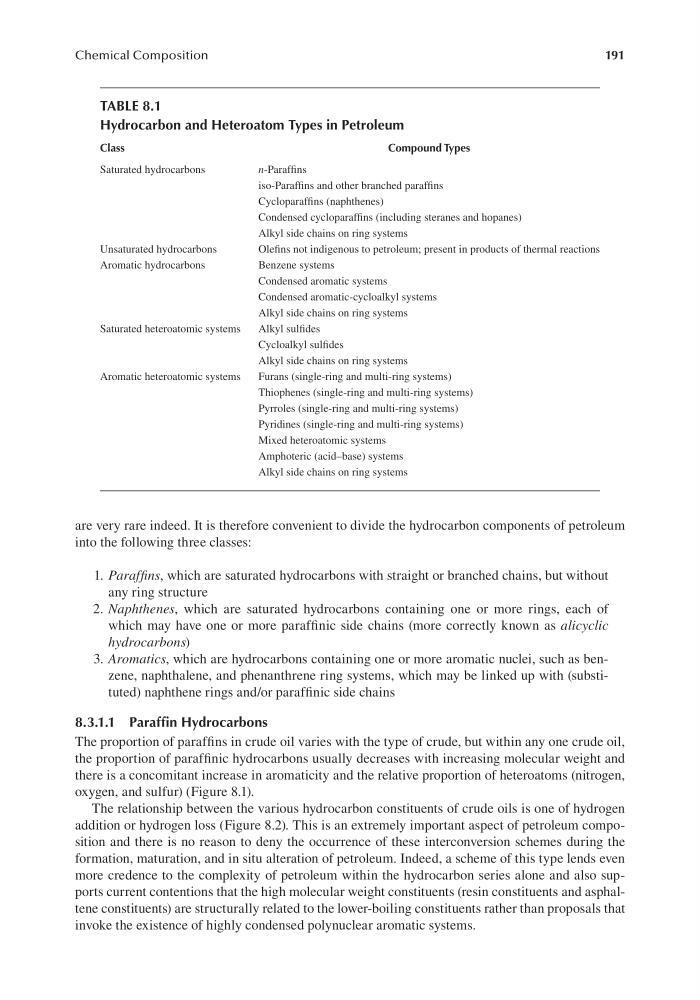
TABLE 8.1
Hydrocarbon and Heteroatom Types in Petroleum
Class
Compound Types
Saturated hydrocarbons
n-Paraffins
iso-Paraffins and other branched paraffins
Cycloparaffins (naphthenes)
Condensed cycloparaffins (including steranes and hopanes)
Alkyl side chains on ring systems
Unsaturated hydrocarbons
Olefins not indigenous to petroleum; present in products of thermal reactions
Aromatic hydrocarbons
Benzene systems
Condensed aromatic systems
Condensed aromatic-cycloalkyl systems
Alkyl side chains on ring systems
Saturated heteroatomic systems
Alkyl sulfides
Cycloalkyl sulfides
Alkyl side chains on ring systems
Aromatic heteroatomic systems
Furans (single-ring and multi-ring systems)
Thiophenes (single-ring and multi-ring systems)
Pyrroles (single-ring and multi-ring systems)
Pyridines (single-ring and multi-ring systems)
Mixed heteroatomic systems
Amphoteric (acid–base) systems
Alkyl side chains on ring systems
Chemical Composition
are very rare indeed. It is therefore convenient to divide the hydrocarbon components of petroleum
into the following three classes:
1. Paraffins, which are saturated hydrocarbons with straight or branched chains, but without
any ring structure
2. Naphthenes, which are saturated hydrocarbons containing one or more rings, each of
which may have one or more paraffinic side chains (more correctly known as alicyclic
hydrocarbons)
3. Aromatics, which are hydrocarbons containing one or more aromatic nuclei, such as benzene, naphthalene, and phenanthrene ring systems, which may be linked up with (substituted) naphthene rings and/or paraffinic side chains
8.3.1.1 Paraffin Hydrocarbons
The proportion of paraffins in crude oil varies with the type of crude, but within any one crude oil,
the proportion of paraffinic hydrocarbons usually decreases with increasing molecular weight and
there is a concomitant increase in aromaticity and the relative proportion of heteroatoms (nitrogen,
oxygen, and sulfur) (Figure 8.1).
The relationship between the various hydrocarbon constituents of crude oils is one of hydrogen
addition or hydrogen loss (Figure 8.2). This is an extremely important aspect of petroleum composition and there is no reason to deny the occurrence of these interconversion schemes during the
formation, maturation, and in situ alteration of petroleum. Indeed, a scheme of this type lends even
more credence to the complexity of petroleum within the hydrocarbon series alone and also supports current contentions that the high molecular weight constituents (resin constituents and asphaltene constituents) are structurally related to the lower-boiling constituents rather than proposals that
invoke the existence of highly condensed polynuclear aromatic systems.
TABLE 8.1
Hydrocarbon and Heteroatom Types in Petroleum
Class
Compound Types
Saturated hydrocarbons
n-Paraffins
iso-Paraffins and other branched paraffins
Cycloparaffins (naphthenes)
Condensed cycloparaffins (including steranes and hopanes)
Alkyl side chains on ring systems
Unsaturated hydrocarbons
Olefins not indigenous to petroleum; present in products of thermal reactions
Aromatic hydrocarbons
Benzene systems
Condensed aromatic systems
Condensed aromatic-cycloalkyl systems
Alkyl side chains on ring systems
Saturated heteroatomic systems
Alkyl sulfides
Cycloalkyl sulfides
Alkyl side chains on ring systems
Aromatic heteroatomic systems
Furans (single-ring and multi-ring systems)
Thiophenes (single-ring and multi-ring systems)
Pyrroles (single-ring and multi-ring systems)
Pyridines (single-ring and multi-ring systems)
Mixed heteroatomic systems
Amphoteric (acid–base) systems
Alkyl side chains on ring systems