

103
Kerogen
origin. Organic sources for the type I kerogen include the lipid-rich products of algal blooms and
the finely divided and extensively reworked lipid-rich biomass deposited in stable stratified lakes.
Type II kerogen is characteristic of the marine oil shales. The organic matter in this type of kerogen is usually derived from a mixture of zooplankton, phytoplankton, and bacterial remains that
were deposited in a reducing environment. Atomic H/C ratios are generally lower than for type I
kerogen, but the O/C atomic ratios are generally higher for type II kerogen than for type I kerogen.
Organic sulfur levels are also generally higher in the type II kerogen. The oil-generating potential
of type II kerogen is generally lower than that of type I kerogen (i.e., less of the organic material is
liberated as oil upon heating a type II kerogen at the same level of maturation).
Type III kerogen is characteristic of coals and coaly shales. Easily identified fossilized plants
and plant fragments are common, indicating that this type of kerogen is derived from woody terrestrial material. These materials have relatively low atomic H/C ratios (usually <1.0) and relatively high atomic O/C ratios (>0.2). Aromatic and heteroaromatic contents are high, and ether units
(especially of the diaryl ethers) are important, as might be anticipated for a lignin-derived material.
Oil-generating potentials are low, but gas-generating potentials are high.
At the beginning of the type I path, the kerogen types have a strongly aliphatic nature; at the
beginning of the type III path the kerogen consists largely of aromatic structures that carry oxygen
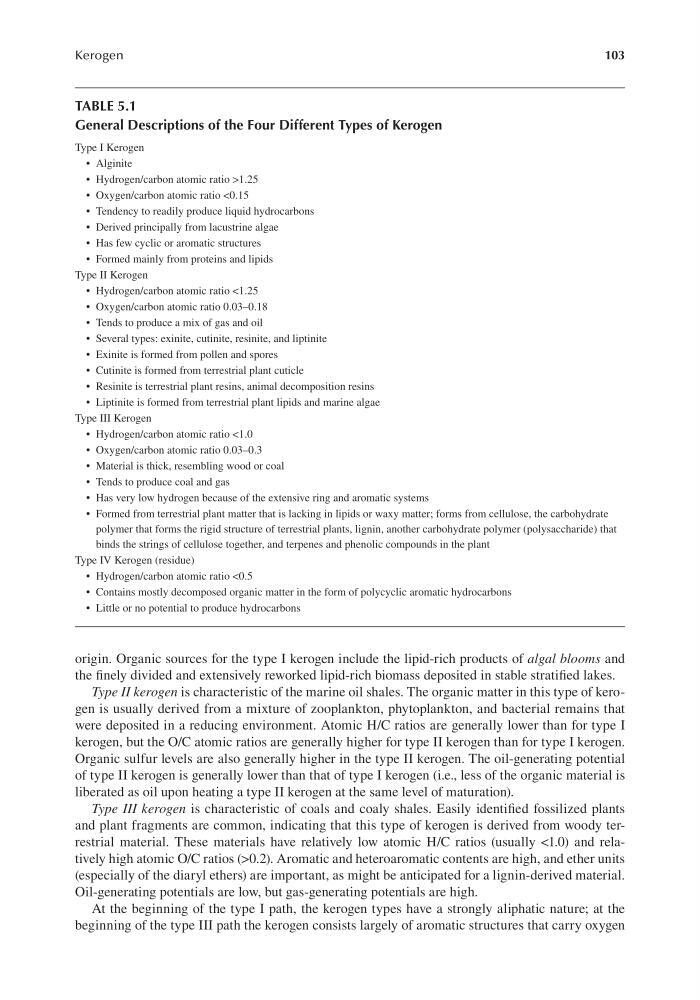
TABLE 5.1
General Descriptions of the Four Different Types of Kerogen
Type I Kerogen
• Alginite
• Hydrogen/carbon atomic ratio >1.25
• Oxygen/carbon atomic ratio <0.15
• Tendency to readily produce liquid hydrocarbons
• Derived principally from lacustrine algae
• Has few cyclic or aromatic structures
• Formed mainly from proteins and lipids
Type II Kerogen
• Hydrogen/carbon atomic ratio <1.25
• Oxygen/carbon atomic ratio 0.03–0.18
• Tends to produce a mix of gas and oil
• Several types: exinite, cutinite, resinite, and liptinite
• Exinite is formed from pollen and spores
• Cutinite is formed from terrestrial plant cuticle
• Resinite is terrestrial plant resins, animal decomposition resins
• Liptinite is formed from terrestrial plant lipids and marine algae
Type III Kerogen
• Hydrogen/carbon atomic ratio <1.0
• Oxygen/carbon atomic ratio 0.03–0.3
• Material is thick, resembling wood or coal
• Tends to produce coal and gas
• Has very low hydrogen because of the extensive ring and aromatic systems
• Formed from terrestrial plant matter that is lacking in lipids or waxy matter; forms from cellulose, the carbohydrate
polymer that forms the rigid structure of terrestrial plants, lignin, another carbohydrate polymer (polysaccharide) that
binds the strings of cellulose together, and terpenes and phenolic compounds in the plant
Type IV Kerogen (residue)
• Hydrogen/carbon atomic ratio <0.5
• Contains mostly decomposed organic matter in the form of polycyclic aromatic hydrocarbons
• Little or no potential to produce hydrocarbons
Kerogen
origin. Organic sources for the type I kerogen include the lipid-rich products of algal blooms and
the finely divided and extensively reworked lipid-rich biomass deposited in stable stratified lakes.
Type II kerogen is characteristic of the marine oil shales. The organic matter in this type of kerogen is usually derived from a mixture of zooplankton, phytoplankton, and bacterial remains that
were deposited in a reducing environment. Atomic H/C ratios are generally lower than for type I
kerogen, but the O/C atomic ratios are generally higher for type II kerogen than for type I kerogen.
Organic sulfur levels are also generally higher in the type II kerogen. The oil-generating potential
of type II kerogen is generally lower than that of type I kerogen (i.e., less of the organic material is
liberated as oil upon heating a type II kerogen at the same level of maturation).
Type III kerogen is characteristic of coals and coaly shales. Easily identified fossilized plants
and plant fragments are common, indicating that this type of kerogen is derived from woody terrestrial material. These materials have relatively low atomic H/C ratios (usually <1.0) and relatively high atomic O/C ratios (>0.2). Aromatic and heteroaromatic contents are high, and ether units
(especially of the diaryl ethers) are important, as might be anticipated for a lignin-derived material.
Oil-generating potentials are low, but gas-generating potentials are high.
At the beginning of the type I path, the kerogen types have a strongly aliphatic nature; at the
beginning of the type III path the kerogen consists largely of aromatic structures that carry oxygen
TABLE 5.1
General Descriptions of the Four Different Types of Kerogen
Type I Kerogen
• Alginite
• Hydrogen/carbon atomic ratio >1.25
• Oxygen/carbon atomic ratio <0.15
• Tendency to readily produce liquid hydrocarbons
• Derived principally from lacustrine algae
• Has few cyclic or aromatic structures
• Formed mainly from proteins and lipids
Type II Kerogen
• Hydrogen/carbon atomic ratio <1.25
• Oxygen/carbon atomic ratio 0.03–0.18
• Tends to produce a mix of gas and oil
• Several types: exinite, cutinite, resinite, and liptinite
• Exinite is formed from pollen and spores
• Cutinite is formed from terrestrial plant cuticle
• Resinite is terrestrial plant resins, animal decomposition resins
• Liptinite is formed from terrestrial plant lipids and marine algae
Type III Kerogen
• Hydrogen/carbon atomic ratio <1.0
• Oxygen/carbon atomic ratio 0.03–0.3
• Material is thick, resembling wood or coal
• Tends to produce coal and gas
• Has very low hydrogen because of the extensive ring and aromatic systems
• Formed from terrestrial plant matter that is lacking in lipids or waxy matter; forms from cellulose, the carbohydrate
polymer that forms the rigid structure of terrestrial plants, lignin, another carbohydrate polymer (polysaccharide) that
binds the strings of cellulose together, and terpenes and phenolic compounds in the plant
Type IV Kerogen (residue)
• Hydrogen/carbon atomic ratio <0.5
• Contains mostly decomposed organic matter in the form of polycyclic aromatic hydrocarbons
• Little or no potential to produce hydrocarbons