

102
The Chemistry and Technology of Petroleum
5.3 COMPOSITION
In very general terms, the hydrogen content of kerogen falls between that of petroleum and that of
coal, but this varies considerably with the source so that a range of values is found. This has been
suggested as reflecting an overlap between terrestrial and aquatic origin. In fact, a high lipid content,
consistent with the occurrence of aquatic plants in the source material, appears to be diminished
in kerogen by lignin of terrestrial origin (Whitehead, 1982, and references cited therein; Scouten,
1990, and references cited therein). In fact, kerogen is best represented as a macromolecule that
contains considerable amounts of carbon and hydrogen (Scouten, 1990). Furthermore, it is the macromolecular and heteroatomic nature of kerogen with up to 400 heteroatoms (nitrogen plus oxygen
plus sulfur) for every 1000 carbon atoms occurring as an integral part of the macromolecule that
classifies kerogen as a naturally occurring heteroatomic material.
5.4 CLASSIFICATION
In addition to being classified as a naturally occurring heteroatomic material, kerogen can be subclassified into four different types (I, II, III, and IV) (Table 5.1). These types of kerogen originate
because of the different kinds of debris deposited in the sediment and also because of the conditions
that prevail in that sediment over geological time. As initially deposited in a recent sediment, each
type of debris may have a characteristic range of composition that can depend upon local conditions,
such as the types of flora and fauna that contribute to the debris. As the sediment is buried deeper
and/or hotter and for a longer time, the organic material in the sediment undergoes maturation to
give oil, gas, or a mixture of the two (Tissot and Welte, 1978; Hunt, 1996).
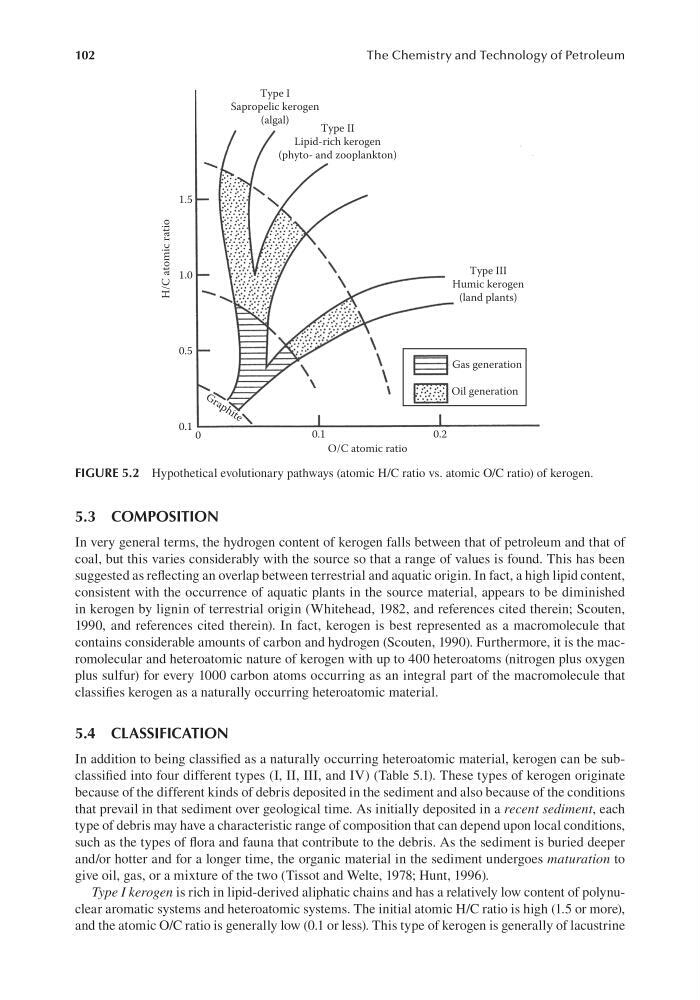
Type I kerogen is rich in lipid-derived aliphatic chains and has a relatively low content of polynuclear aromatic systems and heteroatomic systems. The initial atomic H/C ratio is high (1.5 or more),
and the atomic O/C ratio is generally low (0.1 or less). This type of kerogen is generally of lacustrine
Type III
Humic kerogen
(land plants)
Type II
Lipid-rich kerogen
(phyto- and zooplankton)
Type I
Sapropelic kerogen
(algal)
Gas generation
Oil generation
G r a p h i t e
0.2
H/C atomic ratio
0.1
0.1
1.0
1.5
0.5
0
O/C atomic ratio
FIGURE 5.2 Hypothetical evolutionary pathways (atomic H/C ratio vs. atomic O/C ratio) of kerogen.
The Chemistry and Technology of Petroleum
5.3 COMPOSITION
In very general terms, the hydrogen content of kerogen falls between that of petroleum and that of
coal, but this varies considerably with the source so that a range of values is found. This has been
suggested as reflecting an overlap between terrestrial and aquatic origin. In fact, a high lipid content,
consistent with the occurrence of aquatic plants in the source material, appears to be diminished
in kerogen by lignin of terrestrial origin (Whitehead, 1982, and references cited therein; Scouten,
1990, and references cited therein). In fact, kerogen is best represented as a macromolecule that
contains considerable amounts of carbon and hydrogen (Scouten, 1990). Furthermore, it is the macromolecular and heteroatomic nature of kerogen with up to 400 heteroatoms (nitrogen plus oxygen
plus sulfur) for every 1000 carbon atoms occurring as an integral part of the macromolecule that
classifies kerogen as a naturally occurring heteroatomic material.
5.4 CLASSIFICATION
In addition to being classified as a naturally occurring heteroatomic material, kerogen can be subclassified into four different types (I, II, III, and IV) (Table 5.1). These types of kerogen originate
because of the different kinds of debris deposited in the sediment and also because of the conditions
that prevail in that sediment over geological time. As initially deposited in a recent sediment, each
type of debris may have a characteristic range of composition that can depend upon local conditions,
such as the types of flora and fauna that contribute to the debris. As the sediment is buried deeper
and/or hotter and for a longer time, the organic material in the sediment undergoes maturation to
give oil, gas, or a mixture of the two (Tissot and Welte, 1978; Hunt, 1996).
Type I kerogen is rich in lipid-derived aliphatic chains and has a relatively low content of polynuclear aromatic systems and heteroatomic systems. The initial atomic H/C ratio is high (1.5 or more),
and the atomic O/C ratio is generally low (0.1 or less). This type of kerogen is generally of lacustrine
Type III
Humic kerogen
(land plants)
Type II
Lipid-rich kerogen
(phyto- and zooplankton)
Type I
Sapropelic kerogen
(algal)
Gas generation
Oil generation
G r a p h i t e
0.2
H/C atomic ratio
0.1
0.1
1.0
1.5
0.5
0
O/C atomic ratio
FIGURE 5.2 Hypothetical evolutionary pathways (atomic H/C ratio vs. atomic O/C ratio) of kerogen.