

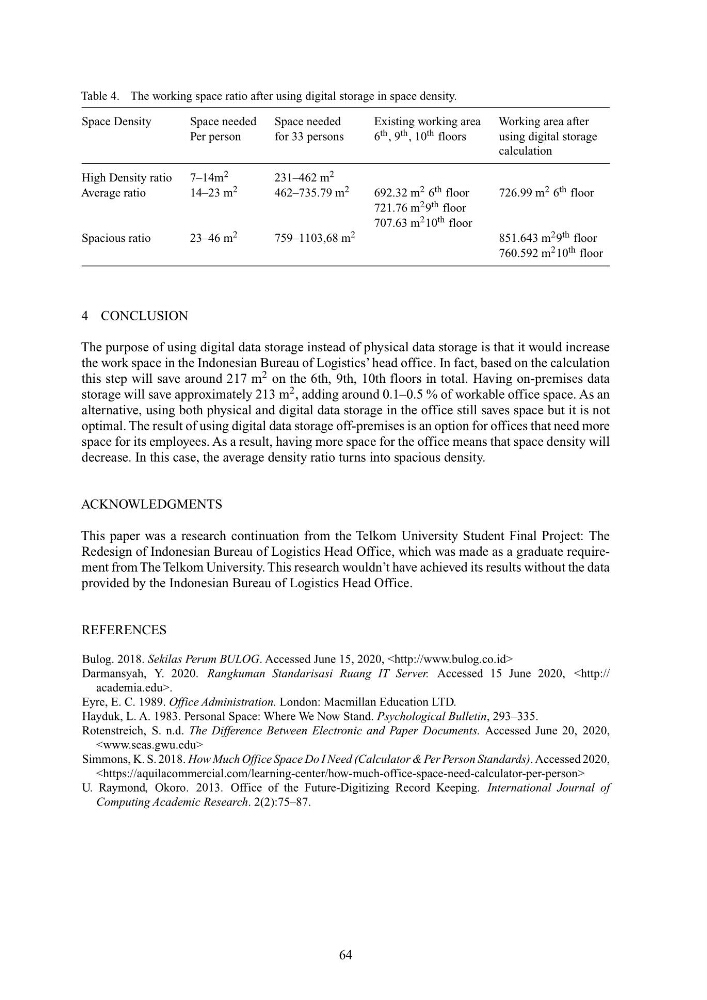
Table 4. The working space ratio after using digital storage in space density.
Space Density
Space needed Space needed
Existing working area Working area after
Per person
for 33 persons
6 th , 9 th , 10 th floors
using digital storage
calculation
High Density ratio 7–14m 2
231–462 m 2
Average ratio
14–23 m 2
462–735.79 m 2
692.32 m 2 6 th floor
726.99 m 2 6 th floor
721.76 m 2 9 th floor
707.63 m 2 10 th floor
Spacious ratio
23–46 m 2
759–1103,68 m 2
851.643 m 2 9 th floor
760.592 m 2 10 th floor
4 CONCLUSION
The purpose of using digital data storage instead of physical data storage is that it would increase
the work space in the Indonesian Bureau of Logistics’ head office. In fact, based on the calculation
this step will save around 217 m 2 on the 6th, 9th, 10th floors in total. Having on-premises data
storage will save approximately 213 m 2 , adding around 0.1–0.5 % of workable office space. As an
alternative, using both physical and digital data storage in the office still saves space but it is not
optimal. The result of using digital data storage off-premises is an option for offices that need more
space for its employees. As a result, having more space for the office means that space density will
decrease. In this case, the average density ratio turns into spacious density.
ACKNOWLEDGMENTS
This paper was a research continuation from the Telkom University Student Final Project: The
Redesign of Indonesian Bureau of Logistics Head Office, which was made as a graduate requirement from The Telkom University. This research wouldn’t have achieved its results without the data
provided by the Indonesian Bureau of Logistics Head Office.
REFERENCES
Bulog. 2018. Sekilas Perum BULOG. Accessed June 15, 2020,
Darmansyah, Y. 2020. Rangkuman Standarisasi Ruang IT Server. Accessed 15 June 2020,
Eyre, E. C. 1989. Office Administration. London: Macmillan Education LTD.
Hayduk, L. A. 1983. Personal Space: Where We Now Stand. Psychological Bulletin, 293–335.
Rotenstreich, S. n.d. The Difference Between Electronic and Paper Documents. Accessed June 20, 2020,
Simmons, K. S. 2018. How Much Office Space Do I Need (Calculator & Per Person Standards). Accessed 2020,
U. Raymond, Okoro. 2013. Office of the Future-Digitizing Record Keeping. International Journal of
Computing Academic Research. 2(2):75–87.
64
Space Density
Space needed Space needed
Existing working area Working area after
Per person
for 33 persons
6 th , 9 th , 10 th floors
using digital storage
calculation
High Density ratio 7–14m 2
231–462 m 2
Average ratio
14–23 m 2
462–735.79 m 2
692.32 m 2 6 th floor
726.99 m 2 6 th floor
721.76 m 2 9 th floor
707.63 m 2 10 th floor
Spacious ratio
23–46 m 2
759–1103,68 m 2
851.643 m 2 9 th floor
760.592 m 2 10 th floor
4 CONCLUSION
The purpose of using digital data storage instead of physical data storage is that it would increase
the work space in the Indonesian Bureau of Logistics’ head office. In fact, based on the calculation
this step will save around 217 m 2 on the 6th, 9th, 10th floors in total. Having on-premises data
storage will save approximately 213 m 2 , adding around 0.1–0.5 % of workable office space. As an
alternative, using both physical and digital data storage in the office still saves space but it is not
optimal. The result of using digital data storage off-premises is an option for offices that need more
space for its employees. As a result, having more space for the office means that space density will
decrease. In this case, the average density ratio turns into spacious density.
ACKNOWLEDGMENTS
This paper was a research continuation from the Telkom University Student Final Project: The
Redesign of Indonesian Bureau of Logistics Head Office, which was made as a graduate requirement from The Telkom University. This research wouldn’t have achieved its results without the data
provided by the Indonesian Bureau of Logistics Head Office.
REFERENCES
Bulog. 2018. Sekilas Perum BULOG. Accessed June 15, 2020,
Darmansyah, Y. 2020. Rangkuman Standarisasi Ruang IT Server. Accessed 15 June 2020,
Eyre, E. C. 1989. Office Administration. London: Macmillan Education LTD.
Hayduk, L. A. 1983. Personal Space: Where We Now Stand. Psychological Bulletin, 293–335.
Rotenstreich, S. n.d. The Difference Between Electronic and Paper Documents. Accessed June 20, 2020,
Simmons, K. S. 2018. How Much Office Space Do I Need (Calculator & Per Person Standards). Accessed 2020,
U. Raymond, Okoro. 2013. Office of the Future-Digitizing Record Keeping. International Journal of
Computing Academic Research. 2(2):75–87.
64