

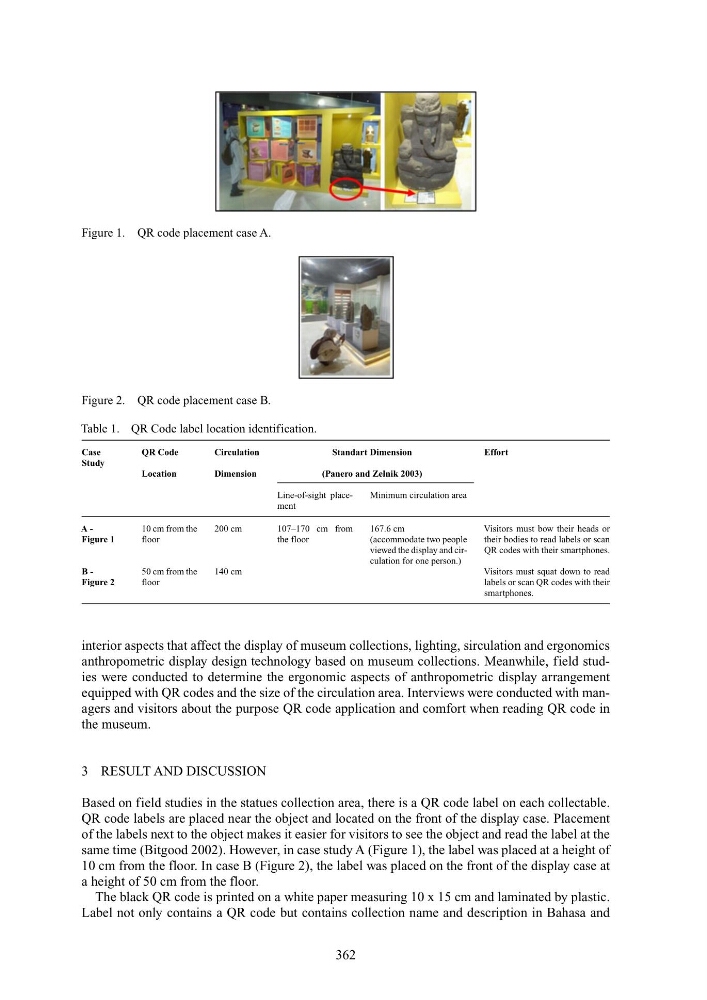
Figure 1. QR code placement case A.
Figure 2. QR code placement case B.
Table 1. QR Code label location identification.
Case
Study
QR Code
Circulation
Standart Dimension
Effort
Location
Dimension
(Panero and Zelnik 2003)
Line-of-sight placement
Minimum circulation area
A -
Figure 1
10 cm from the
floor
200 cm
107–170 cm from
the floor
167.6 cm
(accommodate two people
viewed the display and circulation for one person.)
Visitors must bow their heads or
their bodies to read labels or scan
QR codes with their smartphones.
B -
Figure 2
50 cm from the
floor
140 cm
Visitors must squat down to read
labels or scan QR codes with their
smartphones.
interior aspects that affect the display of museum collections, lighting, sirculation and ergonomics
anthropometric display design technology based on museum collections. Meanwhile, field studies were conducted to determine the ergonomic aspects of anthropometric display arrangement
equipped with QR codes and the size of the circulation area. Interviews were conducted with managers and visitors about the purpose QR code application and comfort when reading QR code in
the museum.
3 RESULT AND DISCUSSION
Based on field studies in the statues collection area, there is a QR code label on each collectable.
QR code labels are placed near the object and located on the front of the display case. Placement
of the labels next to the object makes it easier for visitors to see the object and read the label at the
same time (Bitgood 2002). However, in case study A (Figure 1), the label was placed at a height of
10 cm from the floor. In case B (Figure 2), the label was placed on the front of the display case at
a height of 50 cm from the floor.
The black QR code is printed on a white paper measuring 10 x 15 cm and laminated by plastic.
Label not only contains a QR code but contains collection name and description in Bahasa and
362
Figure 2. QR code placement case B.
Table 1. QR Code label location identification.
Case
Study
QR Code
Circulation
Standart Dimension
Effort
Location
Dimension
(Panero and Zelnik 2003)
Line-of-sight placement
Minimum circulation area
A -
Figure 1
10 cm from the
floor
200 cm
107–170 cm from
the floor
167.6 cm
(accommodate two people
viewed the display and circulation for one person.)
Visitors must bow their heads or
their bodies to read labels or scan
QR codes with their smartphones.
B -
Figure 2
50 cm from the
floor
140 cm
Visitors must squat down to read
labels or scan QR codes with their
smartphones.
interior aspects that affect the display of museum collections, lighting, sirculation and ergonomics
anthropometric display design technology based on museum collections. Meanwhile, field studies were conducted to determine the ergonomic aspects of anthropometric display arrangement
equipped with QR codes and the size of the circulation area. Interviews were conducted with managers and visitors about the purpose QR code application and comfort when reading QR code in
the museum.
3 RESULT AND DISCUSSION
Based on field studies in the statues collection area, there is a QR code label on each collectable.
QR code labels are placed near the object and located on the front of the display case. Placement
of the labels next to the object makes it easier for visitors to see the object and read the label at the
same time (Bitgood 2002). However, in case study A (Figure 1), the label was placed at a height of
10 cm from the floor. In case B (Figure 2), the label was placed on the front of the display case at
a height of 50 cm from the floor.
The black QR code is printed on a white paper measuring 10 x 15 cm and laminated by plastic.
Label not only contains a QR code but contains collection name and description in Bahasa and
362