

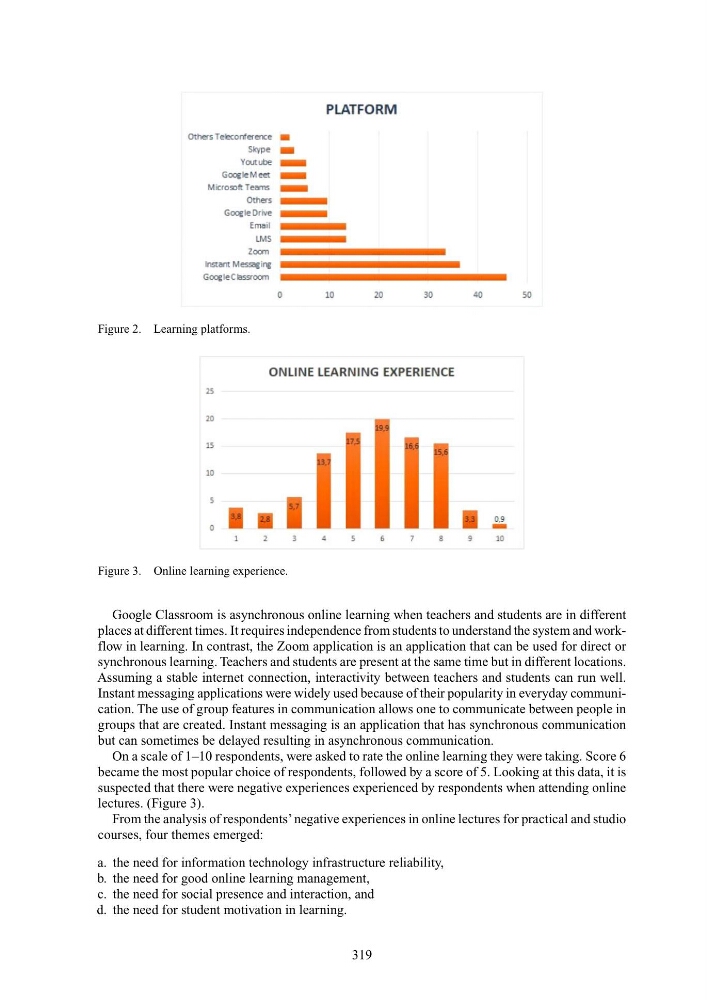
Figure 2. Learning platforms.
Figure 3. Online learning experience.
Google Classroom is asynchronous online learning when teachers and students are in different
places at different times. It requires independence from students to understand the system and workflow in learning. In contrast, the Zoom application is an application that can be used for direct or
synchronous learning. Teachers and students are present at the same time but in different locations.
Assuming a stable internet connection, interactivity between teachers and students can run well.
Instant messaging applications were widely used because of their popularity in everyday communication. The use of group features in communication allows one to communicate between people in
groups that are created. Instant messaging is an application that has synchronous communication
but can sometimes be delayed resulting in asynchronous communication.
On a scale of 1–10 respondents, were asked to rate the online learning they were taking. Score 6
became the most popular choice of respondents, followed by a score of 5. Looking at this data, it is
suspected that there were negative experiences experienced by respondents when attending online
lectures. (Figure 3).
From the analysis of respondents’ negative experiences in online lectures for practical and studio
courses, four themes emerged:
a. the need for information technology infrastructure reliability,
b. the need for good online learning management,
c. the need for social presence and interaction, and
d. the need for student motivation in learning.
319
Figure 3. Online learning experience.
Google Classroom is asynchronous online learning when teachers and students are in different
places at different times. It requires independence from students to understand the system and workflow in learning. In contrast, the Zoom application is an application that can be used for direct or
synchronous learning. Teachers and students are present at the same time but in different locations.
Assuming a stable internet connection, interactivity between teachers and students can run well.
Instant messaging applications were widely used because of their popularity in everyday communication. The use of group features in communication allows one to communicate between people in
groups that are created. Instant messaging is an application that has synchronous communication
but can sometimes be delayed resulting in asynchronous communication.
On a scale of 1–10 respondents, were asked to rate the online learning they were taking. Score 6
became the most popular choice of respondents, followed by a score of 5. Looking at this data, it is
suspected that there were negative experiences experienced by respondents when attending online
lectures. (Figure 3).
From the analysis of respondents’ negative experiences in online lectures for practical and studio
courses, four themes emerged:
a. the need for information technology infrastructure reliability,
b. the need for good online learning management,
c. the need for social presence and interaction, and
d. the need for student motivation in learning.
319