

3.2 Real user experience
Students who took the Concept Development course are expected to have holistic abilities in
applying design as a real-world problem-solving tool. Therefore, this course presents partners from
the industry as real clients with real problems as case studies for students. The purpose of inviting
clients is to foster student confidence through the opportunity to make decisions in designing and
presenting the idea in front of real clients (Coleman et al. 2016). Thus, students are expected to be
able to explain the design concept, why use the design approach, and how the idea can answer the
client’s needs. This method can also train students’ soft skills in managing a design project, such
as how they present design concepts and how to answer questions raised by clients. Besides, by
introducing students to real clients, they are expected to be able to open opportunities and build
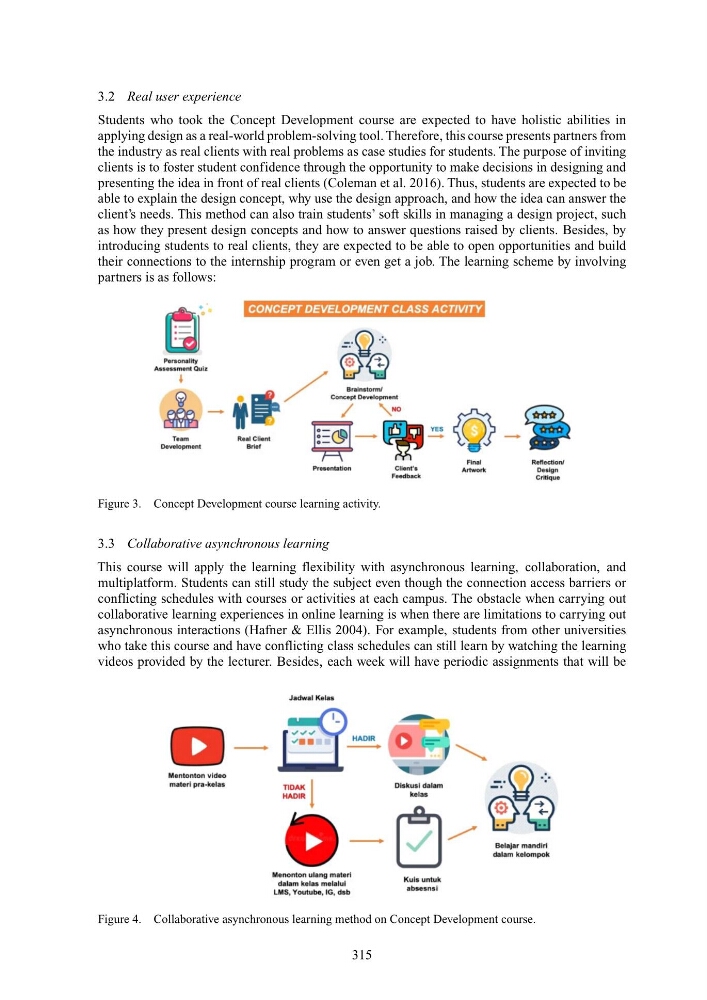
their connections to the internship program or even get a job. The learning scheme by involving
partners is as follows:
Figure 3. Concept Development course learning activity.
3.3 Collaborative asynchronous learning
This course will apply the learning flexibility with asynchronous learning, collaboration, and
multiplatform. Students can still study the subject even though the connection access barriers or
conflicting schedules with courses or activities at each campus. The obstacle when carrying out
collaborative learning experiences in online learning is when there are limitations to carrying out
asynchronous interactions (Hafner & Ellis 2004). For example, students from other universities
who take this course and have conflicting class schedules can still learn by watching the learning
videos provided by the lecturer. Besides, each week will have periodic assignments that will be
Figure 4. Collaborative asynchronous learning method on Concept Development course.
315
Students who took the Concept Development course are expected to have holistic abilities in
applying design as a real-world problem-solving tool. Therefore, this course presents partners from
the industry as real clients with real problems as case studies for students. The purpose of inviting
clients is to foster student confidence through the opportunity to make decisions in designing and
presenting the idea in front of real clients (Coleman et al. 2016). Thus, students are expected to be
able to explain the design concept, why use the design approach, and how the idea can answer the
client’s needs. This method can also train students’ soft skills in managing a design project, such
as how they present design concepts and how to answer questions raised by clients. Besides, by
introducing students to real clients, they are expected to be able to open opportunities and build
their connections to the internship program or even get a job. The learning scheme by involving
partners is as follows:
Figure 3. Concept Development course learning activity.
3.3 Collaborative asynchronous learning
This course will apply the learning flexibility with asynchronous learning, collaboration, and
multiplatform. Students can still study the subject even though the connection access barriers or
conflicting schedules with courses or activities at each campus. The obstacle when carrying out
collaborative learning experiences in online learning is when there are limitations to carrying out
asynchronous interactions (Hafner & Ellis 2004). For example, students from other universities
who take this course and have conflicting class schedules can still learn by watching the learning
videos provided by the lecturer. Besides, each week will have periodic assignments that will be
Figure 4. Collaborative asynchronous learning method on Concept Development course.
315