

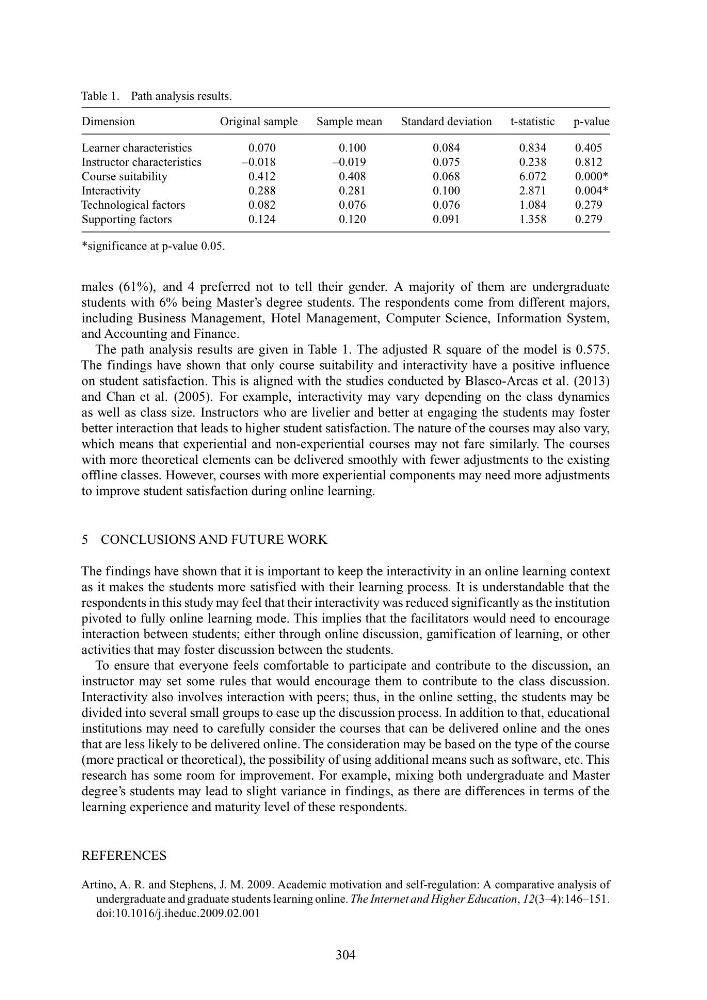
Table 1. Path analysis results.
Dimension
Original sample
Sample mean
Standard deviation
t-statistic
p-value
Learner characteristics
0.070
0.100
0.084
0.834
0.405
Instructor characteristics
–0.018
–0.019
0.075
0.238
0.812
Course suitability
0.412
0.408
0.068
6.072
0.000*
Interactivity
0.288
0.281
0.100
2.871
0.004*
Technological factors
0.082
0.076
0.076
1.084
0.279
Supporting factors
0.124
0.120
0.091
1.358
0.279
*significance at p-value 0.05.
males (61%), and 4 preferred not to tell their gender. A majority of them are undergraduate
students with 6% being Master’s degree students. The respondents come from different majors,
including Business Management, Hotel Management, Computer Science, Information System,
and Accounting and Finance.
The path analysis results are given in Table 1. The adjusted R square of the model is 0.575.
The findings have shown that only course suitability and interactivity have a positive influence
on student satisfaction. This is aligned with the studies conducted by Blasco-Arcas et al. (2013)
and Chan et al. (2005). For example, interactivity may vary depending on the class dynamics
as well as class size. Instructors who are livelier and better at engaging the students may foster
better interaction that leads to higher student satisfaction. The nature of the courses may also vary,
which means that experiential and non-experiential courses may not fare similarly. The courses
with more theoretical elements can be delivered smoothly with fewer adjustments to the existing
offline classes. However, courses with more experiential components may need more adjustments
to improve student satisfaction during online learning.
5 CONCLUSIONS AND FUTURE WORK
The findings have shown that it is important to keep the interactivity in an online learning context
as it makes the students more satisfied with their learning process. It is understandable that the
respondents in this study may feel that their interactivity was reduced significantly as the institution
pivoted to fully online learning mode. This implies that the facilitators would need to encourage
interaction between students; either through online discussion, gamification of learning, or other
activities that may foster discussion between the students.
To ensure that everyone feels comfortable to participate and contribute to the discussion, an
instructor may set some rules that would encourage them to contribute to the class discussion.
Interactivity also involves interaction with peers; thus, in the online setting, the students may be
divided into several small groups to ease up the discussion process. In addition to that, educational
institutions may need to carefully consider the courses that can be delivered online and the ones
that are less likely to be delivered online. The consideration may be based on the type of the course
(more practical or theoretical), the possibility of using additional means such as software, etc. This
research has some room for improvement. For example, mixing both undergraduate and Master
degree’s students may lead to slight variance in findings, as there are differences in terms of the
learning experience and maturity level of these respondents.
REFERENCES
Artino, A. R. and Stephens, J. M. 2009. Academic motivation and self-regulation: A comparative analysis of
undergraduate and graduate students learning online. The Internet and Higher Education, 12(3–4):146–151.
doi:10.1016/j.iheduc.2009.02.001
304
Dimension
Original sample
Sample mean
Standard deviation
t-statistic
p-value
Learner characteristics
0.070
0.100
0.084
0.834
0.405
Instructor characteristics
–0.018
–0.019
0.075
0.238
0.812
Course suitability
0.412
0.408
0.068
6.072
0.000*
Interactivity
0.288
0.281
0.100
2.871
0.004*
Technological factors
0.082
0.076
0.076
1.084
0.279
Supporting factors
0.124
0.120
0.091
1.358
0.279
*significance at p-value 0.05.
males (61%), and 4 preferred not to tell their gender. A majority of them are undergraduate
students with 6% being Master’s degree students. The respondents come from different majors,
including Business Management, Hotel Management, Computer Science, Information System,
and Accounting and Finance.
The path analysis results are given in Table 1. The adjusted R square of the model is 0.575.
The findings have shown that only course suitability and interactivity have a positive influence
on student satisfaction. This is aligned with the studies conducted by Blasco-Arcas et al. (2013)
and Chan et al. (2005). For example, interactivity may vary depending on the class dynamics
as well as class size. Instructors who are livelier and better at engaging the students may foster
better interaction that leads to higher student satisfaction. The nature of the courses may also vary,
which means that experiential and non-experiential courses may not fare similarly. The courses
with more theoretical elements can be delivered smoothly with fewer adjustments to the existing
offline classes. However, courses with more experiential components may need more adjustments
to improve student satisfaction during online learning.
5 CONCLUSIONS AND FUTURE WORK
The findings have shown that it is important to keep the interactivity in an online learning context
as it makes the students more satisfied with their learning process. It is understandable that the
respondents in this study may feel that their interactivity was reduced significantly as the institution
pivoted to fully online learning mode. This implies that the facilitators would need to encourage
interaction between students; either through online discussion, gamification of learning, or other
activities that may foster discussion between the students.
To ensure that everyone feels comfortable to participate and contribute to the discussion, an
instructor may set some rules that would encourage them to contribute to the class discussion.
Interactivity also involves interaction with peers; thus, in the online setting, the students may be
divided into several small groups to ease up the discussion process. In addition to that, educational
institutions may need to carefully consider the courses that can be delivered online and the ones
that are less likely to be delivered online. The consideration may be based on the type of the course
(more practical or theoretical), the possibility of using additional means such as software, etc. This
research has some room for improvement. For example, mixing both undergraduate and Master
degree’s students may lead to slight variance in findings, as there are differences in terms of the
learning experience and maturity level of these respondents.
REFERENCES
Artino, A. R. and Stephens, J. M. 2009. Academic motivation and self-regulation: A comparative analysis of
undergraduate and graduate students learning online. The Internet and Higher Education, 12(3–4):146–151.
doi:10.1016/j.iheduc.2009.02.001
304