

of a princess figure imaged with the aim of accommodating the beautiful impression of a beautiful
person. In Javanese shadow puppet art, the face of a princess is composed of anatomical elements
such as jaitan eyes, a sharp nose, a salitan mouth, which are also equally used in the wayang
facial imagery of satria characters, connoted to a handsome face. In general, the female figures
(princesses) are each distinguished only from the worn objects, including head jewelry (crown,
etc.) and hairdos (bun rivet, unraveled), then also clothing and other accessories.
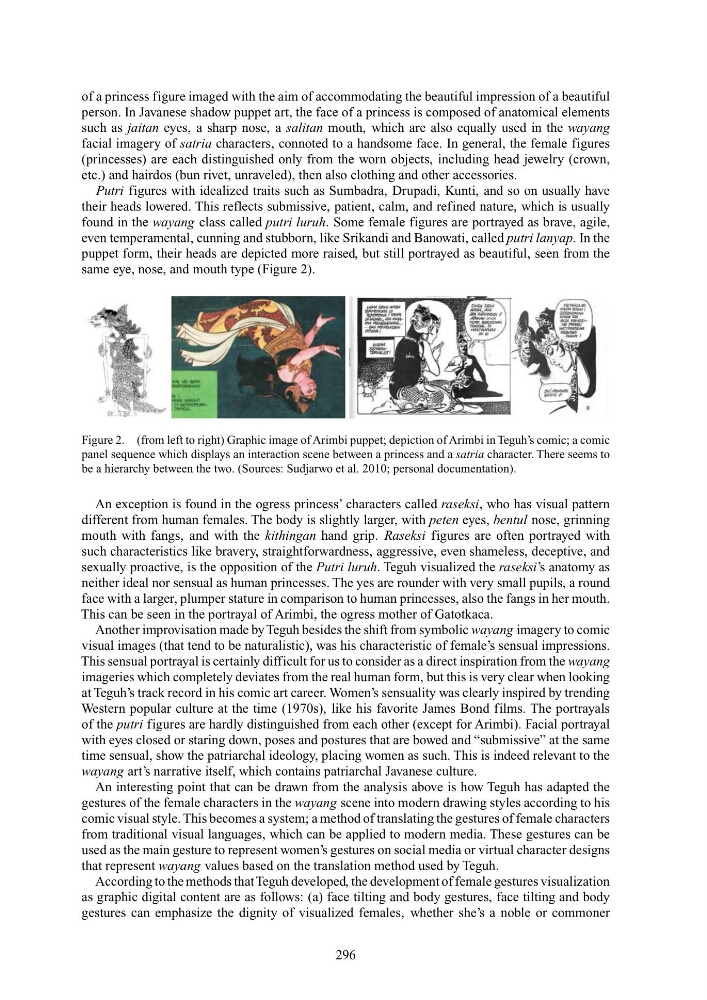
Putri figures with idealized traits such as Sumbadra, Drupadi, Kunti, and so on usually have
their heads lowered. This reflects submissive, patient, calm, and refined nature, which is usually
found in the wayang class called putri luruh. Some female figures are portrayed as brave, agile,
even temperamental, cunning and stubborn, like Srikandi and Banowati, called putri lanyap. In the
puppet form, their heads are depicted more raised, but still portrayed as beautiful, seen from the
same eye, nose, and mouth type (Figure 2).
Figure 2. (from left to right) Graphic image of Arimbi puppet; depiction of Arimbi in Teguh’s comic; a comic
panel sequence which displays an interaction scene between a princess and a satria character. There seems to
be a hierarchy between the two. (Sources: Sudjarwo et al. 2010; personal documentation).
An exception is found in the ogress princess’ characters called raseksi, who has visual pattern
different from human females. The body is slightly larger, with peten eyes, bentul nose, grinning
mouth with fangs, and with the kithingan hand grip. Raseksi figures are often portrayed with
such characteristics like bravery, straightforwardness, aggressive, even shameless, deceptive, and
sexually proactive, is the opposition of the Putri luruh. Teguh visualized the raseksi’s anatomy as
neither ideal nor sensual as human princesses. The yes are rounder with very small pupils, a round
face with a larger, plumper stature in comparison to human princesses, also the fangs in her mouth.
This can be seen in the portrayal of Arimbi, the ogress mother of Gatotkaca.
Another improvisation made by Teguh besides the shift from symbolic wayang imagery to comic
visual images (that tend to be naturalistic), was his characteristic of female’s sensual impressions.
This sensual portrayal is certainly difficult for us to consider as a direct inspiration from the wayang
imageries which completely deviates from the real human form, but this is very clear when looking
at Teguh’s track record in his comic art career. Women’s sensuality was clearly inspired by trending
Western popular culture at the time (1970s), like his favorite James Bond films. The portrayals
of the putri figures are hardly distinguished from each other (except for Arimbi). Facial portrayal
with eyes closed or staring down, poses and postures that are bowed and “submissive” at the same
time sensual, show the patriarchal ideology, placing women as such. This is indeed relevant to the
wayang art’s narrative itself, which contains patriarchal Javanese culture.
An interesting point that can be drawn from the analysis above is how Teguh has adapted the
gestures of the female characters in the wayang scene into modern drawing styles according to his
comic visual style. This becomes a system; a method of translating the gestures of female characters
from traditional visual languages, which can be applied to modern media. These gestures can be
used as the main gesture to represent women’s gestures on social media or virtual character designs
that represent wayang values based on the translation method used by Teguh.
According to the methods that Teguh developed, the development of female gestures visualization
as graphic digital content are as follows: (a) face tilting and body gestures, face tilting and body
gestures can emphasize the dignity of visualized females, whether she’s a noble or commoner
296
person. In Javanese shadow puppet art, the face of a princess is composed of anatomical elements
such as jaitan eyes, a sharp nose, a salitan mouth, which are also equally used in the wayang
facial imagery of satria characters, connoted to a handsome face. In general, the female figures
(princesses) are each distinguished only from the worn objects, including head jewelry (crown,
etc.) and hairdos (bun rivet, unraveled), then also clothing and other accessories.
Putri figures with idealized traits such as Sumbadra, Drupadi, Kunti, and so on usually have
their heads lowered. This reflects submissive, patient, calm, and refined nature, which is usually
found in the wayang class called putri luruh. Some female figures are portrayed as brave, agile,
even temperamental, cunning and stubborn, like Srikandi and Banowati, called putri lanyap. In the
puppet form, their heads are depicted more raised, but still portrayed as beautiful, seen from the
same eye, nose, and mouth type (Figure 2).
Figure 2. (from left to right) Graphic image of Arimbi puppet; depiction of Arimbi in Teguh’s comic; a comic
panel sequence which displays an interaction scene between a princess and a satria character. There seems to
be a hierarchy between the two. (Sources: Sudjarwo et al. 2010; personal documentation).
An exception is found in the ogress princess’ characters called raseksi, who has visual pattern
different from human females. The body is slightly larger, with peten eyes, bentul nose, grinning
mouth with fangs, and with the kithingan hand grip. Raseksi figures are often portrayed with
such characteristics like bravery, straightforwardness, aggressive, even shameless, deceptive, and
sexually proactive, is the opposition of the Putri luruh. Teguh visualized the raseksi’s anatomy as
neither ideal nor sensual as human princesses. The yes are rounder with very small pupils, a round
face with a larger, plumper stature in comparison to human princesses, also the fangs in her mouth.
This can be seen in the portrayal of Arimbi, the ogress mother of Gatotkaca.
Another improvisation made by Teguh besides the shift from symbolic wayang imagery to comic
visual images (that tend to be naturalistic), was his characteristic of female’s sensual impressions.
This sensual portrayal is certainly difficult for us to consider as a direct inspiration from the wayang
imageries which completely deviates from the real human form, but this is very clear when looking
at Teguh’s track record in his comic art career. Women’s sensuality was clearly inspired by trending
Western popular culture at the time (1970s), like his favorite James Bond films. The portrayals
of the putri figures are hardly distinguished from each other (except for Arimbi). Facial portrayal
with eyes closed or staring down, poses and postures that are bowed and “submissive” at the same
time sensual, show the patriarchal ideology, placing women as such. This is indeed relevant to the
wayang art’s narrative itself, which contains patriarchal Javanese culture.
An interesting point that can be drawn from the analysis above is how Teguh has adapted the
gestures of the female characters in the wayang scene into modern drawing styles according to his
comic visual style. This becomes a system; a method of translating the gestures of female characters
from traditional visual languages, which can be applied to modern media. These gestures can be
used as the main gesture to represent women’s gestures on social media or virtual character designs
that represent wayang values based on the translation method used by Teguh.
According to the methods that Teguh developed, the development of female gestures visualization
as graphic digital content are as follows: (a) face tilting and body gestures, face tilting and body
gestures can emphasize the dignity of visualized females, whether she’s a noble or commoner
296