

included the portrayal of anatomy and appearance, posture and gestures, hair, clothing, accessories,
and others, as well as the position in the scene.
The main data samples as observed artifacts were: (1) Mahabharata # 1–10 wayang comic
series, published by Misurind (Midas Surya Grafindo) (1986–1988); and (2) Mahabharata comic
series bonuses Ananda children’s weekly magazine no.17–52 & no. 06–47 (1983–1984), Kartini
Magazine Publisher. Secondary data samples were graphic images of Surakarta wayang kulit from
various printed sources such as the works of Hardjowirogo (1949) and Sudjarwo et al. (2010). The
Surakarta wayang image was chosen as a comparison due to the information in the comic; Teguh
mentioned Sedjarah Wajang Purwa by Hardjowirogo (1949) as the primary source together with
comic works by R.A. Kosasih. Clearly, Teguh refers to the “iconography” of the wayang character
in the book, which contains graphic images of the Surakarta wayang style.
The analysis method used was a modified version of Aesthetic Morphology and Art Criticism
from Edmund Burke Feldman in Koesoemadinata & Aditya (2016). The stages were: visual description, formal analysis, interpretation and evaluation. The visual description stage, combined with
formal analysis, will describe in detail the elements of appearance and portrayal of selected objects.
Visual analysis (a combination of stages 1 and 2) of the characters was specifically carried out on:
(1) biological anatomy, in part or in whole, including appearance, gesture and body language; and
(2) clothing including accessories and other attributes. This stage was an analysis of the internal
aspects (intra-aesthetic), the studied visual artifact object, which is considered as ‘text’. Next, was
the interpretation stage, where the previous stage was compared to external aspects (extra-aesthetic)
such as graphic images of the same wayang character. It was linked to sociocultural contexts such
as Javanese wayang traditional narratives, Javanese traditional views, women’s discourses, and
influences of popular culture that are contemporary with Teguh. The evaluation stage tried to comprehend the context and reasons behind the visual adaptation carried out by Teguh. Here the studied
object was appreciated further.
3 THE PRINCESS CHARACTERS VISUALIZATION ANALYSIS AND DISCUSSIONS
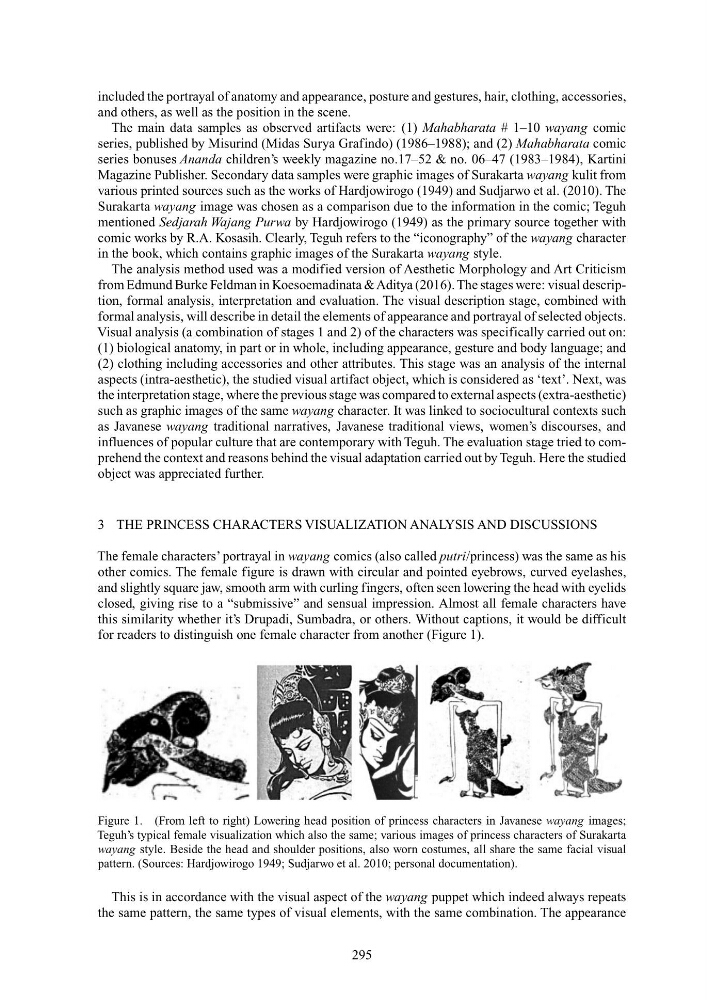
The female characters’ portrayal in wayang comics (also called putri/princess) was the same as his
other comics. The female figure is drawn with circular and pointed eyebrows, curved eyelashes,
and slightly square jaw, smooth arm with curling fingers, often seen lowering the head with eyelids
closed, giving rise to a “submissive” and sensual impression. Almost all female characters have
this similarity whether it’s Drupadi, Sumbadra, or others. Without captions, it would be difficult
for readers to distinguish one female character from another (Figure 1).
Figure 1. (From left to right) Lowering head position of princess characters in Javanese wayang images;
Teguh’s typical female visualization which also the same; various images of princess characters of Surakarta
wayang style. Beside the head and shoulder positions, also worn costumes, all share the same facial visual
pattern. (Sources: Hardjowirogo 1949; Sudjarwo et al. 2010; personal documentation).
This is in accordance with the visual aspect of the wayang puppet which indeed always repeats
the same pattern, the same types of visual elements, with the same combination. The appearance
295
and others, as well as the position in the scene.
The main data samples as observed artifacts were: (1) Mahabharata # 1–10 wayang comic
series, published by Misurind (Midas Surya Grafindo) (1986–1988); and (2) Mahabharata comic
series bonuses Ananda children’s weekly magazine no.17–52 & no. 06–47 (1983–1984), Kartini
Magazine Publisher. Secondary data samples were graphic images of Surakarta wayang kulit from
various printed sources such as the works of Hardjowirogo (1949) and Sudjarwo et al. (2010). The
Surakarta wayang image was chosen as a comparison due to the information in the comic; Teguh
mentioned Sedjarah Wajang Purwa by Hardjowirogo (1949) as the primary source together with
comic works by R.A. Kosasih. Clearly, Teguh refers to the “iconography” of the wayang character
in the book, which contains graphic images of the Surakarta wayang style.
The analysis method used was a modified version of Aesthetic Morphology and Art Criticism
from Edmund Burke Feldman in Koesoemadinata & Aditya (2016). The stages were: visual description, formal analysis, interpretation and evaluation. The visual description stage, combined with
formal analysis, will describe in detail the elements of appearance and portrayal of selected objects.
Visual analysis (a combination of stages 1 and 2) of the characters was specifically carried out on:
(1) biological anatomy, in part or in whole, including appearance, gesture and body language; and
(2) clothing including accessories and other attributes. This stage was an analysis of the internal
aspects (intra-aesthetic), the studied visual artifact object, which is considered as ‘text’. Next, was
the interpretation stage, where the previous stage was compared to external aspects (extra-aesthetic)
such as graphic images of the same wayang character. It was linked to sociocultural contexts such
as Javanese wayang traditional narratives, Javanese traditional views, women’s discourses, and
influences of popular culture that are contemporary with Teguh. The evaluation stage tried to comprehend the context and reasons behind the visual adaptation carried out by Teguh. Here the studied
object was appreciated further.
3 THE PRINCESS CHARACTERS VISUALIZATION ANALYSIS AND DISCUSSIONS
The female characters’ portrayal in wayang comics (also called putri/princess) was the same as his
other comics. The female figure is drawn with circular and pointed eyebrows, curved eyelashes,
and slightly square jaw, smooth arm with curling fingers, often seen lowering the head with eyelids
closed, giving rise to a “submissive” and sensual impression. Almost all female characters have
this similarity whether it’s Drupadi, Sumbadra, or others. Without captions, it would be difficult
for readers to distinguish one female character from another (Figure 1).
Figure 1. (From left to right) Lowering head position of princess characters in Javanese wayang images;
Teguh’s typical female visualization which also the same; various images of princess characters of Surakarta
wayang style. Beside the head and shoulder positions, also worn costumes, all share the same facial visual
pattern. (Sources: Hardjowirogo 1949; Sudjarwo et al. 2010; personal documentation).
This is in accordance with the visual aspect of the wayang puppet which indeed always repeats
the same pattern, the same types of visual elements, with the same combination. The appearance
295