

information) and cinematic elements (mise-en-scene, cinematography, editing, and sound) (Pratista
2008).
The message in advertising is the main element as object of research in semiotics. A commercial
contains three elements: (1) a sign (text), the entity (object) being advertised; (2) context in the
form of environment, people or other beings giving meaning to objects; and (3) text (in the form
of writing) which strengthens the meaning (anchoring) (Piliang 2010). In the text significance,
Barthes in Thwaites and Davis (2009) divided it into denotation and connotation order. Denotation
appears to be something after true meaning, with a strong relationship between the signifier and
the signified. The connotation, as the second order of significance of the text or signifier, appears
as a rather less tangible, imaginary, or illusory meaning. Next, is the myth—the second stage of
signification—which constitutes of a way of thinking of a particular culture toward some matters,
a manner to conceptualize or comprehend matters (Fiske 2007), and ideology as an illusionary
belief in the form of pseudo-ideas and pseudo-awareness (Fiske 2007).
3 RESULT AND DISCUSSION
The television advertisement Welcome Back Micin SWAG Generation was the object of the research
conducted by the author. This is a commercial for an MSG (Monosodium Glutamate) product from
the Sasa brand from PT Sasa Inti, the commercial has been broadcasted on television since early
2020, lasting for 59 seconds of duration (Sasa Melezatkan 2020). The analysis of MSG Sasa’s
commercial text was carried out toward the narrative and cinematic elements as a sign and sign
systems. Text analysis was performed based on narrative, text elements, and cinematic elements.
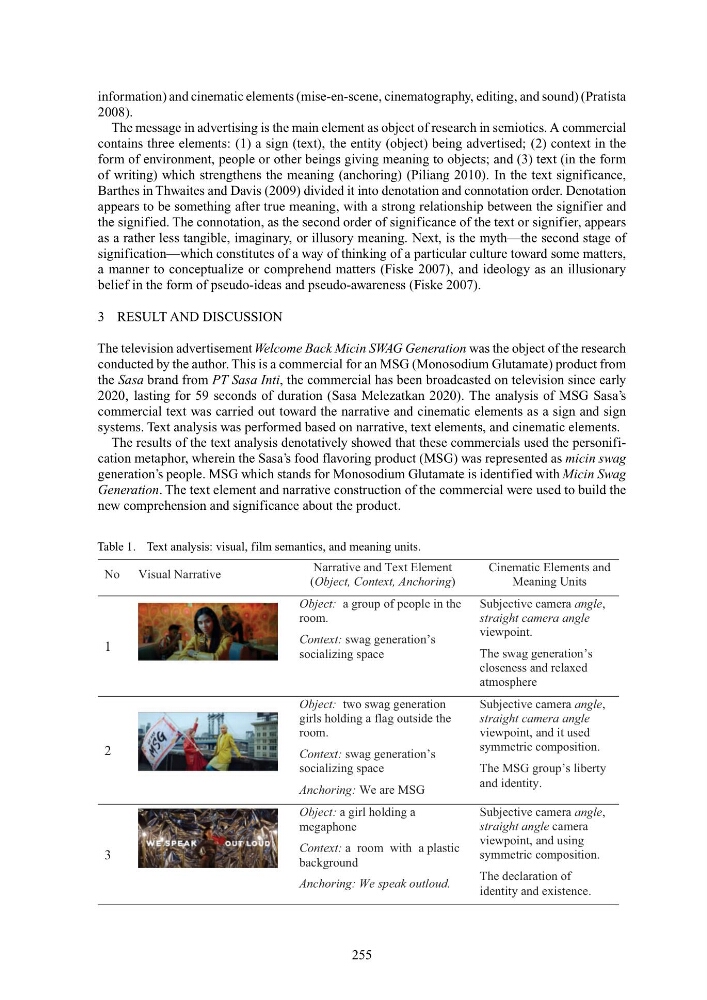
The results of the text analysis denotatively showed that these commercials used the personification metaphor, wherein the Sasa’s food flavoring product (MSG) was represented as micin swag
generation’s people. MSG which stands for Monosodium Glutamate is identified with Micin Swag
Generation. The text element and narrative construction of the commercial were used to build the
new comprehension and significance about the product.
Table 1. Text analysis: visual, film semantics, and meaning units.
No
Visual Narrative
Narrative and Text Element
(Object, Context, Anchoring)
Cinematic Elements and
Meaning Units
1
Object: a group of people in the
room.
Context: swag generation’s
socializing space
Subjective camera angle,
straight camera angle
viewpoint.
The swag generation’s
closeness and relaxed
atmosphere
2
Object: two swag generation
girls holding a flag outside the
room.
Context: swag generation’s
socializing space
Anchoring: We are MSG
Subjective camera angle,
straight camera angle
viewpoint, and it used
symmetric composition.
The MSG group’s liberty
and identity.
3
Object: a girl holding a
megaphone
Context: a room with a plastic
background
Anchoring: We speak outloud.
Subjective camera angle,
straight angle camera
viewpoint, and using
symmetric composition.
The declaration of
identity and existence.
255
2008).
The message in advertising is the main element as object of research in semiotics. A commercial
contains three elements: (1) a sign (text), the entity (object) being advertised; (2) context in the
form of environment, people or other beings giving meaning to objects; and (3) text (in the form
of writing) which strengthens the meaning (anchoring) (Piliang 2010). In the text significance,
Barthes in Thwaites and Davis (2009) divided it into denotation and connotation order. Denotation
appears to be something after true meaning, with a strong relationship between the signifier and
the signified. The connotation, as the second order of significance of the text or signifier, appears
as a rather less tangible, imaginary, or illusory meaning. Next, is the myth—the second stage of
signification—which constitutes of a way of thinking of a particular culture toward some matters,
a manner to conceptualize or comprehend matters (Fiske 2007), and ideology as an illusionary
belief in the form of pseudo-ideas and pseudo-awareness (Fiske 2007).
3 RESULT AND DISCUSSION
The television advertisement Welcome Back Micin SWAG Generation was the object of the research
conducted by the author. This is a commercial for an MSG (Monosodium Glutamate) product from
the Sasa brand from PT Sasa Inti, the commercial has been broadcasted on television since early
2020, lasting for 59 seconds of duration (Sasa Melezatkan 2020). The analysis of MSG Sasa’s
commercial text was carried out toward the narrative and cinematic elements as a sign and sign
systems. Text analysis was performed based on narrative, text elements, and cinematic elements.
The results of the text analysis denotatively showed that these commercials used the personification metaphor, wherein the Sasa’s food flavoring product (MSG) was represented as micin swag
generation’s people. MSG which stands for Monosodium Glutamate is identified with Micin Swag
Generation. The text element and narrative construction of the commercial were used to build the
new comprehension and significance about the product.
Table 1. Text analysis: visual, film semantics, and meaning units.
No
Visual Narrative
Narrative and Text Element
(Object, Context, Anchoring)
Cinematic Elements and
Meaning Units
1
Object: a group of people in the
room.
Context: swag generation’s
socializing space
Subjective camera angle,
straight camera angle
viewpoint.
The swag generation’s
closeness and relaxed
atmosphere
2
Object: two swag generation
girls holding a flag outside the
room.
Context: swag generation’s
socializing space
Anchoring: We are MSG
Subjective camera angle,
straight camera angle
viewpoint, and it used
symmetric composition.
The MSG group’s liberty
and identity.
3
Object: a girl holding a
megaphone
Context: a room with a plastic
background
Anchoring: We speak outloud.
Subjective camera angle,
straight angle camera
viewpoint, and using
symmetric composition.
The declaration of
identity and existence.
255