

Data collection used a questionnaire and the interview method to obtain data about complaints
when using a screen-printing table design and then measuring the dimensions of the product and
the dimensions of the user’s body with the anthropometric measurement method with sitting work
attitude and reach of the hands and feet when in a standing position.
3 RESULT AND DISCUSSION
3.1 Modular table design data
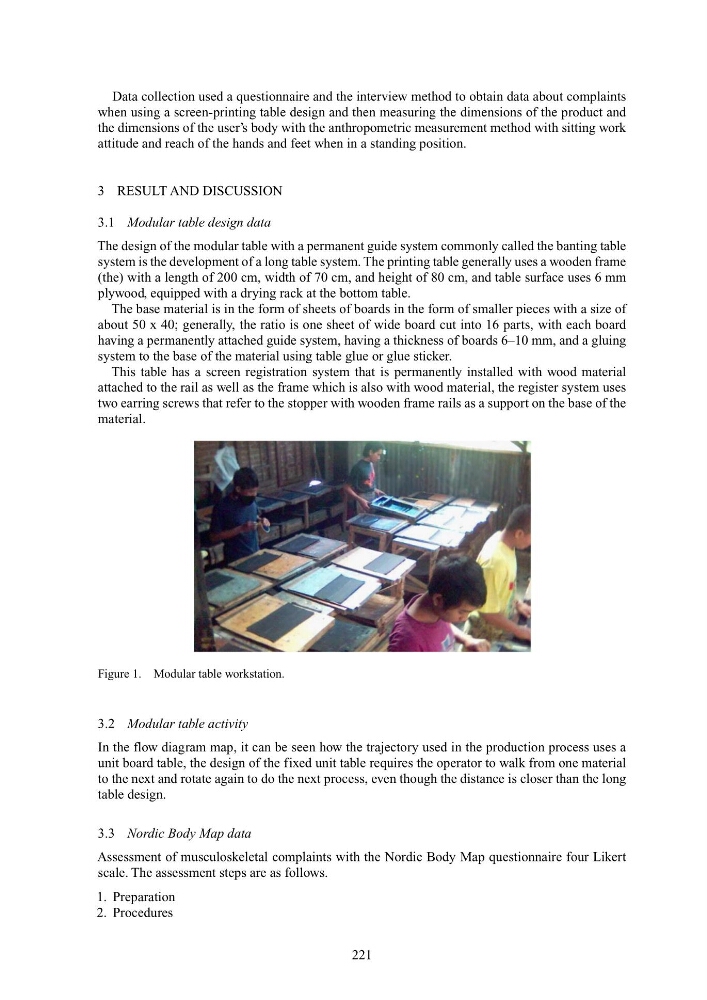
The design of the modular table with a permanent guide system commonly called the banting table
system is the development of a long table system. The printing table generally uses a wooden frame
(the) with a length of 200 cm, width of 70 cm, and height of 80 cm, and table surface uses 6 mm
plywood, equipped with a drying rack at the bottom table.
The base material is in the form of sheets of boards in the form of smaller pieces with a size of
about 50 x 40; generally, the ratio is one sheet of wide board cut into 16 parts, with each board
having a permanently attached guide system, having a thickness of boards 6–10 mm, and a gluing
system to the base of the material using table glue or glue sticker.
This table has a screen registration system that is permanently installed with wood material
attached to the rail as well as the frame which is also with wood material, the register system uses
two earring screws that refer to the stopper with wooden frame rails as a support on the base of the
material.
Figure 1. Modular table workstation.
3.2 Modular table activity
In the flow diagram map, it can be seen how the trajectory used in the production process uses a
unit board table, the design of the fixed unit table requires the operator to walk from one material
to the next and rotate again to do the next process, even though the distance is closer than the long
table design.
3.3 Nordic Body Map data
Assessment of musculoskeletal complaints with the Nordic Body Map questionnaire four Likert
scale. The assessment steps are as follows.
1. Preparation
2. Procedures
221
when using a screen-printing table design and then measuring the dimensions of the product and
the dimensions of the user’s body with the anthropometric measurement method with sitting work
attitude and reach of the hands and feet when in a standing position.
3 RESULT AND DISCUSSION
3.1 Modular table design data
The design of the modular table with a permanent guide system commonly called the banting table
system is the development of a long table system. The printing table generally uses a wooden frame
(the) with a length of 200 cm, width of 70 cm, and height of 80 cm, and table surface uses 6 mm
plywood, equipped with a drying rack at the bottom table.
The base material is in the form of sheets of boards in the form of smaller pieces with a size of
about 50 x 40; generally, the ratio is one sheet of wide board cut into 16 parts, with each board
having a permanently attached guide system, having a thickness of boards 6–10 mm, and a gluing
system to the base of the material using table glue or glue sticker.
This table has a screen registration system that is permanently installed with wood material
attached to the rail as well as the frame which is also with wood material, the register system uses
two earring screws that refer to the stopper with wooden frame rails as a support on the base of the
material.
Figure 1. Modular table workstation.
3.2 Modular table activity
In the flow diagram map, it can be seen how the trajectory used in the production process uses a
unit board table, the design of the fixed unit table requires the operator to walk from one material
to the next and rotate again to do the next process, even though the distance is closer than the long
table design.
3.3 Nordic Body Map data
Assessment of musculoskeletal complaints with the Nordic Body Map questionnaire four Likert
scale. The assessment steps are as follows.
1. Preparation
2. Procedures
221