

media as learning instruments. Using content analysis, the research realizes that although the
board game/table-top version is successful in helping the students raise their vocabulary skills,
the game still has much weakness with regard to language learning instruments, such as sounds.
Therefore, the research team recruited the visual communication advisor and designers to simplify
the table-top game to more compact physical devices, reproduce it as digital game, and update the
contents so as to facilitate access for an expanded user base.
3 RESULT & DISCUSSIONS
3.1 Early prototype
SPEAK UP! was first introduced to high school English teachers in a community service program,
however the COVID-19 pandemic forced teachers to learn the uses of SPEAK UP! in an online
meeting. This conditions made the researchers want to develop SPEAK UP! into adigital version
that could be easily accessed using gadgets. To simplify the game’s physical devices, reproduce
and update content, facilitate access and expand users, the offline or table-top version of the game
was developed into an online game. SPEAK UP! developed into a web-based and mobile online
version under the name SQUARE TALKS!
3.2 New mock up and product development
Since the research focused on the game’s visualizations, this research will use the aesthetics aspect
from four basic elements in game design: mechanics, stories, aesthetics, and technologies. These
four elements couldn’t stand alone to create a good game; they must work as a unity. A game must
have a good narration where the world’s buildings and characters make the game come to life by
using a mechanics that allows the players to interact with their technologies. These aspects must
have the aesthetics touch and also the instruments to play with (Aditya & Febrina, 2019). The
research is focusing on aesthetic aspects, which give the game looks, sounds, and feels that have
the direct relationship to players’ experience and Technologies Aspects, as the medium in which
the aesthetics take place and produced (Schell 2019). Other opinions that support the statements
above are visual aesthetics such as the overall looks, feel of the game, and the character of the
game. Visual aesthetics appearance must have a cognitive function and aesthetic function (Plass et
al. 2010). Art and design in a game determines how the tools and functions of game mechanics
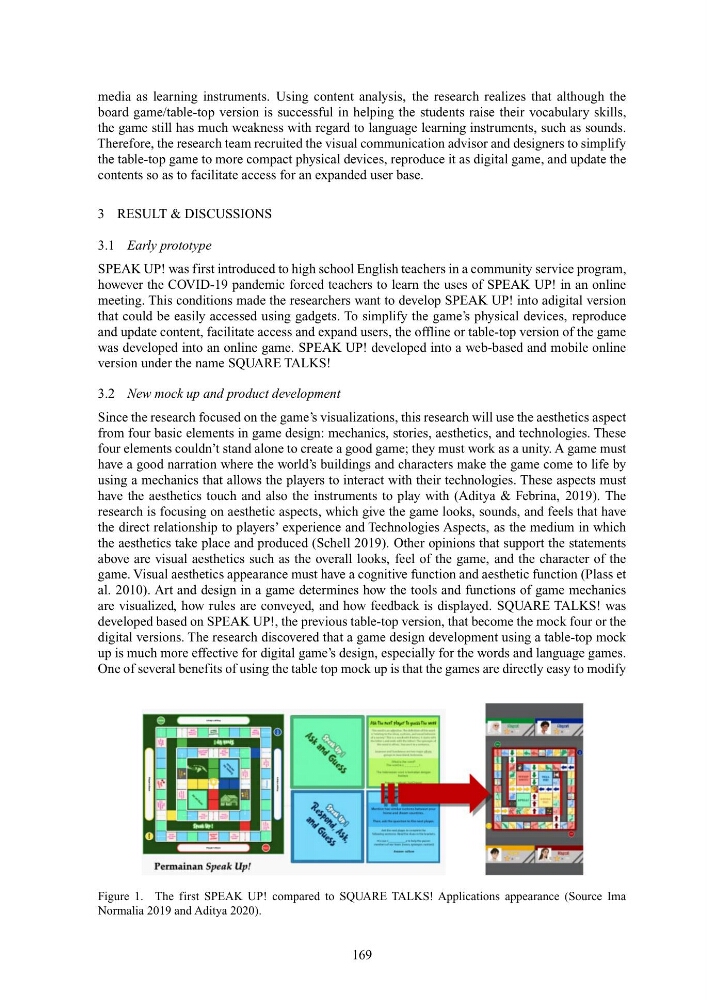
are visualized, how rules are conveyed, and how feedback is displayed. SQUARE TALKS! was
developed based on SPEAK UP!, the previous table-top version, that become the mock four or the
digital versions. The research discovered that a game design development using a table-top mock
up is much more effective for digital game’s design, especially for the words and language games.
One of several benefits of using the table top mock up is that the games are directly easy to modify
Figure 1. The first SPEAK UP! compared to SQUARE TALKS! Applications appearance (Source Ima
Normalia 2019 and Aditya 2020).
169
board game/table-top version is successful in helping the students raise their vocabulary skills,
the game still has much weakness with regard to language learning instruments, such as sounds.
Therefore, the research team recruited the visual communication advisor and designers to simplify
the table-top game to more compact physical devices, reproduce it as digital game, and update the
contents so as to facilitate access for an expanded user base.
3 RESULT & DISCUSSIONS
3.1 Early prototype
SPEAK UP! was first introduced to high school English teachers in a community service program,
however the COVID-19 pandemic forced teachers to learn the uses of SPEAK UP! in an online
meeting. This conditions made the researchers want to develop SPEAK UP! into adigital version
that could be easily accessed using gadgets. To simplify the game’s physical devices, reproduce
and update content, facilitate access and expand users, the offline or table-top version of the game
was developed into an online game. SPEAK UP! developed into a web-based and mobile online
version under the name SQUARE TALKS!
3.2 New mock up and product development
Since the research focused on the game’s visualizations, this research will use the aesthetics aspect
from four basic elements in game design: mechanics, stories, aesthetics, and technologies. These
four elements couldn’t stand alone to create a good game; they must work as a unity. A game must
have a good narration where the world’s buildings and characters make the game come to life by
using a mechanics that allows the players to interact with their technologies. These aspects must
have the aesthetics touch and also the instruments to play with (Aditya & Febrina, 2019). The
research is focusing on aesthetic aspects, which give the game looks, sounds, and feels that have
the direct relationship to players’ experience and Technologies Aspects, as the medium in which
the aesthetics take place and produced (Schell 2019). Other opinions that support the statements
above are visual aesthetics such as the overall looks, feel of the game, and the character of the
game. Visual aesthetics appearance must have a cognitive function and aesthetic function (Plass et
al. 2010). Art and design in a game determines how the tools and functions of game mechanics
are visualized, how rules are conveyed, and how feedback is displayed. SQUARE TALKS! was
developed based on SPEAK UP!, the previous table-top version, that become the mock four or the
digital versions. The research discovered that a game design development using a table-top mock
up is much more effective for digital game’s design, especially for the words and language games.
One of several benefits of using the table top mock up is that the games are directly easy to modify
Figure 1. The first SPEAK UP! compared to SQUARE TALKS! Applications appearance (Source Ima
Normalia 2019 and Aditya 2020).
169