

to adapt well to innovation and has proven by experimental results to be able to produce several
innovative designs (Ciptandi 2018).
There is a problem when innovation is to be given to traditional batik in Tuban continuously,
which is currently in a new normal condition. In the protocol set by the government, generally,
they still have to pay attention to physical distancing, where people are required to keep a distance from others by at least 1 meter and minimize crowding activities and prioritize activities
carried out independently from home. At the same time, one of the stages in the diffusion of
the innovation approach is persuasive communication from the innovation provider to the batik
craftsmen/innovator. In addition to adjusting to the usual communication patterns in the Tuban
environment, the other important step is that communication must be carried out intensively and
personally by minimizing the distance between the innovation provider and the innovator, especially
when conducting experiments together.
2 METHODOLOGY
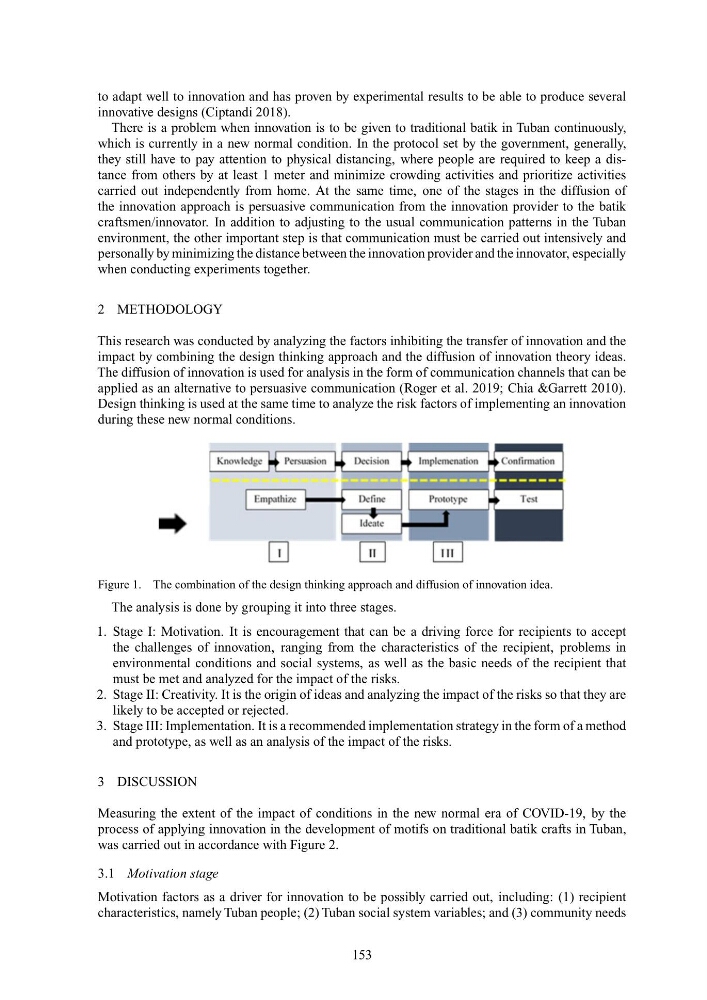
This research was conducted by analyzing the factors inhibiting the transfer of innovation and the
impact by combining the design thinking approach and the diffusion of innovation theory ideas.
The diffusion of innovation is used for analysis in the form of communication channels that can be
applied as an alternative to persuasive communication (Roger et al. 2019; Chia &Garrett 2010).
Design thinking is used at the same time to analyze the risk factors of implementing an innovation
during these new normal conditions.
Figure 1. The combination of the design thinking approach and diffusion of innovation idea.
The analysis is done by grouping it into three stages.
1. Stage I: Motivation. It is encouragement that can be a driving force for recipients to accept
the challenges of innovation, ranging from the characteristics of the recipient, problems in
environmental conditions and social systems, as well as the basic needs of the recipient that
must be met and analyzed for the impact of the risks.
2. Stage II: Creativity. It is the origin of ideas and analyzing the impact of the risks so that they are
likely to be accepted or rejected.
3. Stage III: Implementation. It is a recommended implementation strategy in the form of a method
and prototype, as well as an analysis of the impact of the risks.
3 DISCUSSION
Measuring the extent of the impact of conditions in the new normal era of COVID-19, by the
process of applying innovation in the development of motifs on traditional batik crafts in Tuban,
was carried out in accordance with Figure 2.
3.1 Motivation stage
Motivation factors as a driver for innovation to be possibly carried out, including: (1) recipient
characteristics, namely Tuban people; (2) Tuban social system variables; and (3) community needs
153
innovative designs (Ciptandi 2018).
There is a problem when innovation is to be given to traditional batik in Tuban continuously,
which is currently in a new normal condition. In the protocol set by the government, generally,
they still have to pay attention to physical distancing, where people are required to keep a distance from others by at least 1 meter and minimize crowding activities and prioritize activities
carried out independently from home. At the same time, one of the stages in the diffusion of
the innovation approach is persuasive communication from the innovation provider to the batik
craftsmen/innovator. In addition to adjusting to the usual communication patterns in the Tuban
environment, the other important step is that communication must be carried out intensively and
personally by minimizing the distance between the innovation provider and the innovator, especially
when conducting experiments together.
2 METHODOLOGY
This research was conducted by analyzing the factors inhibiting the transfer of innovation and the
impact by combining the design thinking approach and the diffusion of innovation theory ideas.
The diffusion of innovation is used for analysis in the form of communication channels that can be
applied as an alternative to persuasive communication (Roger et al. 2019; Chia &Garrett 2010).
Design thinking is used at the same time to analyze the risk factors of implementing an innovation
during these new normal conditions.
Figure 1. The combination of the design thinking approach and diffusion of innovation idea.
The analysis is done by grouping it into three stages.
1. Stage I: Motivation. It is encouragement that can be a driving force for recipients to accept
the challenges of innovation, ranging from the characteristics of the recipient, problems in
environmental conditions and social systems, as well as the basic needs of the recipient that
must be met and analyzed for the impact of the risks.
2. Stage II: Creativity. It is the origin of ideas and analyzing the impact of the risks so that they are
likely to be accepted or rejected.
3. Stage III: Implementation. It is a recommended implementation strategy in the form of a method
and prototype, as well as an analysis of the impact of the risks.
3 DISCUSSION
Measuring the extent of the impact of conditions in the new normal era of COVID-19, by the
process of applying innovation in the development of motifs on traditional batik crafts in Tuban,
was carried out in accordance with Figure 2.
3.1 Motivation stage
Motivation factors as a driver for innovation to be possibly carried out, including: (1) recipient
characteristics, namely Tuban people; (2) Tuban social system variables; and (3) community needs
153