

sensory game application is the wall element. The following will discuss the results further and
discussion of this research.
2 RESEARCH METHODS
The research method used is a qualitative method, in which an analysis of the latest literature reviews
the development of children’s play activites during a pandemic situation. It is then associated with
user experience in the field, obtained through a questionnaire. The first step is capturing the
phenomenon experienced by toddler (0–5 years old) in Indonesia during this pandemic when they
are playing games at their own home. After that, further analysis is carried out on the needs of the
game that has been done so far, especially the sensory games. There were 50 respondents who are
parents as well as workers, where they participate in awork from home (WFH) system as well as
accompanying their toddler to play at home during this pandemic. The result from the questionnaire
will be a foundation to design a sensory game as a room treatment during the pandemic situation.
3 RESULT AND DISCUSSION
3.1 Result
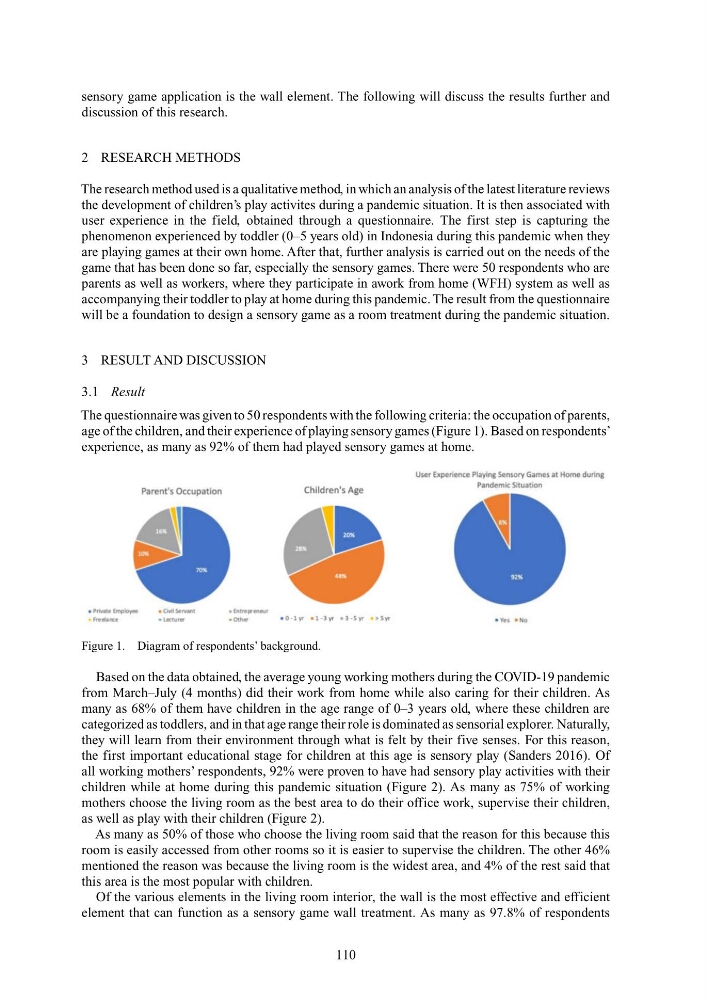
The questionnaire was given to 50 respondents with the following criteria: the occupation of parents,
age of the children, and their experience of playing sensory games (Figure 1). Based on respondents’
experience, as many as 92% of them had played sensory games at home.
Figure 1. Diagram of respondents’ background.
Based on the data obtained, the average young working mothers during the COVID-19 pandemic
from March–July (4 months) did their work from home while also caring for their children. As
many as 68% of them have children in the age range of 0–3 years old, where these children are
categorized as toddlers, and in that age range their role is dominated as sensorial explorer. Naturally,
they will learn from their environment through what is felt by their five senses. For this reason,
the first important educational stage for children at this age is sensory play (Sanders 2016). Of
all working mothers’ respondents, 92% were proven to have had sensory play activities with their
children while at home during this pandemic situation (Figure 2). As many as 75% of working
mothers choose the living room as the best area to do their office work, supervise their children,
as well as play with their children (Figure 2).
As many as 50% of those who choose the living room said that the reason for this because this
room is easily accessed from other rooms so it is easier to supervise the children. The other 46%
mentioned the reason was because the living room is the widest area, and 4% of the rest said that
this area is the most popular with children.
Of the various elements in the living room interior, the wall is the most effective and efficient
element that can function as a sensory game wall treatment. As many as 97.8% of respondents
110
discussion of this research.
2 RESEARCH METHODS
The research method used is a qualitative method, in which an analysis of the latest literature reviews
the development of children’s play activites during a pandemic situation. It is then associated with
user experience in the field, obtained through a questionnaire. The first step is capturing the
phenomenon experienced by toddler (0–5 years old) in Indonesia during this pandemic when they
are playing games at their own home. After that, further analysis is carried out on the needs of the
game that has been done so far, especially the sensory games. There were 50 respondents who are
parents as well as workers, where they participate in awork from home (WFH) system as well as
accompanying their toddler to play at home during this pandemic. The result from the questionnaire
will be a foundation to design a sensory game as a room treatment during the pandemic situation.
3 RESULT AND DISCUSSION
3.1 Result
The questionnaire was given to 50 respondents with the following criteria: the occupation of parents,
age of the children, and their experience of playing sensory games (Figure 1). Based on respondents’
experience, as many as 92% of them had played sensory games at home.
Figure 1. Diagram of respondents’ background.
Based on the data obtained, the average young working mothers during the COVID-19 pandemic
from March–July (4 months) did their work from home while also caring for their children. As
many as 68% of them have children in the age range of 0–3 years old, where these children are
categorized as toddlers, and in that age range their role is dominated as sensorial explorer. Naturally,
they will learn from their environment through what is felt by their five senses. For this reason,
the first important educational stage for children at this age is sensory play (Sanders 2016). Of
all working mothers’ respondents, 92% were proven to have had sensory play activities with their
children while at home during this pandemic situation (Figure 2). As many as 75% of working
mothers choose the living room as the best area to do their office work, supervise their children,
as well as play with their children (Figure 2).
As many as 50% of those who choose the living room said that the reason for this because this
room is easily accessed from other rooms so it is easier to supervise the children. The other 46%
mentioned the reason was because the living room is the widest area, and 4% of the rest said that
this area is the most popular with children.
Of the various elements in the living room interior, the wall is the most effective and efficient
element that can function as a sensory game wall treatment. As many as 97.8% of respondents
110