

When viewed from the perspective of the existence and function of sidewalks and road shoulders,
the increased activity of residents leads to an increase in the territorial structure of the sidewalks
and road shoulders where the initial function determines that the area is a free area (public space)
but when the activity occurs, the area experiences layers of imaginary levels. Where some of the
areas are semi-public areas, namely areas where street vendors, or residents sit, indicating that
pedestrians cannot enter the area as freely as they can if there are no street vendors or residents
doing activities. Meanwhile, when viewed from the point of view of B to A (private area to public
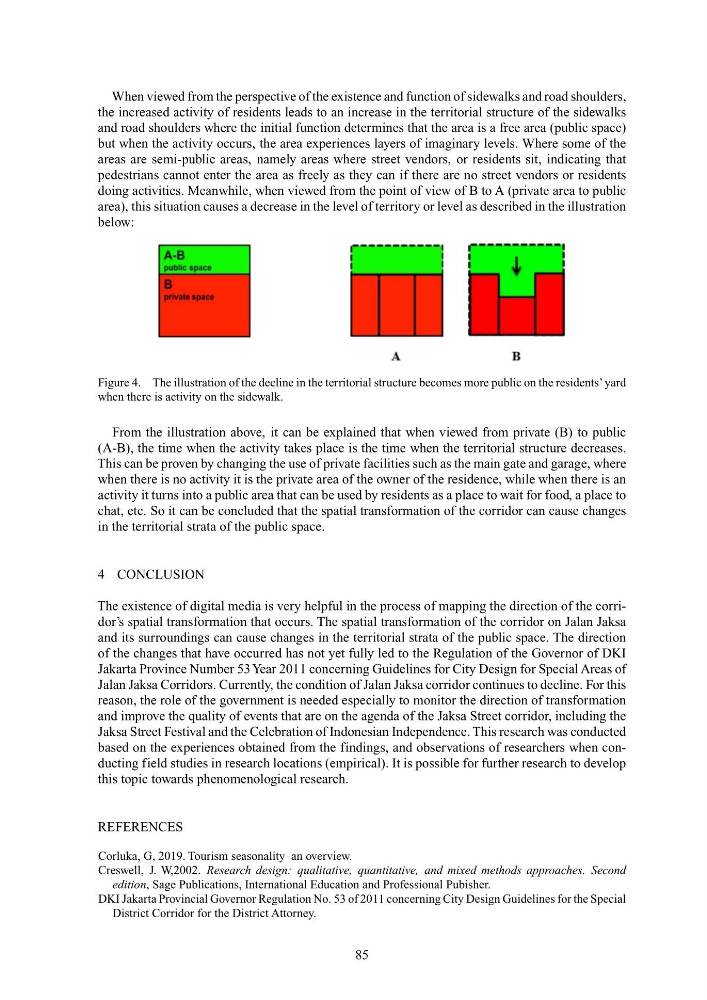
area), this situation causes a decrease in the level of territory or level as described in the illustration
below:
Figure 4. The illustration of the decline in the territorial structure becomes more public on the residents’ yard
when there is activity on the sidewalk.
From the illustration above, it can be explained that when viewed from private (B) to public
(A-B), the time when the activity takes place is the time when the territorial structure decreases.
This can be proven by changing the use of private facilities such as the main gate and garage, where
when there is no activity it is the private area of the owner of the residence, while when there is an
activity it turns into a public area that can be used by residents as a place to wait for food, a place to
chat, etc. So it can be concluded that the spatial transformation of the corridor can cause changes
in the territorial strata of the public space.
4 CONCLUSION
The existence of digital media is very helpful in the process of mapping the direction of the corridor’s spatial transformation that occurs. The spatial transformation of the corridor on Jalan Jaksa
and its surroundings can cause changes in the territorial strata of the public space. The direction
of the changes that have occurred has not yet fully led to the Regulation of the Governor of DKI
Jakarta Province Number 53 Year 2011 concerning Guidelines for City Design for Special Areas of
Jalan Jaksa Corridors. Currently, the condition of Jalan Jaksa corridor continues to decline. For this
reason, the role of the government is needed especially to monitor the direction of transformation
and improve the quality of events that are on the agenda of the Jaksa Street corridor, including the
Jaksa Street Festival and the Celebration of Indonesian Independence. This research was conducted
based on the experiences obtained from the findings, and observations of researchers when conducting field studies in research locations (empirical). It is possible for further research to develop
this topic towards phenomenological research.
REFERENCES
Corluka, G, 2019. Tourism seasonality–an overview.
Creswell, J. W,2002. Research design: qualitative, quantitative, and mixed methods approaches. Second
edition, Sage Publications, International Education and Professional Pubisher.
DKI Jakarta Provincial Governor Regulation No. 53 of 2011 concerning City Design Guidelines for the Special
District Corridor for the District Attorney.
85
the increased activity of residents leads to an increase in the territorial structure of the sidewalks
and road shoulders where the initial function determines that the area is a free area (public space)
but when the activity occurs, the area experiences layers of imaginary levels. Where some of the
areas are semi-public areas, namely areas where street vendors, or residents sit, indicating that
pedestrians cannot enter the area as freely as they can if there are no street vendors or residents
doing activities. Meanwhile, when viewed from the point of view of B to A (private area to public
area), this situation causes a decrease in the level of territory or level as described in the illustration
below:
Figure 4. The illustration of the decline in the territorial structure becomes more public on the residents’ yard
when there is activity on the sidewalk.
From the illustration above, it can be explained that when viewed from private (B) to public
(A-B), the time when the activity takes place is the time when the territorial structure decreases.
This can be proven by changing the use of private facilities such as the main gate and garage, where
when there is no activity it is the private area of the owner of the residence, while when there is an
activity it turns into a public area that can be used by residents as a place to wait for food, a place to
chat, etc. So it can be concluded that the spatial transformation of the corridor can cause changes
in the territorial strata of the public space.
4 CONCLUSION
The existence of digital media is very helpful in the process of mapping the direction of the corridor’s spatial transformation that occurs. The spatial transformation of the corridor on Jalan Jaksa
and its surroundings can cause changes in the territorial strata of the public space. The direction
of the changes that have occurred has not yet fully led to the Regulation of the Governor of DKI
Jakarta Province Number 53 Year 2011 concerning Guidelines for City Design for Special Areas of
Jalan Jaksa Corridors. Currently, the condition of Jalan Jaksa corridor continues to decline. For this
reason, the role of the government is needed especially to monitor the direction of transformation
and improve the quality of events that are on the agenda of the Jaksa Street corridor, including the
Jaksa Street Festival and the Celebration of Indonesian Independence. This research was conducted
based on the experiences obtained from the findings, and observations of researchers when conducting field studies in research locations (empirical). It is possible for further research to develop
this topic towards phenomenological research.
REFERENCES
Corluka, G, 2019. Tourism seasonality–an overview.
Creswell, J. W,2002. Research design: qualitative, quantitative, and mixed methods approaches. Second
edition, Sage Publications, International Education and Professional Pubisher.
DKI Jakarta Provincial Governor Regulation No. 53 of 2011 concerning City Design Guidelines for the Special
District Corridor for the District Attorney.
85