

86 Beam-based Correction and Optimization for Accelerators
θ
(mrad)
-0.2
0
0.2
0.4
s (m)
0
20
40
60
80
100
x (mm)
-1
0
1
no weight
w/ weight
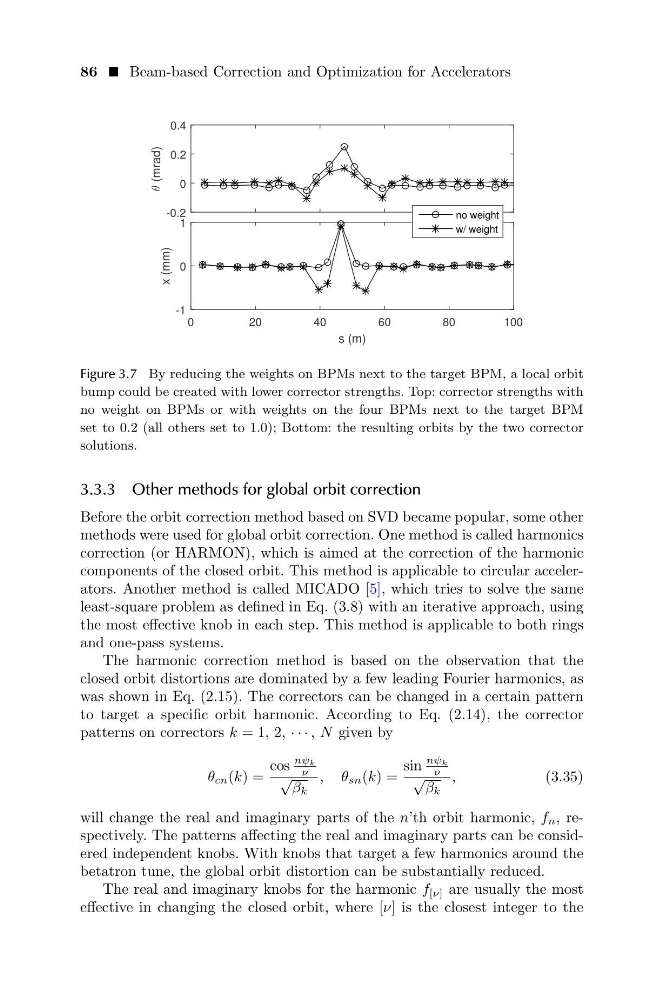
Figure 3.7 By reducing the weights on BPMs next to the target BPM, a local orbit
bump could be created with lower corrector strengths. Top: corrector strengths with
no weight on BPMs or with weights on the four BPMs next to the target BPM
set to 0.2 (all others set to 1.0); Bottom: the resulting orbits by the two corrector
solutions.
3.3.3 Other methods for global orbit correction
Before the orbit correction method based on SVD became popular, some other
methods were used for global orbit correction. One method is called harmonics
correction (or HARMON), which is aimed at the correction of the harmonic
components of the closed orbit. This method is applicable to circular accelerators. Another method is called MICADO [5], which tries to solve the same
least-square problem as defined in Eq. (3.8) with an iterative approach, using
the most effective knob in each step. This method is applicable to both rings
and one-pass systems.
The harmonic correction method is based on the observation that the
closed orbit distortions are dominated by a few leading Fourier harmonics, as
was shown in Eq. (2.15). The correctors can be changed in a certain pattern
to target a specific orbit harmonic. According to Eq. (2.14), the corrector
patterns on correctors k = 1, 2, · · · , N given by
θ cn (k) =
cos
nψ k
ν
√
β k
, θ sn (k) =
sin
nψ k
ν
√
β k
,
(3.35)
will change the real and imaginary parts of the n’th orbit harmonic, f n , respectively. The patterns affecting the real and imaginary parts can be considered independent knobs. With knobs that target a few harmonics around the
betatron tune, the global orbit distortion can be substantially reduced.
The real and imaginary knobs for the harmonic f [ν] are usually the most
effective in changing the closed orbit, where [ν] is the closest integer to the
θ
(mrad)
-0.2
0
0.2
0.4
s (m)
0
20
40
60
80
100
x (mm)
-1
0
1
no weight
w/ weight
Figure 3.7 By reducing the weights on BPMs next to the target BPM, a local orbit
bump could be created with lower corrector strengths. Top: corrector strengths with
no weight on BPMs or with weights on the four BPMs next to the target BPM
set to 0.2 (all others set to 1.0); Bottom: the resulting orbits by the two corrector
solutions.
3.3.3 Other methods for global orbit correction
Before the orbit correction method based on SVD became popular, some other
methods were used for global orbit correction. One method is called harmonics
correction (or HARMON), which is aimed at the correction of the harmonic
components of the closed orbit. This method is applicable to circular accelerators. Another method is called MICADO [5], which tries to solve the same
least-square problem as defined in Eq. (3.8) with an iterative approach, using
the most effective knob in each step. This method is applicable to both rings
and one-pass systems.
The harmonic correction method is based on the observation that the
closed orbit distortions are dominated by a few leading Fourier harmonics, as
was shown in Eq. (2.15). The correctors can be changed in a certain pattern
to target a specific orbit harmonic. According to Eq. (2.14), the corrector
patterns on correctors k = 1, 2, · · · , N given by
θ cn (k) =
cos
nψ k
ν
√
β k
, θ sn (k) =
sin
nψ k
ν
√
β k
,
(3.35)
will change the real and imaginary parts of the n’th orbit harmonic, f n , respectively. The patterns affecting the real and imaginary parts can be considered independent knobs. With knobs that target a few harmonics around the
betatron tune, the global orbit distortion can be substantially reduced.
The real and imaginary knobs for the harmonic f [ν] are usually the most
effective in changing the closed orbit, where [ν] is the closest integer to the