

44 Beam-based Correction and Optimization for Accelerators
2.4 LINEAR COUPLING
In an ideal lattice that consists of drift spaces, dipoles, and quadrupoles,
the beam motion in the horizontal plane is independent of the motion in
the vertical plane, and vice versa. However, if skew quadrupole field components are present in the lattice, the motion in the two planes will be coupled.
Because magnetic fields in skew quadrupoles are linearly dependent on the
transverse coordinates, the coupled beam motion is linear. Main sources of
skew quadrupole components are rolls of quadrupole magnets and vertical
orbit offsets in sextupole magnets. Solenoid fields also cause linear betatron
coupling, although they are not common in high energy accelerators.
Knowing the magnetic fields in a skew quadrupole as given in Eq. (1.19),
the equations of motion in a skew quadrupole field are found to be
x
= a 1 y,
y
= a 1 x,
(2.51)
where a 1 =
1
Bρ
∂Bx
∂x is the normalized skew quadrupole gradient. The motion
in the skew quadrupole field can be solved. In the thin-lens approximation, the
solution can be represented by a transfer matrix that relates the coordinate
vectors at its entrance and exit faces
T sq =
1
0
0
0
0
1 a 1 ∆s 0
0
0
1
0
a 1 ∆s 0
0
1
,
(2.52)
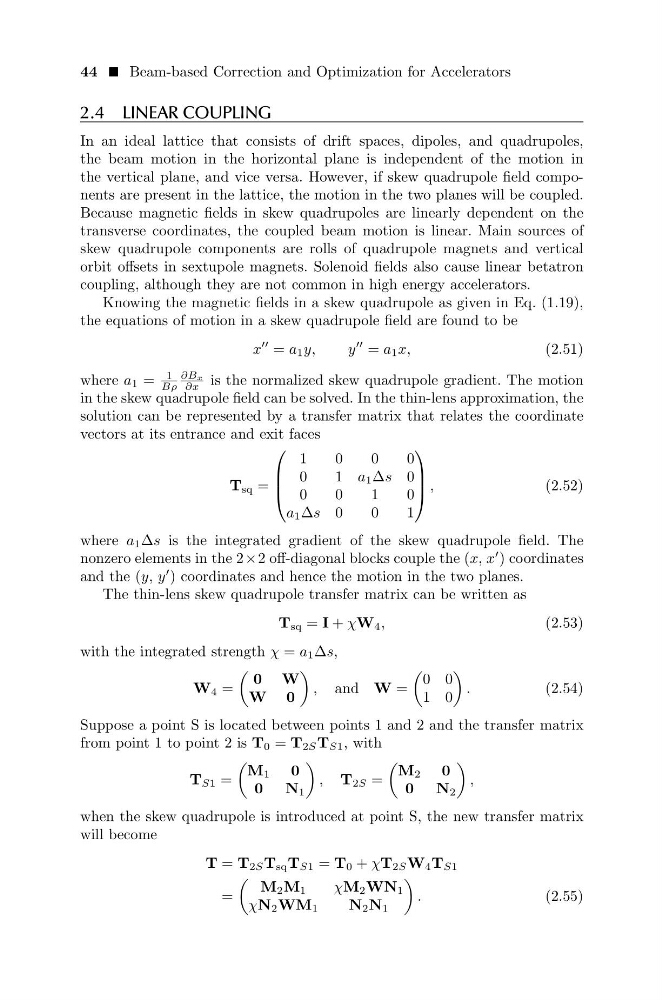
where a 1 ∆s is the integrated gradient of the skew quadrupole field. The
nonzero elements in the 2×2 off-diagonal blocks couple the (x, x
) coordinates
and the (y, y
) coordinates and hence the motion in the two planes.
The thin-lens skew quadrupole transfer matrix can be written as
T sq = I + χW 4 ,
(2.53)
with the integrated strength χ = a 1 ∆s,
W 4 =
0 W
W 0
, and W =
0 0
1 0
.
(2.54)
Suppose a point S is located between points 1 and 2 and the transfer matrix
from point 1 to point 2 is T 0 = T 2S T S1 , with
T S1 =
M 1 0
0 N 1
, T 2S =
M 2 0
0 N 2
,
when the skew quadrupole is introduced at point S, the new transfer matrix
will become
T = T 2S T sq T S1 = T 0 + χT 2S W 4 T S1
=
M 2 M 1
χM 2 WN 1
χN 2 WM 1
N 2 N 1
.
(2.55)
2.4 LINEAR COUPLING
In an ideal lattice that consists of drift spaces, dipoles, and quadrupoles,
the beam motion in the horizontal plane is independent of the motion in
the vertical plane, and vice versa. However, if skew quadrupole field components are present in the lattice, the motion in the two planes will be coupled.
Because magnetic fields in skew quadrupoles are linearly dependent on the
transverse coordinates, the coupled beam motion is linear. Main sources of
skew quadrupole components are rolls of quadrupole magnets and vertical
orbit offsets in sextupole magnets. Solenoid fields also cause linear betatron
coupling, although they are not common in high energy accelerators.
Knowing the magnetic fields in a skew quadrupole as given in Eq. (1.19),
the equations of motion in a skew quadrupole field are found to be
x
= a 1 y,
y
= a 1 x,
(2.51)
where a 1 =
1
Bρ
∂Bx
∂x is the normalized skew quadrupole gradient. The motion
in the skew quadrupole field can be solved. In the thin-lens approximation, the
solution can be represented by a transfer matrix that relates the coordinate
vectors at its entrance and exit faces
T sq =
1
0
0
0
0
1 a 1 ∆s 0
0
0
1
0
a 1 ∆s 0
0
1
,
(2.52)
where a 1 ∆s is the integrated gradient of the skew quadrupole field. The
nonzero elements in the 2×2 off-diagonal blocks couple the (x, x
) coordinates
and the (y, y
) coordinates and hence the motion in the two planes.
The thin-lens skew quadrupole transfer matrix can be written as
T sq = I + χW 4 ,
(2.53)
with the integrated strength χ = a 1 ∆s,
W 4 =
0 W
W 0
, and W =
0 0
1 0
.
(2.54)
Suppose a point S is located between points 1 and 2 and the transfer matrix
from point 1 to point 2 is T 0 = T 2S T S1 , with
T S1 =
M 1 0
0 N 1
, T 2S =
M 2 0
0 N 2
,
when the skew quadrupole is introduced at point S, the new transfer matrix
will become
T = T 2S T sq T S1 = T 0 + χT 2S W 4 T S1
=
M 2 M 1
χM 2 WN 1
χN 2 WM 1
N 2 N 1
.
(2.55)