

Beam dynamics topics 43
where we have dropped the x β term since it is oscillatory and should largely
cancel in the integration. The momentum compaction factor is defined as the
derivative of the fractional path length change with respect to the momentum
deviation,
α c ≡
dC
Cdδ
=
1
C
hDds.
(2.45)
The momentum compaction factor is very important for the longitudinal motion as it affects the arrival time of off-momentum particles at the RF cavities.
The impact of the dispersion function and the momentum compaction
factor to the longitudinal motion is naturally described by the transfer matrix
for the 6-dimensional phase space coordinates. To simplify the notation, we
omit the vertical plane here. Considering the coordinates X = (x, x
, z, δ),
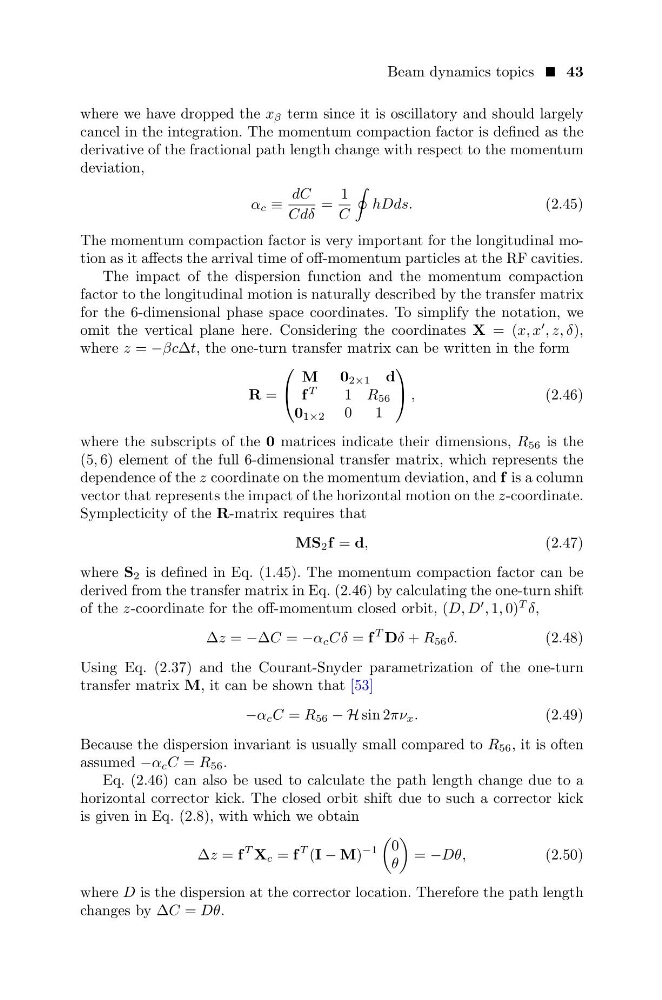
where z = −βc∆t, the one-turn transfer matrix can be written in the form
R =
M 0 2×1 d
f
T
0 1×2
1 R 56
0
1
,
(2.46)
where the subscripts of the 0 matrices indicate their dimensions, R 56 is the
(5, 6) element of the full 6-dimensional transfer matrix, which represents the
dependence of the z coordinate on the momentum deviation, and f is a column
vector that represents the impact of the horizontal motion on the z-coordinate.
Symplecticity of the R-matrix requires that
MS 2 f = d,
(2.47)
where S 2 is defined in Eq. (1.45). The momentum compaction factor can be
derived from the transfer matrix in Eq. (2.46) by calculating the one-turn shift
of the z-coordinate for the off-momentum closed orbit, (D, D
, 1, 0)
T δ,
∆z = −∆C = −α c Cδ = f
T Dδ + R 56 δ.
(2.48)
Using Eq. (2.37) and the Courant-Snyder parametrization of the one-turn
transfer matrix M, it can be shown that [53]
−α c C = R 56 − H sin 2πν x .
(2.49)
Because the dispersion invariant is usually small compared to R 56 , it is often
assumed −α c C = R 56 .
Eq. (2.46) can also be used to calculate the path length change due to a
horizontal corrector kick. The closed orbit shift due to such a corrector kick
is given in Eq. (2.8), with which we obtain
∆z = f
T X c = f
T (I − M)
−1
0
θ
= −Dθ,
(2.50)
where D is the dispersion at the corrector location. Therefore the path length
changes by ∆C = Dθ.
where we have dropped the x β term since it is oscillatory and should largely
cancel in the integration. The momentum compaction factor is defined as the
derivative of the fractional path length change with respect to the momentum
deviation,
α c ≡
dC
Cdδ
=
1
C
hDds.
(2.45)
The momentum compaction factor is very important for the longitudinal motion as it affects the arrival time of off-momentum particles at the RF cavities.
The impact of the dispersion function and the momentum compaction
factor to the longitudinal motion is naturally described by the transfer matrix
for the 6-dimensional phase space coordinates. To simplify the notation, we
omit the vertical plane here. Considering the coordinates X = (x, x
, z, δ),
where z = −βc∆t, the one-turn transfer matrix can be written in the form
R =
M 0 2×1 d
f
T
0 1×2
1 R 56
0
1
,
(2.46)
where the subscripts of the 0 matrices indicate their dimensions, R 56 is the
(5, 6) element of the full 6-dimensional transfer matrix, which represents the
dependence of the z coordinate on the momentum deviation, and f is a column
vector that represents the impact of the horizontal motion on the z-coordinate.
Symplecticity of the R-matrix requires that
MS 2 f = d,
(2.47)
where S 2 is defined in Eq. (1.45). The momentum compaction factor can be
derived from the transfer matrix in Eq. (2.46) by calculating the one-turn shift
of the z-coordinate for the off-momentum closed orbit, (D, D
, 1, 0)
T δ,
∆z = −∆C = −α c Cδ = f
T Dδ + R 56 δ.
(2.48)
Using Eq. (2.37) and the Courant-Snyder parametrization of the one-turn
transfer matrix M, it can be shown that [53]
−α c C = R 56 − H sin 2πν x .
(2.49)
Because the dispersion invariant is usually small compared to R 56 , it is often
assumed −α c C = R 56 .
Eq. (2.46) can also be used to calculate the path length change due to a
horizontal corrector kick. The closed orbit shift due to such a corrector kick
is given in Eq. (2.8), with which we obtain
∆z = f
T X c = f
T (I − M)
−1
0
θ
= −Dθ,
(2.50)
where D is the dispersion at the corrector location. Therefore the path length
changes by ∆C = Dθ.