

Application of beam-based optimization 223
S F M
S F 2
S F 3
S F 4
S F 5
S D
M
S D
2
S D
3
S D
4
S D
5
-0.5
0
0.5
1
I (A)
v 1
v 2
v 3
v 4
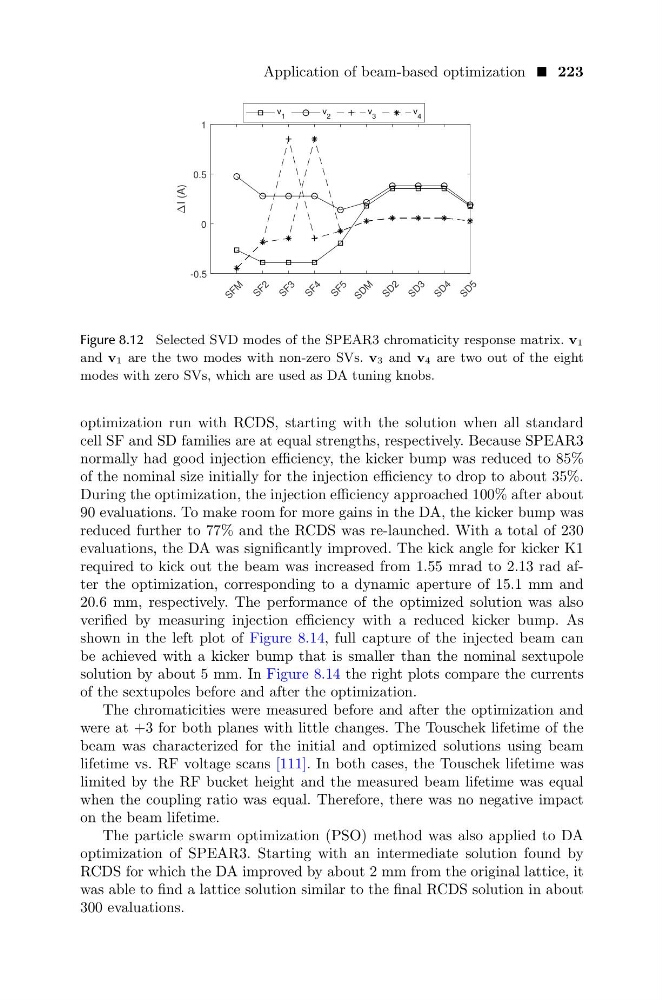
Figure 8.12 Selected SVD modes of the SPEAR3 chromaticity response matrix. v1
and v1 are the two modes with non-zero SVs. v3 and v4 are two out of the eight
modes with zero SVs, which are used as DA tuning knobs.
optimization run with RCDS, starting with the solution when all standard
cell SF and SD families are at equal strengths, respectively. Because SPEAR3
normally had good injection efficiency, the kicker bump was reduced to 85%
of the nominal size initially for the injection efficiency to drop to about 35%.
During the optimization, the injection efficiency approached 100% after about
90 evaluations. To make room for more gains in the DA, the kicker bump was
reduced further to 77% and the RCDS was re-launched. With a total of 230
evaluations, the DA was significantly improved. The kick angle for kicker K1
required to kick out the beam was increased from 1.55 mrad to 2.13 rad after the optimization, corresponding to a dynamic aperture of 15.1 mm and
20.6 mm, respectively. The performance of the optimized solution was also
verified by measuring injection efficiency with a reduced kicker bump. As
shown in the left plot of Figure 8.14, full capture of the injected beam can
be achieved with a kicker bump that is smaller than the nominal sextupole
solution by about 5 mm. In Figure 8.14 the right plots compare the currents
of the sextupoles before and after the optimization.
The chromaticities were measured before and after the optimization and
were at +3 for both planes with little changes. The Touschek lifetime of the
beam was characterized for the initial and optimized solutions using beam
lifetime vs. RF voltage scans [111]. In both cases, the Touschek lifetime was
limited by the RF bucket height and the measured beam lifetime was equal
when the coupling ratio was equal. Therefore, there was no negative impact
on the beam lifetime.
The particle swarm optimization (PSO) method was also applied to DA
optimization of SPEAR3. Starting with an intermediate solution found by
RCDS for which the DA improved by about 2 mm from the original lattice, it
was able to find a lattice solution similar to the final RCDS solution in about
300 evaluations.
S F M
S F 2
S F 3
S F 4
S F 5
S D
M
S D
2
S D
3
S D
4
S D
5
-0.5
0
0.5
1
I (A)
v 1
v 2
v 3
v 4
Figure 8.12 Selected SVD modes of the SPEAR3 chromaticity response matrix. v1
and v1 are the two modes with non-zero SVs. v3 and v4 are two out of the eight
modes with zero SVs, which are used as DA tuning knobs.
optimization run with RCDS, starting with the solution when all standard
cell SF and SD families are at equal strengths, respectively. Because SPEAR3
normally had good injection efficiency, the kicker bump was reduced to 85%
of the nominal size initially for the injection efficiency to drop to about 35%.
During the optimization, the injection efficiency approached 100% after about
90 evaluations. To make room for more gains in the DA, the kicker bump was
reduced further to 77% and the RCDS was re-launched. With a total of 230
evaluations, the DA was significantly improved. The kick angle for kicker K1
required to kick out the beam was increased from 1.55 mrad to 2.13 rad after the optimization, corresponding to a dynamic aperture of 15.1 mm and
20.6 mm, respectively. The performance of the optimized solution was also
verified by measuring injection efficiency with a reduced kicker bump. As
shown in the left plot of Figure 8.14, full capture of the injected beam can
be achieved with a kicker bump that is smaller than the nominal sextupole
solution by about 5 mm. In Figure 8.14 the right plots compare the currents
of the sextupoles before and after the optimization.
The chromaticities were measured before and after the optimization and
were at +3 for both planes with little changes. The Touschek lifetime of the
beam was characterized for the initial and optimized solutions using beam
lifetime vs. RF voltage scans [111]. In both cases, the Touschek lifetime was
limited by the RF bucket height and the measured beam lifetime was equal
when the coupling ratio was equal. Therefore, there was no negative impact
on the beam lifetime.
The particle swarm optimization (PSO) method was also applied to DA
optimization of SPEAR3. Starting with an intermediate solution found by
RCDS for which the DA improved by about 2 mm from the original lattice, it
was able to find a lattice solution similar to the final RCDS solution in about
300 evaluations.