

Application of beam-based optimization 219
-1.5
-1
-0.5
0
objective (mA/min)
N-M Simplex
0
50
100
150
200
250
300
0.2
0.4
0.6
0.8
x
-1.5
-1
-0.5
0
objective (mA/min)
RSimplex
0
50
100
150
200
250
300
350
400
evaluation
0.2
0.4
0.6
0.8
x
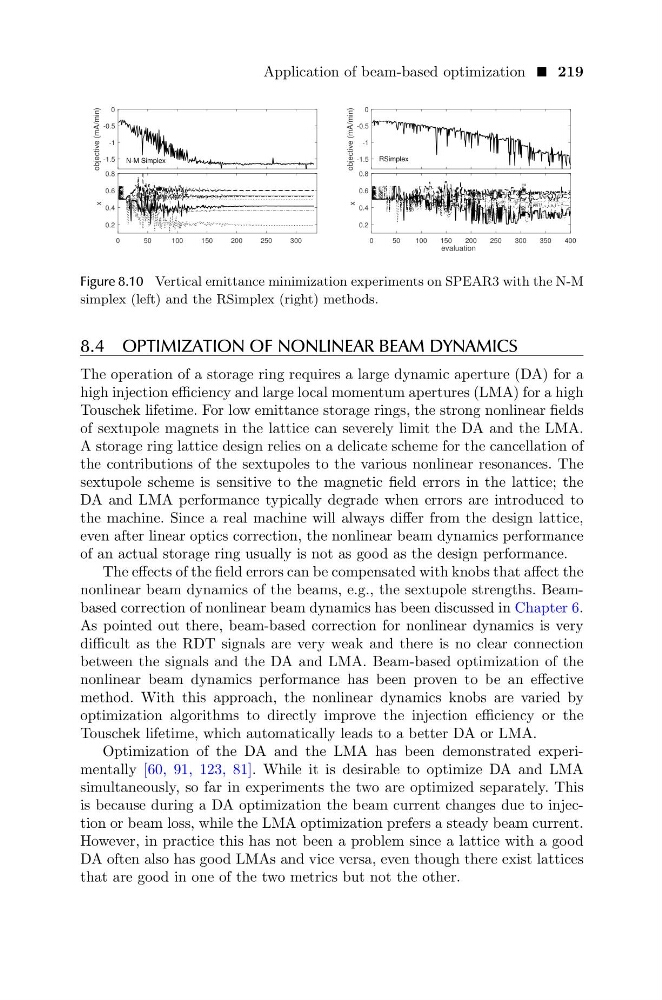
Figure 8.10 Vertical emittance minimization experiments on SPEAR3 with the N-M
simplex (left) and the RSimplex (right) methods.
8.4 OPTIMIZATION OF NONLINEAR BEAM DYNAMICS
The operation of a storage ring requires a large dynamic aperture (DA) for a
high injection efficiency and large local momentum apertures (LMA) for a high
Touschek lifetime. For low emittance storage rings, the strong nonlinear fields
of sextupole magnets in the lattice can severely limit the DA and the LMA.
A storage ring lattice design relies on a delicate scheme for the cancellation of
the contributions of the sextupoles to the various nonlinear resonances. The
sextupole scheme is sensitive to the magnetic field errors in the lattice; the
DA and LMA performance typically degrade when errors are introduced to
the machine. Since a real machine will always differ from the design lattice,
even after linear optics correction, the nonlinear beam dynamics performance
of an actual storage ring usually is not as good as the design performance.
The effects of the field errors can be compensated with knobs that affect the
nonlinear beam dynamics of the beams, e.g., the sextupole strengths. Beambased correction of nonlinear beam dynamics has been discussed in Chapter 6.
As pointed out there, beam-based correction for nonlinear dynamics is very
difficult as the RDT signals are very weak and there is no clear connection
between the signals and the DA and LMA. Beam-based optimization of the
nonlinear beam dynamics performance has been proven to be an effective
method. With this approach, the nonlinear dynamics knobs are varied by
optimization algorithms to directly improve the injection efficiency or the
Touschek lifetime, which automatically leads to a better DA or LMA.
Optimization of the DA and the LMA has been demonstrated experimentally [60, 91, 123, 81]. While it is desirable to optimize DA and LMA
simultaneously, so far in experiments the two are optimized separately. This
is because during a DA optimization the beam current changes due to injection or beam loss, while the LMA optimization prefers a steady beam current.
However, in practice this has not been a problem since a lattice with a good
DA often also has good LMAs and vice versa, even though there exist lattices
that are good in one of the two metrics but not the other.
-1.5
-1
-0.5
0
objective (mA/min)
N-M Simplex
0
50
100
150
200
250
300
0.2
0.4
0.6
0.8
x
-1.5
-1
-0.5
0
objective (mA/min)
RSimplex
0
50
100
150
200
250
300
350
400
evaluation
0.2
0.4
0.6
0.8
x
Figure 8.10 Vertical emittance minimization experiments on SPEAR3 with the N-M
simplex (left) and the RSimplex (right) methods.
8.4 OPTIMIZATION OF NONLINEAR BEAM DYNAMICS
The operation of a storage ring requires a large dynamic aperture (DA) for a
high injection efficiency and large local momentum apertures (LMA) for a high
Touschek lifetime. For low emittance storage rings, the strong nonlinear fields
of sextupole magnets in the lattice can severely limit the DA and the LMA.
A storage ring lattice design relies on a delicate scheme for the cancellation of
the contributions of the sextupoles to the various nonlinear resonances. The
sextupole scheme is sensitive to the magnetic field errors in the lattice; the
DA and LMA performance typically degrade when errors are introduced to
the machine. Since a real machine will always differ from the design lattice,
even after linear optics correction, the nonlinear beam dynamics performance
of an actual storage ring usually is not as good as the design performance.
The effects of the field errors can be compensated with knobs that affect the
nonlinear beam dynamics of the beams, e.g., the sextupole strengths. Beambased correction of nonlinear beam dynamics has been discussed in Chapter 6.
As pointed out there, beam-based correction for nonlinear dynamics is very
difficult as the RDT signals are very weak and there is no clear connection
between the signals and the DA and LMA. Beam-based optimization of the
nonlinear beam dynamics performance has been proven to be an effective
method. With this approach, the nonlinear dynamics knobs are varied by
optimization algorithms to directly improve the injection efficiency or the
Touschek lifetime, which automatically leads to a better DA or LMA.
Optimization of the DA and the LMA has been demonstrated experimentally [60, 91, 123, 81]. While it is desirable to optimize DA and LMA
simultaneously, so far in experiments the two are optimized separately. This
is because during a DA optimization the beam current changes due to injection or beam loss, while the LMA optimization prefers a steady beam current.
However, in practice this has not been a problem since a lattice with a good
DA often also has good LMAs and vice versa, even though there exist lattices
that are good in one of the two metrics but not the other.