

Application of beam-based optimization 213
500
1000
1500
objective (um)
N-M Simplex
0
50
100
150
evaluation
0.2
0.4
0.6
0.8
x
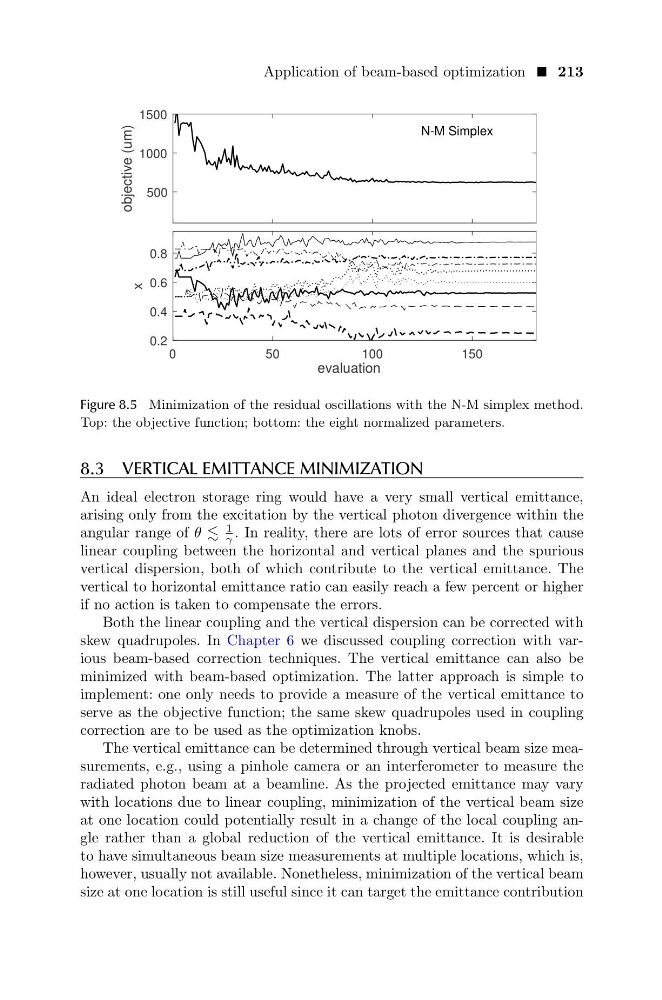
Figure 8.5 Minimization of the residual oscillations with the N-M simplex method.
Top: the objective function; bottom: the eight normalized parameters.
8.3 VERTICAL EMITTANCE MINIMIZATION
An ideal electron storage ring would have a very small vertical emittance,
arising only from the excitation by the vertical photon divergence within the
angular range of θ
1
γ . In reality, there are lots of error sources that cause
linear coupling between the horizontal and vertical planes and the spurious
vertical dispersion, both of which contribute to the vertical emittance. The
vertical to horizontal emittance ratio can easily reach a few percent or higher
if no action is taken to compensate the errors.
Both the linear coupling and the vertical dispersion can be corrected with
skew quadrupoles. In Chapter 6 we discussed coupling correction with various beam-based correction techniques. The vertical emittance can also be
minimized with beam-based optimization. The latter approach is simple to
implement: one only needs to provide a measure of the vertical emittance to
serve as the objective function; the same skew quadrupoles used in coupling
correction are to be used as the optimization knobs.
The vertical emittance can be determined through vertical beam size measurements, e.g., using a pinhole camera or an interferometer to measure the
radiated photon beam at a beamline. As the projected emittance may vary
with locations due to linear coupling, minimization of the vertical beam size
at one location could potentially result in a change of the local coupling angle rather than a global reduction of the vertical emittance. It is desirable
to have simultaneous beam size measurements at multiple locations, which is,
however, usually not available. Nonetheless, minimization of the vertical beam
size at one location is still useful since it can target the emittance contribution
500
1000
1500
objective (um)
N-M Simplex
0
50
100
150
evaluation
0.2
0.4
0.6
0.8
x
Figure 8.5 Minimization of the residual oscillations with the N-M simplex method.
Top: the objective function; bottom: the eight normalized parameters.
8.3 VERTICAL EMITTANCE MINIMIZATION
An ideal electron storage ring would have a very small vertical emittance,
arising only from the excitation by the vertical photon divergence within the
angular range of θ
1
γ . In reality, there are lots of error sources that cause
linear coupling between the horizontal and vertical planes and the spurious
vertical dispersion, both of which contribute to the vertical emittance. The
vertical to horizontal emittance ratio can easily reach a few percent or higher
if no action is taken to compensate the errors.
Both the linear coupling and the vertical dispersion can be corrected with
skew quadrupoles. In Chapter 6 we discussed coupling correction with various beam-based correction techniques. The vertical emittance can also be
minimized with beam-based optimization. The latter approach is simple to
implement: one only needs to provide a measure of the vertical emittance to
serve as the objective function; the same skew quadrupoles used in coupling
correction are to be used as the optimization knobs.
The vertical emittance can be determined through vertical beam size measurements, e.g., using a pinhole camera or an interferometer to measure the
radiated photon beam at a beamline. As the projected emittance may vary
with locations due to linear coupling, minimization of the vertical beam size
at one location could potentially result in a change of the local coupling angle rather than a global reduction of the vertical emittance. It is desirable
to have simultaneous beam size measurements at multiple locations, which is,
however, usually not available. Nonetheless, minimization of the vertical beam
size at one location is still useful since it can target the emittance contribution