

200 Beam-based Correction and Optimization for Accelerators
0
50
100
150
200
250
300
evaluations
10
-4
10
-2
10
0
y = f(x)
RSimplex, N=300
=0.001
=0.01
=0.1
0
20
40
60
80
100
cases
10
-4
10
-2
10
0
f
min
RSimplex, N=300
=0.001
=0.01
=0.1
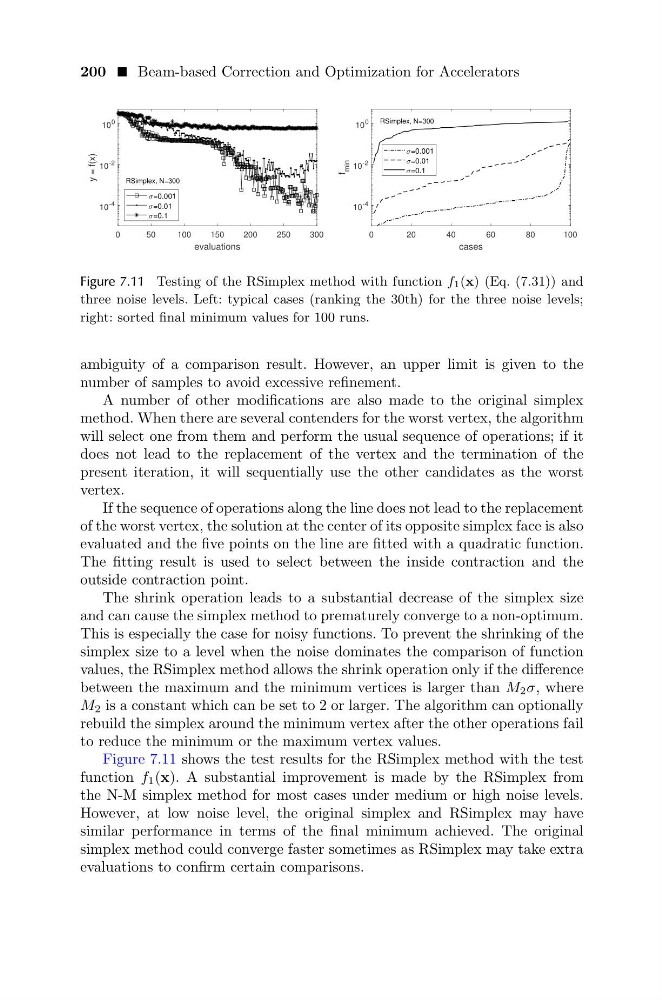
Figure 7.11 Testing of the RSimplex method with function f1(x) (Eq. (7.31)) and
three noise levels. Left: typical cases (ranking the 30th) for the three noise levels;
right: sorted final minimum values for 100 runs.
ambiguity of a comparison result. However, an upper limit is given to the
number of samples to avoid excessive refinement.
A number of other modifications are also made to the original simplex
method. When there are several contenders for the worst vertex, the algorithm
will select one from them and perform the usual sequence of operations; if it
does not lead to the replacement of the vertex and the termination of the
present iteration, it will sequentially use the other candidates as the worst
vertex.
If the sequence of operations along the line does not lead to the replacement
of the worst vertex, the solution at the center of its opposite simplex face is also
evaluated and the five points on the line are fitted with a quadratic function.
The fitting result is used to select between the inside contraction and the
outside contraction point.
The shrink operation leads to a substantial decrease of the simplex size
and can cause the simplex method to prematurely converge to a non-optimum.
This is especially the case for noisy functions. To prevent the shrinking of the
simplex size to a level when the noise dominates the comparison of function
values, the RSimplex method allows the shrink operation only if the difference
between the maximum and the minimum vertices is larger than M 2 σ, where
M 2 is a constant which can be set to 2 or larger. The algorithm can optionally
rebuild the simplex around the minimum vertex after the other operations fail
to reduce the minimum or the maximum vertex values.
Figure 7.11 shows the test results for the RSimplex method with the test
function f 1 (x). A substantial improvement is made by the RSimplex from
the N-M simplex method for most cases under medium or high noise levels.
However, at low noise level, the original simplex and RSimplex may have
similar performance in terms of the final minimum achieved. The original
simplex method could converge faster sometimes as RSimplex may take extra
evaluations to confirm certain comparisons.
0
50
100
150
200
250
300
evaluations
10
-4
10
-2
10
0
y = f(x)
RSimplex, N=300
=0.001
=0.01
=0.1
0
20
40
60
80
100
cases
10
-4
10
-2
10
0
f
min
RSimplex, N=300
=0.001
=0.01
=0.1
Figure 7.11 Testing of the RSimplex method with function f1(x) (Eq. (7.31)) and
three noise levels. Left: typical cases (ranking the 30th) for the three noise levels;
right: sorted final minimum values for 100 runs.
ambiguity of a comparison result. However, an upper limit is given to the
number of samples to avoid excessive refinement.
A number of other modifications are also made to the original simplex
method. When there are several contenders for the worst vertex, the algorithm
will select one from them and perform the usual sequence of operations; if it
does not lead to the replacement of the vertex and the termination of the
present iteration, it will sequentially use the other candidates as the worst
vertex.
If the sequence of operations along the line does not lead to the replacement
of the worst vertex, the solution at the center of its opposite simplex face is also
evaluated and the five points on the line are fitted with a quadratic function.
The fitting result is used to select between the inside contraction and the
outside contraction point.
The shrink operation leads to a substantial decrease of the simplex size
and can cause the simplex method to prematurely converge to a non-optimum.
This is especially the case for noisy functions. To prevent the shrinking of the
simplex size to a level when the noise dominates the comparison of function
values, the RSimplex method allows the shrink operation only if the difference
between the maximum and the minimum vertices is larger than M 2 σ, where
M 2 is a constant which can be set to 2 or larger. The algorithm can optionally
rebuild the simplex around the minimum vertex after the other operations fail
to reduce the minimum or the maximum vertex values.
Figure 7.11 shows the test results for the RSimplex method with the test
function f 1 (x). A substantial improvement is made by the RSimplex from
the N-M simplex method for most cases under medium or high noise levels.
However, at low noise level, the original simplex and RSimplex may have
similar performance in terms of the final minimum achieved. The original
simplex method could converge faster sometimes as RSimplex may take extra
evaluations to confirm certain comparisons.