

198 Beam-based Correction and Optimization for Accelerators
-0.2
-0.15
-0.1
-0.05
0
0.05
0.1
-1
-0.9
-0.8
-0.7
-0.6
objective
0
1
2
3
4
5
6
samples
fitted
predicted min
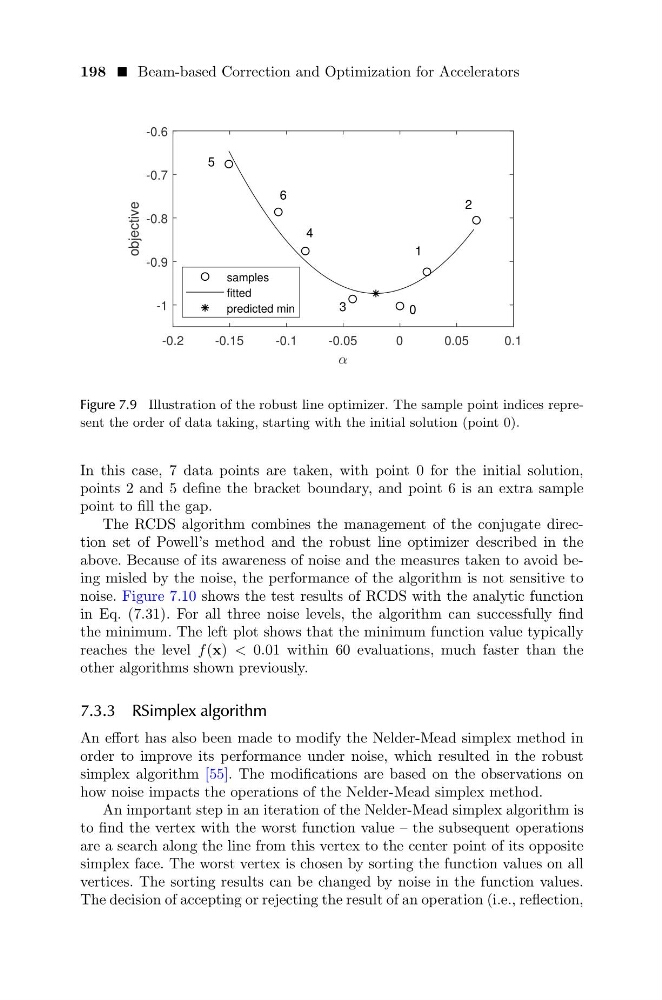
Figure 7.9 Illustration of the robust line optimizer. The sample point indices represent the order of data taking, starting with the initial solution (point 0).
In this case, 7 data points are taken, with point 0 for the initial solution,
points 2 and 5 define the bracket boundary, and point 6 is an extra sample
point to fill the gap.
The RCDS algorithm combines the management of the conjugate direction set of Powell’s method and the robust line optimizer described in the
above. Because of its awareness of noise and the measures taken to avoid being misled by the noise, the performance of the algorithm is not sensitive to
noise. Figure 7.10 shows the test results of RCDS with the analytic function
in Eq. (7.31). For all three noise levels, the algorithm can successfully find
the minimum. The left plot shows that the minimum function value typically
reaches the level f (x) < 0.01 within 60 evaluations, much faster than the
other algorithms shown previously.
7.3.3 RSimplex algorithm
An effort has also been made to modify the Nelder-Mead simplex method in
order to improve its performance under noise, which resulted in the robust
simplex algorithm [55]. The modifications are based on the observations on
how noise impacts the operations of the Nelder-Mead simplex method.
An important step in an iteration of the Nelder-Mead simplex algorithm is
to find the vertex with the worst function value – the subsequent operations
are a search along the line from this vertex to the center point of its opposite
simplex face. The worst vertex is chosen by sorting the function values on all
vertices. The sorting results can be changed by noise in the function values.
The decision of accepting or rejecting the result of an operation (i.e., reflection,
-0.2
-0.15
-0.1
-0.05
0
0.05
0.1
-1
-0.9
-0.8
-0.7
-0.6
objective
0
1
2
3
4
5
6
samples
fitted
predicted min
Figure 7.9 Illustration of the robust line optimizer. The sample point indices represent the order of data taking, starting with the initial solution (point 0).
In this case, 7 data points are taken, with point 0 for the initial solution,
points 2 and 5 define the bracket boundary, and point 6 is an extra sample
point to fill the gap.
The RCDS algorithm combines the management of the conjugate direction set of Powell’s method and the robust line optimizer described in the
above. Because of its awareness of noise and the measures taken to avoid being misled by the noise, the performance of the algorithm is not sensitive to
noise. Figure 7.10 shows the test results of RCDS with the analytic function
in Eq. (7.31). For all three noise levels, the algorithm can successfully find
the minimum. The left plot shows that the minimum function value typically
reaches the level f (x) < 0.01 within 60 evaluations, much faster than the
other algorithms shown previously.
7.3.3 RSimplex algorithm
An effort has also been made to modify the Nelder-Mead simplex method in
order to improve its performance under noise, which resulted in the robust
simplex algorithm [55]. The modifications are based on the observations on
how noise impacts the operations of the Nelder-Mead simplex method.
An important step in an iteration of the Nelder-Mead simplex algorithm is
to find the vertex with the worst function value – the subsequent operations
are a search along the line from this vertex to the center point of its opposite
simplex face. The worst vertex is chosen by sorting the function values on all
vertices. The sorting results can be changed by noise in the function values.
The decision of accepting or rejecting the result of an operation (i.e., reflection,