

Coupling and nonlinear dynamics correction 161
0
5
10
15
20
25
30
section
0
0.05
0.1
0.15
|f
1001
|
x-before
y-before
x-after
y-after
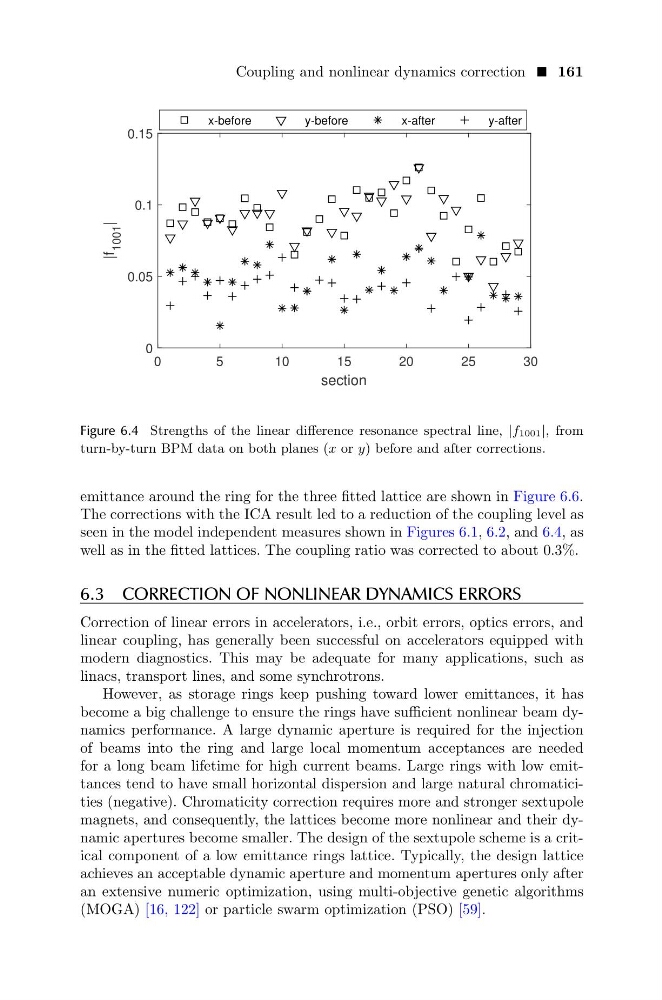
Figure 6.4 Strengths of the linear difference resonance spectral line, |f1001|, from
turn-by-turn BPM data on both planes (x or y) before and after corrections.
emittance around the ring for the three fitted lattice are shown in Figure 6.6.
The corrections with the ICA result led to a reduction of the coupling level as
seen in the model independent measures shown in Figures 6.1, 6.2, and 6.4, as
well as in the fitted lattices. The coupling ratio was corrected to about 0.3%.
6.3 CORRECTION OF NONLINEAR DYNAMICS ERRORS
Correction of linear errors in accelerators, i.e., orbit errors, optics errors, and
linear coupling, has generally been successful on accelerators equipped with
modern diagnostics. This may be adequate for many applications, such as
linacs, transport lines, and some synchrotrons.
However, as storage rings keep pushing toward lower emittances, it has
become a big challenge to ensure the rings have sufficient nonlinear beam dynamics performance. A large dynamic aperture is required for the injection
of beams into the ring and large local momentum acceptances are needed
for a long beam lifetime for high current beams. Large rings with low emittances tend to have small horizontal dispersion and large natural chromaticities (negative). Chromaticity correction requires more and stronger sextupole
magnets, and consequently, the lattices become more nonlinear and their dynamic apertures become smaller. The design of the sextupole scheme is a critical component of a low emittance rings lattice. Typically, the design lattice
achieves an acceptable dynamic aperture and momentum apertures only after
an extensive numeric optimization, using multi-objective genetic algorithms
(MOGA) [16, 122] or particle swarm optimization (PSO) [59].
0
5
10
15
20
25
30
section
0
0.05
0.1
0.15
|f
1001
|
x-before
y-before
x-after
y-after
Figure 6.4 Strengths of the linear difference resonance spectral line, |f1001|, from
turn-by-turn BPM data on both planes (x or y) before and after corrections.
emittance around the ring for the three fitted lattice are shown in Figure 6.6.
The corrections with the ICA result led to a reduction of the coupling level as
seen in the model independent measures shown in Figures 6.1, 6.2, and 6.4, as
well as in the fitted lattices. The coupling ratio was corrected to about 0.3%.
6.3 CORRECTION OF NONLINEAR DYNAMICS ERRORS
Correction of linear errors in accelerators, i.e., orbit errors, optics errors, and
linear coupling, has generally been successful on accelerators equipped with
modern diagnostics. This may be adequate for many applications, such as
linacs, transport lines, and some synchrotrons.
However, as storage rings keep pushing toward lower emittances, it has
become a big challenge to ensure the rings have sufficient nonlinear beam dynamics performance. A large dynamic aperture is required for the injection
of beams into the ring and large local momentum acceptances are needed
for a long beam lifetime for high current beams. Large rings with low emittances tend to have small horizontal dispersion and large natural chromaticities (negative). Chromaticity correction requires more and stronger sextupole
magnets, and consequently, the lattices become more nonlinear and their dynamic apertures become smaller. The design of the sextupole scheme is a critical component of a low emittance rings lattice. Typically, the design lattice
achieves an acceptable dynamic aperture and momentum apertures only after
an extensive numeric optimization, using multi-objective genetic algorithms
(MOGA) [16, 122] or particle swarm optimization (PSO) [59].