

Linear optics measurement and correction - II 135
0
20
40
index
10
-3
10
-2
10
-1
SV
0.05 0.1 0.15 0.2 0.25
tune
0
5
10
|F(v)|
v 1
v 2
0
20
40
60
80
100
120
BPM index
-0.2
0
0.2
u
1
, u
2
H-BPM V-BPM
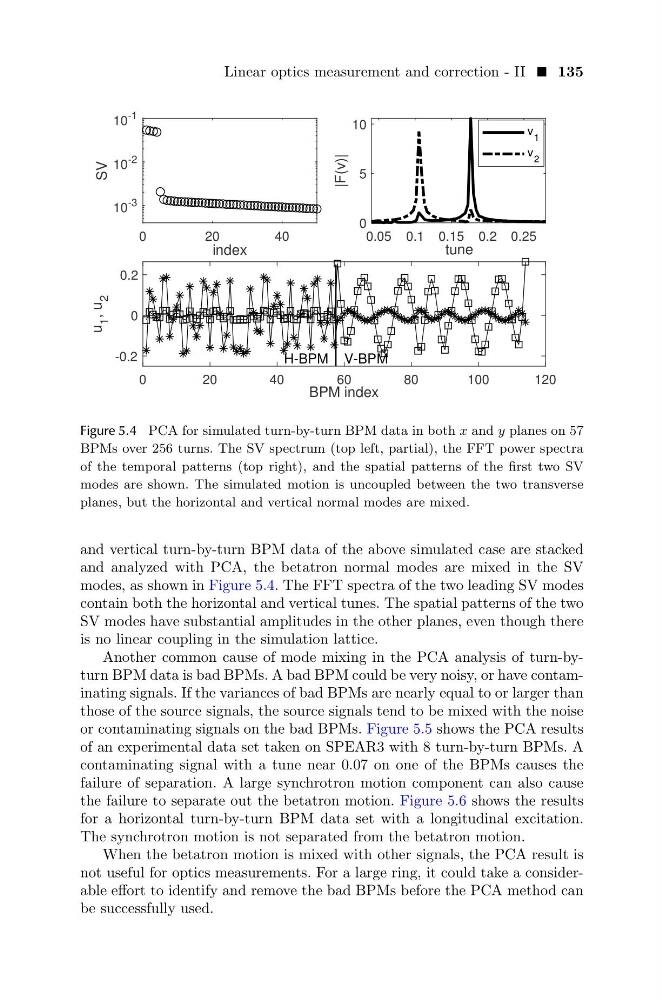
Figure 5.4 PCA for simulated turn-by-turn BPM data in both x and y planes on 57
BPMs over 256 turns. The SV spectrum (top left, partial), the FFT power spectra
of the temporal patterns (top right), and the spatial patterns of the first two SV
modes are shown. The simulated motion is uncoupled between the two transverse
planes, but the horizontal and vertical normal modes are mixed.
and vertical turn-by-turn BPM data of the above simulated case are stacked
and analyzed with PCA, the betatron normal modes are mixed in the SV
modes, as shown in Figure 5.4. The FFT spectra of the two leading SV modes
contain both the horizontal and vertical tunes. The spatial patterns of the two
SV modes have substantial amplitudes in the other planes, even though there
is no linear coupling in the simulation lattice.
Another common cause of mode mixing in the PCA analysis of turn-byturn BPM data is bad BPMs. A bad BPM could be very noisy, or have contaminating signals. If the variances of bad BPMs are nearly equal to or larger than
those of the source signals, the source signals tend to be mixed with the noise
or contaminating signals on the bad BPMs. Figure 5.5 shows the PCA results
of an experimental data set taken on SPEAR3 with 8 turn-by-turn BPMs. A
contaminating signal with a tune near 0.07 on one of the BPMs causes the
failure of separation. A large synchrotron motion component can also cause
the failure to separate out the betatron motion. Figure 5.6 shows the results
for a horizontal turn-by-turn BPM data set with a longitudinal excitation.
The synchrotron motion is not separated from the betatron motion.
When the betatron motion is mixed with other signals, the PCA result is
not useful for optics measurements. For a large ring, it could take a considerable effort to identify and remove the bad BPMs before the PCA method can
be successfully used.
0
20
40
index
10
-3
10
-2
10
-1
SV
0.05 0.1 0.15 0.2 0.25
tune
0
5
10
|F(v)|
v 1
v 2
0
20
40
60
80
100
120
BPM index
-0.2
0
0.2
u
1
, u
2
H-BPM V-BPM
Figure 5.4 PCA for simulated turn-by-turn BPM data in both x and y planes on 57
BPMs over 256 turns. The SV spectrum (top left, partial), the FFT power spectra
of the temporal patterns (top right), and the spatial patterns of the first two SV
modes are shown. The simulated motion is uncoupled between the two transverse
planes, but the horizontal and vertical normal modes are mixed.
and vertical turn-by-turn BPM data of the above simulated case are stacked
and analyzed with PCA, the betatron normal modes are mixed in the SV
modes, as shown in Figure 5.4. The FFT spectra of the two leading SV modes
contain both the horizontal and vertical tunes. The spatial patterns of the two
SV modes have substantial amplitudes in the other planes, even though there
is no linear coupling in the simulation lattice.
Another common cause of mode mixing in the PCA analysis of turn-byturn BPM data is bad BPMs. A bad BPM could be very noisy, or have contaminating signals. If the variances of bad BPMs are nearly equal to or larger than
those of the source signals, the source signals tend to be mixed with the noise
or contaminating signals on the bad BPMs. Figure 5.5 shows the PCA results
of an experimental data set taken on SPEAR3 with 8 turn-by-turn BPMs. A
contaminating signal with a tune near 0.07 on one of the BPMs causes the
failure of separation. A large synchrotron motion component can also cause
the failure to separate out the betatron motion. Figure 5.6 shows the results
for a horizontal turn-by-turn BPM data set with a longitudinal excitation.
The synchrotron motion is not separated from the betatron motion.
When the betatron motion is mixed with other signals, the PCA result is
not useful for optics measurements. For a large ring, it could take a considerable effort to identify and remove the bad BPMs before the PCA method can
be successfully used.