

Top Curr Chem (Z) (2018) 376:24
1 3
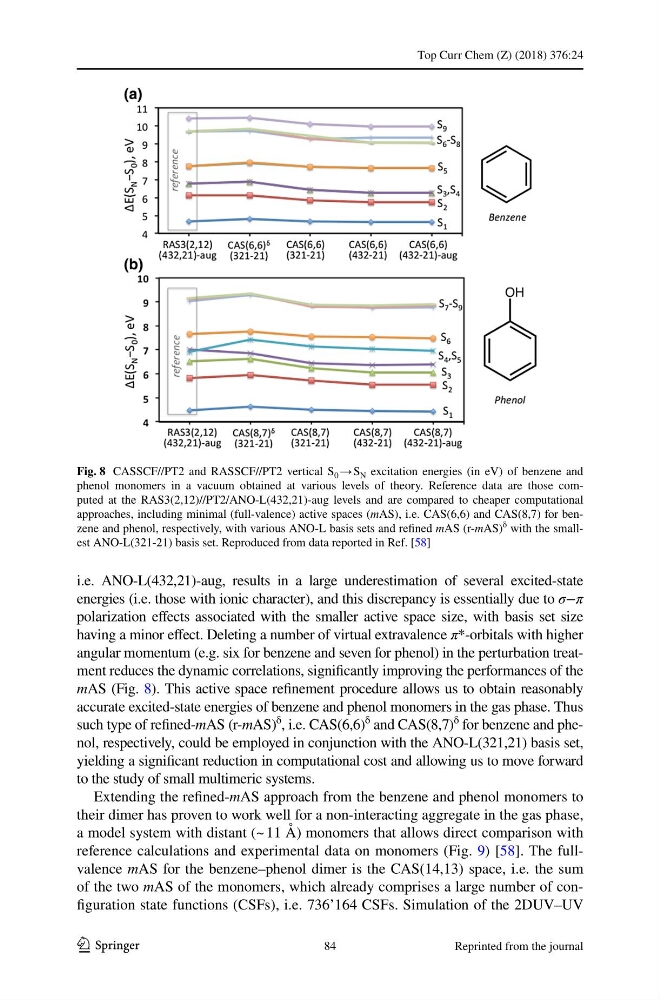
i.e. ANO-L(432,21)-aug, results in a large underestimation of several excited-state
energies (i.e. those with ionic character), and this discrepancy is essentially due to σ−π
polarization effects associated with the smaller active space size, with basis set size
having a minor effect. Deleting a number of virtual extravalence π*-orbitals with higher
angular momentum (e.g. six for benzene and seven for phenol) in the perturbation treatment reduces the dynamic correlations, significantly improving the performances of the
mAS (Fig. 8). This active space refinement procedure allows us to obtain reasonably
accurate excited-state energies of benzene and phenol monomers in the gas phase. Thus
such type of refined-mAS (r-mAS)
δ
, i.e. CAS(6,6)
δ
and CAS(8,7)
δ
for benzene and phenol, respectively, could be employed in conjunction with the ANO-L(321,21) basis set,
yielding a significant reduction in computational cost and allowing us to move forward
to the study of small multimeric systems.
Extending the refined-mAS approach from the benzene and phenol monomers to
their dimer has proven to work well for a non-interacting aggregate in the gas phase,
a model system with distant (~ 11 Å) monomers that allows direct comparison with
reference calculations and experimental data on monomers (Fig. 9) [58]. The fullvalence mAS for the benzene–phenol dimer is the CAS(14,13) space, i.e. the sum
of the two mAS of the monomers, which already comprises a large number of configuration state functions (CSFs), i.e. 736’164 CSFs. Simulation of the 2DUV–UV
Fig. 8 CASSCF//PT2 and RASSCF//PT2 vertical S 0 → S N excitation energies (in eV) of benzene and
phenol monomers in a vacuum obtained at various levels of theory. Reference data are those computed at the RAS3(2,12)//PT2/ANO-L(432,21)-aug levels and are compared to cheaper computational
approaches, including minimal (full-valence) active spaces (mAS), i.e. CAS(6,6) and CAS(8,7) for benzene and phenol, respectively, with various ANO-L basis sets and refined mAS (r-mAS)
δ with the smallest ANO-L(321-21) basis set. Reproduced from data reported in Ref. [58]
84
Reprinted from the journal
1 3
i.e. ANO-L(432,21)-aug, results in a large underestimation of several excited-state
energies (i.e. those with ionic character), and this discrepancy is essentially due to σ−π
polarization effects associated with the smaller active space size, with basis set size
having a minor effect. Deleting a number of virtual extravalence π*-orbitals with higher
angular momentum (e.g. six for benzene and seven for phenol) in the perturbation treatment reduces the dynamic correlations, significantly improving the performances of the
mAS (Fig. 8). This active space refinement procedure allows us to obtain reasonably
accurate excited-state energies of benzene and phenol monomers in the gas phase. Thus
such type of refined-mAS (r-mAS)
δ
, i.e. CAS(6,6)
δ
and CAS(8,7)
δ
for benzene and phenol, respectively, could be employed in conjunction with the ANO-L(321,21) basis set,
yielding a significant reduction in computational cost and allowing us to move forward
to the study of small multimeric systems.
Extending the refined-mAS approach from the benzene and phenol monomers to
their dimer has proven to work well for a non-interacting aggregate in the gas phase,
a model system with distant (~ 11 Å) monomers that allows direct comparison with
reference calculations and experimental data on monomers (Fig. 9) [58]. The fullvalence mAS for the benzene–phenol dimer is the CAS(14,13) space, i.e. the sum
of the two mAS of the monomers, which already comprises a large number of configuration state functions (CSFs), i.e. 736’164 CSFs. Simulation of the 2DUV–UV
Fig. 8 CASSCF//PT2 and RASSCF//PT2 vertical S 0 → S N excitation energies (in eV) of benzene and
phenol monomers in a vacuum obtained at various levels of theory. Reference data are those computed at the RAS3(2,12)//PT2/ANO-L(432,21)-aug levels and are compared to cheaper computational
approaches, including minimal (full-valence) active spaces (mAS), i.e. CAS(6,6) and CAS(8,7) for benzene and phenol, respectively, with various ANO-L basis sets and refined mAS (r-mAS)
δ with the smallest ANO-L(321-21) basis set. Reproduced from data reported in Ref. [58]
84
Reprinted from the journal