

Top Curr Chem (Z) (2018) 376:24
1 3
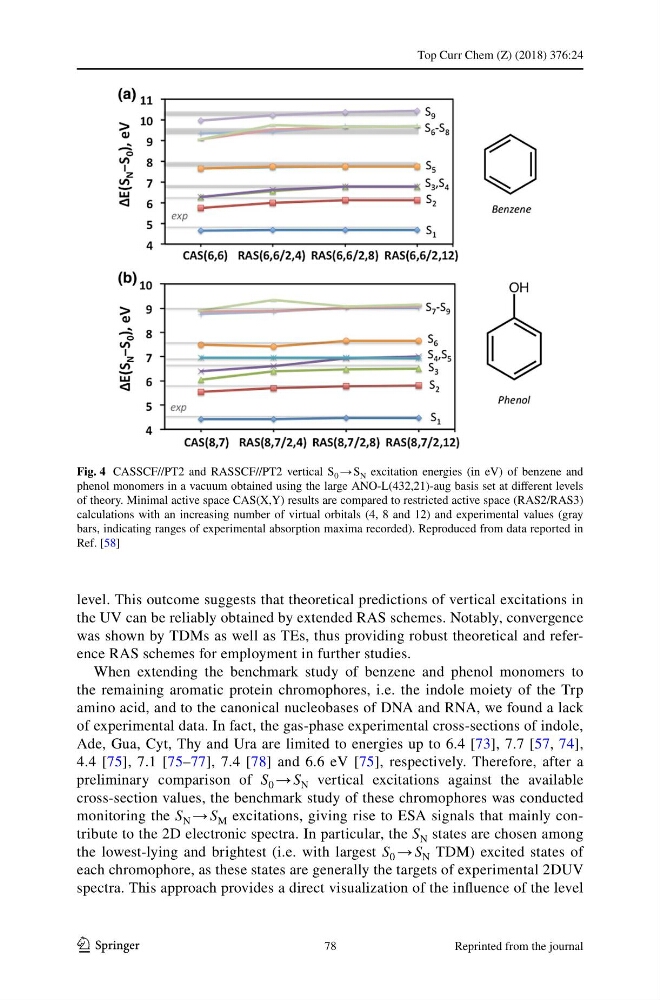
level. This outcome suggests that theoretical predictions of vertical excitations in
the UV can be reliably obtained by extended RAS schemes. Notably, convergence
was shown by TDMs as well as TEs, thus providing robust theoretical and reference RAS schemes for employment in further studies.
When extending the benchmark study of benzene and phenol monomers to
the remaining aromatic protein chromophores, i.e. the indole moiety of the Trp
amino acid, and to the canonical nucleobases of DNA and RNA, we found a lack
of experimental data. In fact, the gas-phase experimental cross-sections of indole,
Ade, Gua, Cyt, Thy and Ura are limited to energies up to 6.4 [73], 7.7 [57, 74],
4.4 [75], 7.1 [75–77], 7.4 [78] and 6.6 eV [75], respectively. Therefore, after a
preliminary comparison of S 0 → S N vertical excitations against the available
cross-section values, the benchmark study of these chromophores was conducted
monitoring the S N → S M excitations, giving rise to ESA signals that mainly contribute to the 2D electronic spectra. In particular, the S N states are chosen among
the lowest-lying and brightest (i.e. with largest S 0 → S N TDM) excited states of
each chromophore, as these states are generally the targets of experimental 2DUV
spectra. This approach provides a direct visualization of the influence of the level
Fig. 4 CASSCF//PT2 and RASSCF//PT2 vertical S 0 → S N excitation energies (in eV) of benzene and
phenol monomers in a vacuum obtained using the large ANO-L(432,21)-aug basis set at different levels
of theory. Minimal active space CAS(X,Y) results are compared to restricted active space (RAS2/RAS3)
calculations with an increasing number of virtual orbitals (4, 8 and 12) and experimental values (gray
bars, indicating ranges of experimental absorption maxima recorded). Reproduced from data reported in
Ref. [58]
78
Reprinted from the journal
1 3
level. This outcome suggests that theoretical predictions of vertical excitations in
the UV can be reliably obtained by extended RAS schemes. Notably, convergence
was shown by TDMs as well as TEs, thus providing robust theoretical and reference RAS schemes for employment in further studies.
When extending the benchmark study of benzene and phenol monomers to
the remaining aromatic protein chromophores, i.e. the indole moiety of the Trp
amino acid, and to the canonical nucleobases of DNA and RNA, we found a lack
of experimental data. In fact, the gas-phase experimental cross-sections of indole,
Ade, Gua, Cyt, Thy and Ura are limited to energies up to 6.4 [73], 7.7 [57, 74],
4.4 [75], 7.1 [75–77], 7.4 [78] and 6.6 eV [75], respectively. Therefore, after a
preliminary comparison of S 0 → S N vertical excitations against the available
cross-section values, the benchmark study of these chromophores was conducted
monitoring the S N → S M excitations, giving rise to ESA signals that mainly contribute to the 2D electronic spectra. In particular, the S N states are chosen among
the lowest-lying and brightest (i.e. with largest S 0 → S N TDM) excited states of
each chromophore, as these states are generally the targets of experimental 2DUV
spectra. This approach provides a direct visualization of the influence of the level
Fig. 4 CASSCF//PT2 and RASSCF//PT2 vertical S 0 → S N excitation energies (in eV) of benzene and
phenol monomers in a vacuum obtained using the large ANO-L(432,21)-aug basis set at different levels
of theory. Minimal active space CAS(X,Y) results are compared to restricted active space (RAS2/RAS3)
calculations with an increasing number of virtual orbitals (4, 8 and 12) and experimental values (gray
bars, indicating ranges of experimental absorption maxima recorded). Reproduced from data reported in
Ref. [58]
78
Reprinted from the journal