

1 3
Top Curr Chem (Z) (2018) 376:24
protocol) in order to generate 2DES spectra for several biological key players in their
native environment. Some applications of the SOS//QM/MM protocol to bio-chromophores are showcased in the Results section, mainly evidencing how a number of bright
excited states in the UV–Vis spectral range often represent the major contribution to
2DES maps and could embody specific spectroscopic fingerprints for tracking groundor excited-state dynamics. Accurate characterization of the excited-state manifold by
advanced electronic structure computations thus represents a pillar supporting the reliable simulation of 2D electronic spectra.
4 Results and Discussion
The basic theoretical background for understanding how to compute nonlinear
electronic spectra has been illustrated in Sect. 2, showing how a complete 2DES
simulation technique would need to combine high-precision electronic structure
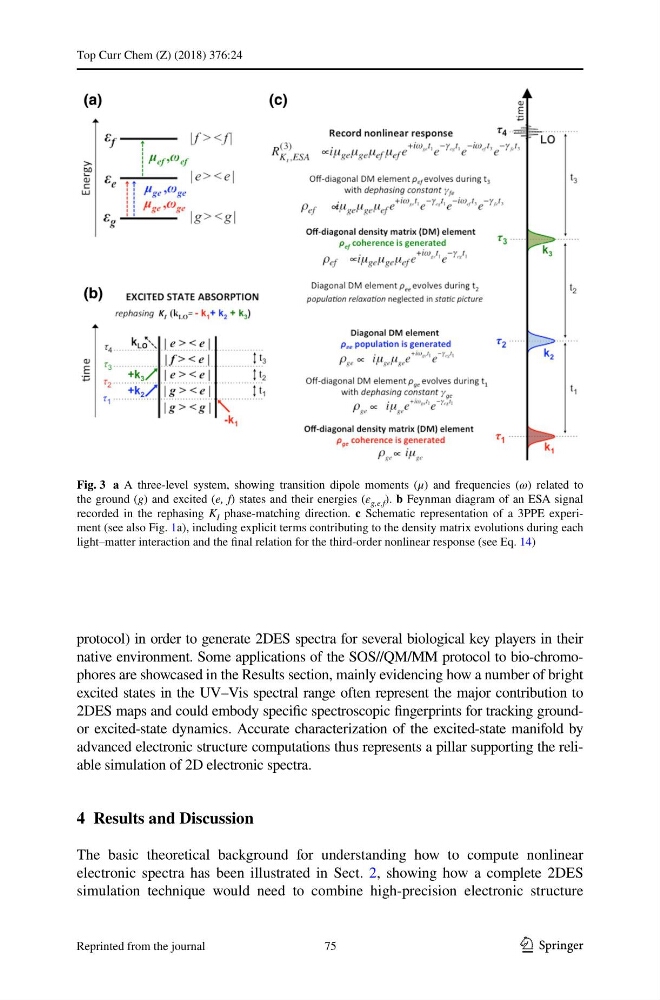
Fig. 3 a A three-level system, showing transition dipole moments (μ) and frequencies (ω) related to
the ground (g) and excited (e, f) states and their energies (ε g,e,f ). b Feynman diagram of an ESA signal
recorded in the rephasing K I phase-matching direction. c Schematic representation of a 3PPE experiment (see also Fig. 1a), including explicit terms contributing to the density matrix evolutions during each
light–matter interaction and the final relation for the third-order nonlinear response (see Eq. 14)
75
Reprinted from the journal
Top Curr Chem (Z) (2018) 376:24
protocol) in order to generate 2DES spectra for several biological key players in their
native environment. Some applications of the SOS//QM/MM protocol to bio-chromophores are showcased in the Results section, mainly evidencing how a number of bright
excited states in the UV–Vis spectral range often represent the major contribution to
2DES maps and could embody specific spectroscopic fingerprints for tracking groundor excited-state dynamics. Accurate characterization of the excited-state manifold by
advanced electronic structure computations thus represents a pillar supporting the reliable simulation of 2D electronic spectra.
4 Results and Discussion
The basic theoretical background for understanding how to compute nonlinear
electronic spectra has been illustrated in Sect. 2, showing how a complete 2DES
simulation technique would need to combine high-precision electronic structure
Fig. 3 a A three-level system, showing transition dipole moments (μ) and frequencies (ω) related to
the ground (g) and excited (e, f) states and their energies (ε g,e,f ). b Feynman diagram of an ESA signal
recorded in the rephasing K I phase-matching direction. c Schematic representation of a 3PPE experiment (see also Fig. 1a), including explicit terms contributing to the density matrix evolutions during each
light–matter interaction and the final relation for the third-order nonlinear response (see Eq. 14)
75
Reprinted from the journal