

Top Curr Chem (Z) (2018) 376:10
1 3
their size and iii) enhancement of the Coulomb interaction [81]. Their properties can
be easily tuned by advanced synthetic methods. Therefore, they have been applied to
a variety of fields: optics, photovoltaics, sensing, and electronics [82]. For instance,
in photovoltaic and photocatalytic applications, the electron and hole dynamics
contribute separately to the photon-to-electron conversion efficiency. It is crucial to
understand and disentangle the dynamics of those species in order to improve the
final materials.
Femtosecond transient absorption spectroscopy is a powerful technique to follow
the electron/hole dynamics in real time, but it is very difficult to disentangle them.
Indeed, the states are very close in energy and a broadband excitation (femtoseconds
pulses) leads to an overlap of their transient signals, while narrowband pulses allow
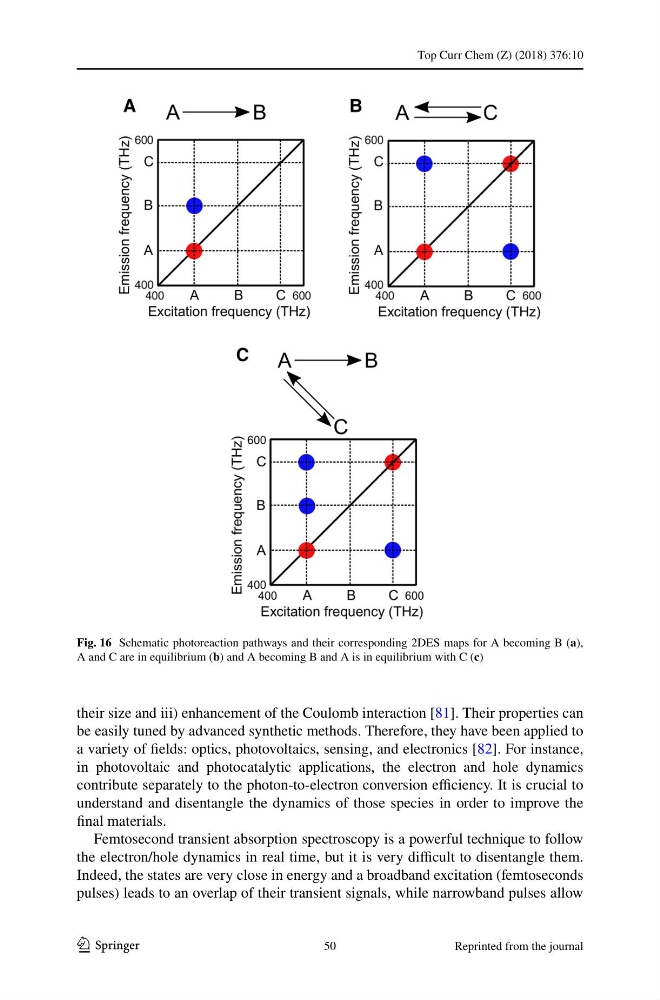
Fig. 16 Schematic photoreaction pathways and their corresponding 2DES maps for A becoming B (a),
A and C are in equilibrium (b) and A becoming B and A is in equilibrium with C (c)
50
Reprinted from the journal
1 3
their size and iii) enhancement of the Coulomb interaction [81]. Their properties can
be easily tuned by advanced synthetic methods. Therefore, they have been applied to
a variety of fields: optics, photovoltaics, sensing, and electronics [82]. For instance,
in photovoltaic and photocatalytic applications, the electron and hole dynamics
contribute separately to the photon-to-electron conversion efficiency. It is crucial to
understand and disentangle the dynamics of those species in order to improve the
final materials.
Femtosecond transient absorption spectroscopy is a powerful technique to follow
the electron/hole dynamics in real time, but it is very difficult to disentangle them.
Indeed, the states are very close in energy and a broadband excitation (femtoseconds
pulses) leads to an overlap of their transient signals, while narrowband pulses allow
Fig. 16 Schematic photoreaction pathways and their corresponding 2DES maps for A becoming B (a),
A and C are in equilibrium (b) and A becoming B and A is in equilibrium with C (c)
50
Reprinted from the journal