

Top Curr Chem (Z) (2018) 376:10
1 3
i.e., a single ground state conformation, which undergoes an excited-state photoisomerization process—either branching on the excited state or relaxing through
multiple sequential intermediates [54, 55]. Numerous time-resolved 1D studies
support one of each model but none were able to clearly distinguish which one is
correct.
2DES is an ideal probe of heterogeneous line broadening and was able to clearly
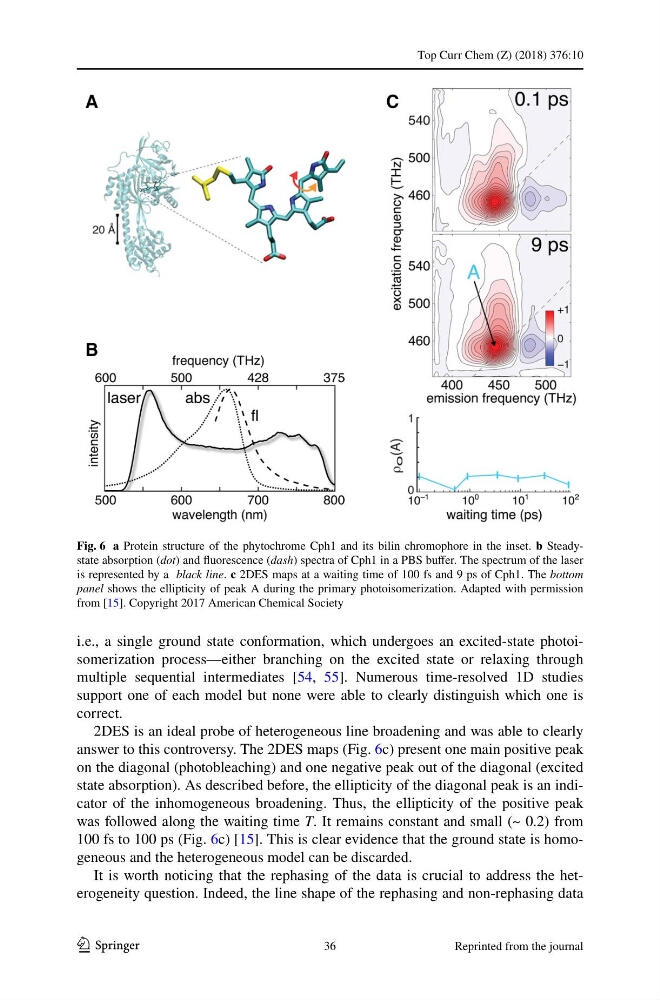
answer to this controversy. The 2DES maps (Fig. 6c) present one main positive peak
on the diagonal (photobleaching) and one negative peak out of the diagonal (excited
state absorption). As described before, the ellipticity of the diagonal peak is an indicator of the inhomogeneous broadening. Thus, the ellipticity of the positive peak
was followed along the waiting time T. It remains constant and small (~ 0.2) from
100 fs to 100 ps (Fig. 6c) [15]. This is clear evidence that the ground state is homogeneous and the heterogeneous model can be discarded.
It is worth noticing that the rephasing of the data is crucial to address the heterogeneity question. Indeed, the line shape of the rephasing and non-rephasing data
Fig. 6 a Protein structure of the phytochrome Cph1 and its bilin chromophore in the inset. b Steadystate absorption (dot) and fluorescence (dash) spectra of Cph1 in a PBS buffer. The spectrum of the laser
is represented by a black line. c 2DES maps at a waiting time of 100 fs and 9 ps of Cph1. The bottom
panel shows the ellipticity of peak A during the primary photoisomerization. Adapted with permission
from [15]. Copyright 2017 American Chemical Society
36
Reprinted from the journal
1 3
i.e., a single ground state conformation, which undergoes an excited-state photoisomerization process—either branching on the excited state or relaxing through
multiple sequential intermediates [54, 55]. Numerous time-resolved 1D studies
support one of each model but none were able to clearly distinguish which one is
correct.
2DES is an ideal probe of heterogeneous line broadening and was able to clearly
answer to this controversy. The 2DES maps (Fig. 6c) present one main positive peak
on the diagonal (photobleaching) and one negative peak out of the diagonal (excited
state absorption). As described before, the ellipticity of the diagonal peak is an indicator of the inhomogeneous broadening. Thus, the ellipticity of the positive peak
was followed along the waiting time T. It remains constant and small (~ 0.2) from
100 fs to 100 ps (Fig. 6c) [15]. This is clear evidence that the ground state is homogeneous and the heterogeneous model can be discarded.
It is worth noticing that the rephasing of the data is crucial to address the heterogeneity question. Indeed, the line shape of the rephasing and non-rephasing data
Fig. 6 a Protein structure of the phytochrome Cph1 and its bilin chromophore in the inset. b Steadystate absorption (dot) and fluorescence (dash) spectra of Cph1 in a PBS buffer. The spectrum of the laser
is represented by a black line. c 2DES maps at a waiting time of 100 fs and 9 ps of Cph1. The bottom
panel shows the ellipticity of peak A during the primary photoisomerization. Adapted with permission
from [15]. Copyright 2017 American Chemical Society
36
Reprinted from the journal