

Top Curr Chem (Z) (2018) 376:6
1 3
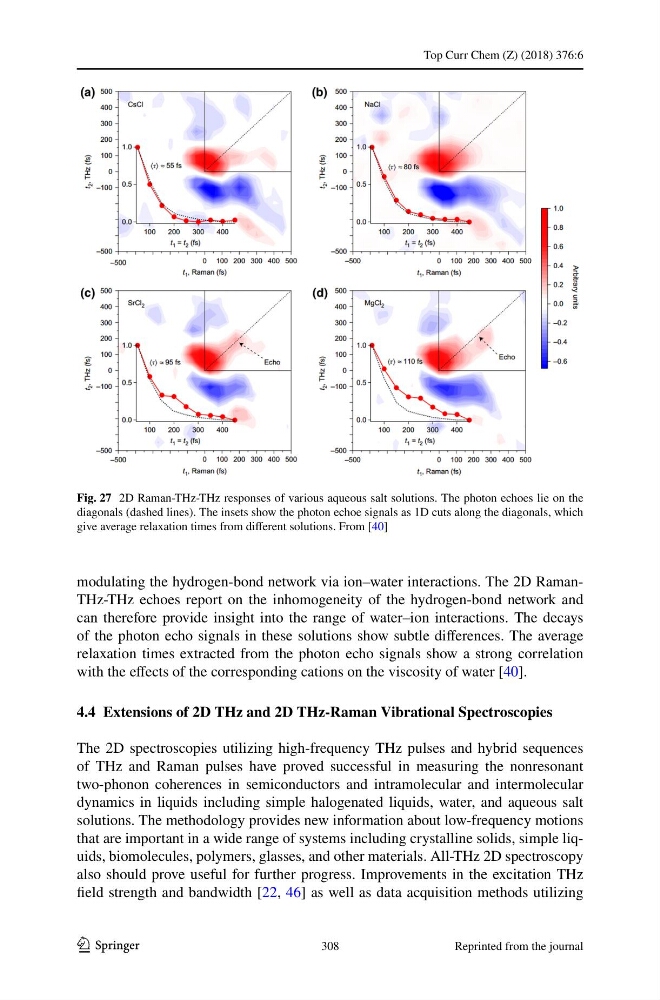
modulating the hydrogen-bond network via ion–water interactions. The 2D RamanTHz-THz echoes report on the inhomogeneity of the hydrogen-bond network and
can therefore provide insight into the range of water–ion interactions. The decays
of the photon echo signals in these solutions show subtle differences. The average
relaxation times extracted from the photon echo signals show a strong correlation
with the effects of the corresponding cations on the viscosity of water [40].
4.4 Extensions of 2D THz and 2D THz‑Raman Vibrational Spectroscopies
The 2D spectroscopies utilizing high-frequency THz pulses and hybrid sequences
of THz and Raman pulses have proved successful in measuring the nonresonant
two-phonon coherences in semiconductors and intramolecular and intermolecular
dynamics in liquids including simple halogenated liquids, water, and aqueous salt
solutions. The methodology provides new information about low-frequency motions
that are important in a wide range of systems including crystalline solids, simple liquids, biomolecules, polymers, glasses, and other materials. All-THz 2D spectroscopy
also should prove useful for further progress. Improvements in the excitation THz
field strength and bandwidth [22, 46] as well as data acquisition methods utilizing
Fig. 27 2D Raman-THz-THz responses of various aqueous salt solutions. The photon echoes lie on the
diagonals (dashed lines). The insets show the photon echoe signals as 1D cuts along the diagonals, which
give average relaxation times from different solutions. From [40]
308
Reprinted from the journal
1 3
modulating the hydrogen-bond network via ion–water interactions. The 2D RamanTHz-THz echoes report on the inhomogeneity of the hydrogen-bond network and
can therefore provide insight into the range of water–ion interactions. The decays
of the photon echo signals in these solutions show subtle differences. The average
relaxation times extracted from the photon echo signals show a strong correlation
with the effects of the corresponding cations on the viscosity of water [40].
4.4 Extensions of 2D THz and 2D THz‑Raman Vibrational Spectroscopies
The 2D spectroscopies utilizing high-frequency THz pulses and hybrid sequences
of THz and Raman pulses have proved successful in measuring the nonresonant
two-phonon coherences in semiconductors and intramolecular and intermolecular
dynamics in liquids including simple halogenated liquids, water, and aqueous salt
solutions. The methodology provides new information about low-frequency motions
that are important in a wide range of systems including crystalline solids, simple liquids, biomolecules, polymers, glasses, and other materials. All-THz 2D spectroscopy
also should prove useful for further progress. Improvements in the excitation THz
field strength and bandwidth [22, 46] as well as data acquisition methods utilizing
Fig. 27 2D Raman-THz-THz responses of various aqueous salt solutions. The photon echoes lie on the
diagonals (dashed lines). The insets show the photon echoe signals as 1D cuts along the diagonals, which
give average relaxation times from different solutions. From [40]
308
Reprinted from the journal