

1 3
Top Curr Chem (Z) (2018) 376:6
to create 2QCs |J〉〈J + 2| and three field interactions with pulse B. The first two
interactions with pulse B create a population |J + 2〉〈J + 2| and the third induces
a rephased 1QC |J + 3〉〈J + 2| or |J + 2〉〈J + 1|, which radiates the nonlinear signals during t. The 2Q-R signals give rise to peaks along f = 2ν in the R quadrant
shown in Fig. 16b. For the fifth-order NR and R signals shown in Fig. 16c, d, THz
pulse A induces 1QCs |J〉〈J + 1| evolving during τ, and pulse B promotes them via
four field-dipole interactions to fifth-order 1QCs with final rotational level, J f , two
quanta away from the initial level J i (namely, |J f − J i | = 2) at |J + 3〉〈J + 2| (R)
or |J + 2〉〈J + 3| (NR). The fifth-order 1QCs then radiate signals correlated to the
1QCs induced during τ.
Example pathways of the THz field-dipole interactions described here are further
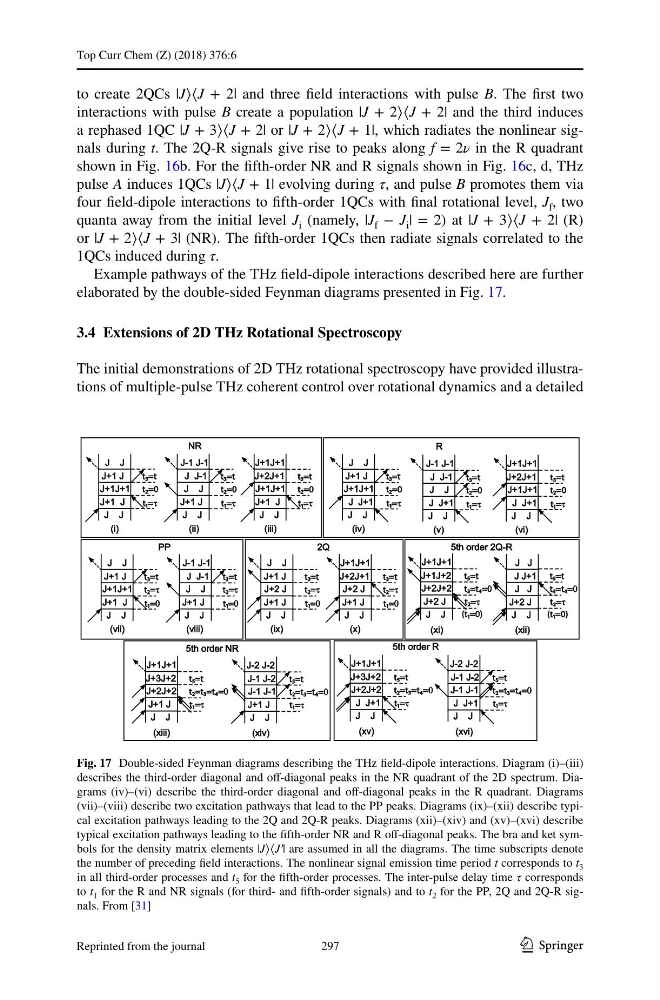
elaborated by the double-sided Feynman diagrams presented in Fig. 17.
3.4 Extensions of 2D THz Rotational Spectroscopy
The initial demonstrations of 2D THz rotational spectroscopy have provided illustrations of multiple-pulse THz coherent control over rotational dynamics and a detailed
Fig. 17 Double-sided Feynman diagrams describing the THz field-dipole interactions. Diagram (i)–(iii)
describes the third-order diagonal and off-diagonal peaks in the NR quadrant of the 2D spectrum. Diagrams (iv)–(vi) describe the third-order diagonal and off-diagonal peaks in the R quadrant. Diagrams
(vii)–(viii) describe two excitation pathways that lead to the PP peaks. Diagrams (ix)–(xii) describe typical excitation pathways leading to the 2Q and 2Q-R peaks. Diagrams (xii)–(xiv) and (xv)–(xvi) describe
typical excitation pathways leading to the fifth-order NR and R off-diagonal peaks. The bra and ket symbols for the density matrix elements |J〉〈J′| are assumed in all the diagrams. The time subscripts denote
the number of preceding field interactions. The nonlinear signal emission time period t corresponds to t 3
in all third-order processes and t 5 for the fifth-order processes. The inter-pulse delay time τ corresponds
to t 1 for the R and NR signals (for third- and fifth-order signals) and to t 2 for the PP, 2Q and 2Q-R signals. From [31]
297
Reprinted from the journal
Top Curr Chem (Z) (2018) 376:6
to create 2QCs |J〉〈J + 2| and three field interactions with pulse B. The first two
interactions with pulse B create a population |J + 2〉〈J + 2| and the third induces
a rephased 1QC |J + 3〉〈J + 2| or |J + 2〉〈J + 1|, which radiates the nonlinear signals during t. The 2Q-R signals give rise to peaks along f = 2ν in the R quadrant
shown in Fig. 16b. For the fifth-order NR and R signals shown in Fig. 16c, d, THz
pulse A induces 1QCs |J〉〈J + 1| evolving during τ, and pulse B promotes them via
four field-dipole interactions to fifth-order 1QCs with final rotational level, J f , two
quanta away from the initial level J i (namely, |J f − J i | = 2) at |J + 3〉〈J + 2| (R)
or |J + 2〉〈J + 3| (NR). The fifth-order 1QCs then radiate signals correlated to the
1QCs induced during τ.
Example pathways of the THz field-dipole interactions described here are further
elaborated by the double-sided Feynman diagrams presented in Fig. 17.
3.4 Extensions of 2D THz Rotational Spectroscopy
The initial demonstrations of 2D THz rotational spectroscopy have provided illustrations of multiple-pulse THz coherent control over rotational dynamics and a detailed
Fig. 17 Double-sided Feynman diagrams describing the THz field-dipole interactions. Diagram (i)–(iii)
describes the third-order diagonal and off-diagonal peaks in the NR quadrant of the 2D spectrum. Diagrams (iv)–(vi) describe the third-order diagonal and off-diagonal peaks in the R quadrant. Diagrams
(vii)–(viii) describe two excitation pathways that lead to the PP peaks. Diagrams (ix)–(xii) describe typical excitation pathways leading to the 2Q and 2Q-R peaks. Diagrams (xii)–(xiv) and (xv)–(xvi) describe
typical excitation pathways leading to the fifth-order NR and R off-diagonal peaks. The bra and ket symbols for the density matrix elements |J〉〈J′| are assumed in all the diagrams. The time subscripts denote
the number of preceding field interactions. The nonlinear signal emission time period t corresponds to t 3
in all third-order processes and t 5 for the fifth-order processes. The inter-pulse delay time τ corresponds
to t 1 for the R and NR signals (for third- and fifth-order signals) and to t 2 for the PP, 2Q and 2Q-R signals. From [31]
297
Reprinted from the journal