

Appendix B: Two-Dimensional Resonance Raman Signal Components
The Feynman diagrams presented in Fig. 3 include dummy indices for vibrational
levels (m, n, j, k, l, u, v, w) associated with the ground and excited electronic states
(r and r* for triiodide, p and p* for diiodide). Transition dipoles are written as
product of integrals over electronic and nuclear degrees of freedom based on the
Condon approximation. For example, an interaction that couples vibrational level m
in the ground electronic state of the reactant and vibrational level n in the excited
electronic state of the reactant contributes the product, l r*r n j m
h
i, to the response
function, where l r*r is the electronic transition dipole and n j m
h
i is a vibrational
overlap integral. We use a notation in which the excited state vibrational energy
level is always written in the bra [48].
The first polarization component is given in Eq. (3). The remaining 11
polarization components are given by
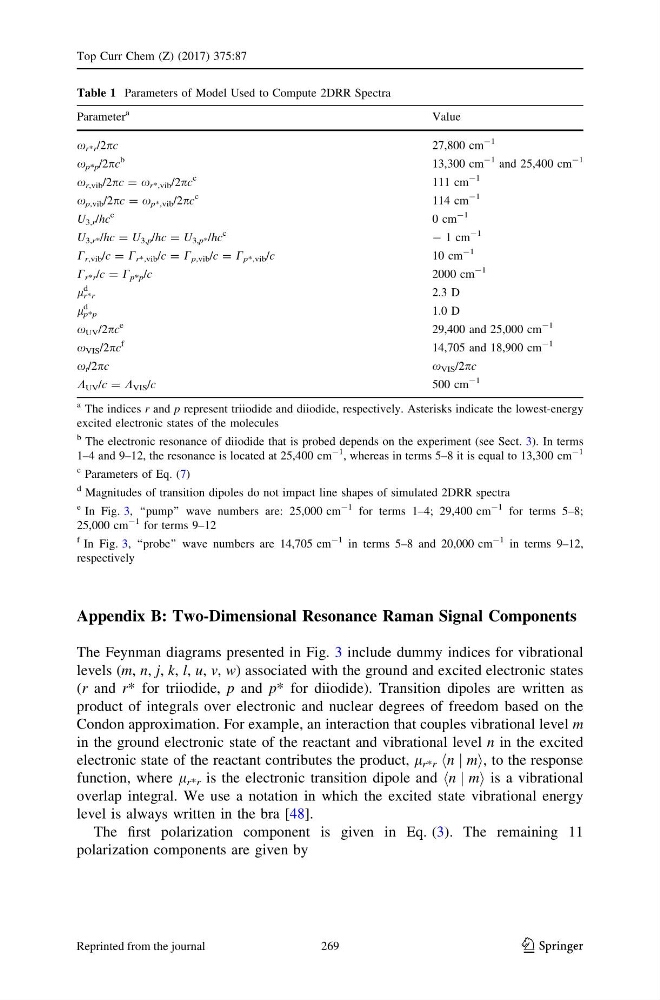
Table 1 Parameters of Model Used to Compute 2DRR Spectra
Parameter
a
Value
x r*r /2pc
27,800 cm
-1
x p*p /2pc
b
13,300 cm
-1 and 25,400 cm
-1
x r,vib /2pc = x r*,vib /2pc
c
111 cm
-1
x p,vib /2pc = x p*,vib /2pc
c
114 cm
-1
U 3,r /hc
c
0 cm
-1
U 3,r* /hc = U 3,p /hc = U 3,p* /hc
c
- 1 cm
-1
C r,vib /c = C r*,vib /c = C p,vib /c = C p*,vib /c
10 cm
-1
C r*r /c = C p*p /c
2000 cm
-1
l r*r
d
2.3 D
l p*p
d
1.0 D
x UV /2pc
e
29,400 and 25,000 cm
-1
x VIS /2pc
f
14,705 and 18,900 cm
-1
x t /2pc
x VIS /2pc
K UV /c = K VIS /c
500 cm
-1
a The indices r and p represent triiodide and diiodide, respectively. Asterisks indicate the lowest-energy
excited electronic states of the molecules
b The electronic resonance of diiodide that is probed depends on the experiment (see Sect. 3). In terms
1–4 and 9–12, the resonance is located at 25,400 cm
-1 , whereas in terms 5–8 it is equal to 13,300 cm
-1
c Parameters of Eq. (7)
d Magnitudes of transition dipoles do not impact line shapes of simulated 2DRR spectra
e In Fig. 3, ‘‘pump’’ wave numbers are: 25,000 cm
-1 for terms 1–4; 29,400 cm
-1 for terms 5–8;
25,000 cm
-1 for terms 9–12
f In Fig. 3, ‘‘probe’’ wave numbers are 14,705 cm
-1 in terms 5–8 and 20,000 cm
-1 in terms 9–12,
respectively
Top Curr Chem (Z) (2017) 375:87
123
269
Reprinted from the journal
The Feynman diagrams presented in Fig. 3 include dummy indices for vibrational
levels (m, n, j, k, l, u, v, w) associated with the ground and excited electronic states
(r and r* for triiodide, p and p* for diiodide). Transition dipoles are written as
product of integrals over electronic and nuclear degrees of freedom based on the
Condon approximation. For example, an interaction that couples vibrational level m
in the ground electronic state of the reactant and vibrational level n in the excited
electronic state of the reactant contributes the product, l r*r n j m
h
i, to the response
function, where l r*r is the electronic transition dipole and n j m
h
i is a vibrational
overlap integral. We use a notation in which the excited state vibrational energy
level is always written in the bra [48].
The first polarization component is given in Eq. (3). The remaining 11
polarization components are given by
Table 1 Parameters of Model Used to Compute 2DRR Spectra
Parameter
a
Value
x r*r /2pc
27,800 cm
-1
x p*p /2pc
b
13,300 cm
-1 and 25,400 cm
-1
x r,vib /2pc = x r*,vib /2pc
c
111 cm
-1
x p,vib /2pc = x p*,vib /2pc
c
114 cm
-1
U 3,r /hc
c
0 cm
-1
U 3,r* /hc = U 3,p /hc = U 3,p* /hc
c
- 1 cm
-1
C r,vib /c = C r*,vib /c = C p,vib /c = C p*,vib /c
10 cm
-1
C r*r /c = C p*p /c
2000 cm
-1
l r*r
d
2.3 D
l p*p
d
1.0 D
x UV /2pc
e
29,400 and 25,000 cm
-1
x VIS /2pc
f
14,705 and 18,900 cm
-1
x t /2pc
x VIS /2pc
K UV /c = K VIS /c
500 cm
-1
a The indices r and p represent triiodide and diiodide, respectively. Asterisks indicate the lowest-energy
excited electronic states of the molecules
b The electronic resonance of diiodide that is probed depends on the experiment (see Sect. 3). In terms
1–4 and 9–12, the resonance is located at 25,400 cm
-1 , whereas in terms 5–8 it is equal to 13,300 cm
-1
c Parameters of Eq. (7)
d Magnitudes of transition dipoles do not impact line shapes of simulated 2DRR spectra
e In Fig. 3, ‘‘pump’’ wave numbers are: 25,000 cm
-1 for terms 1–4; 29,400 cm
-1 for terms 5–8;
25,000 cm
-1 for terms 9–12
f In Fig. 3, ‘‘probe’’ wave numbers are 14,705 cm
-1 in terms 5–8 and 20,000 cm
-1 in terms 9–12,
respectively
Top Curr Chem (Z) (2017) 375:87
123
269
Reprinted from the journal