

Appendix A: Vibrational Hamiltonians
The present model assumes that both triiodide and diiodide possess two electronic
levels and one nuclear coordinate with displaced ground and excited state potential
energy minima. The anharmonic vibrational wave functions for the Franck–Condon
active bond stretching mode of diiodide and the symmetric stretching coordinate of
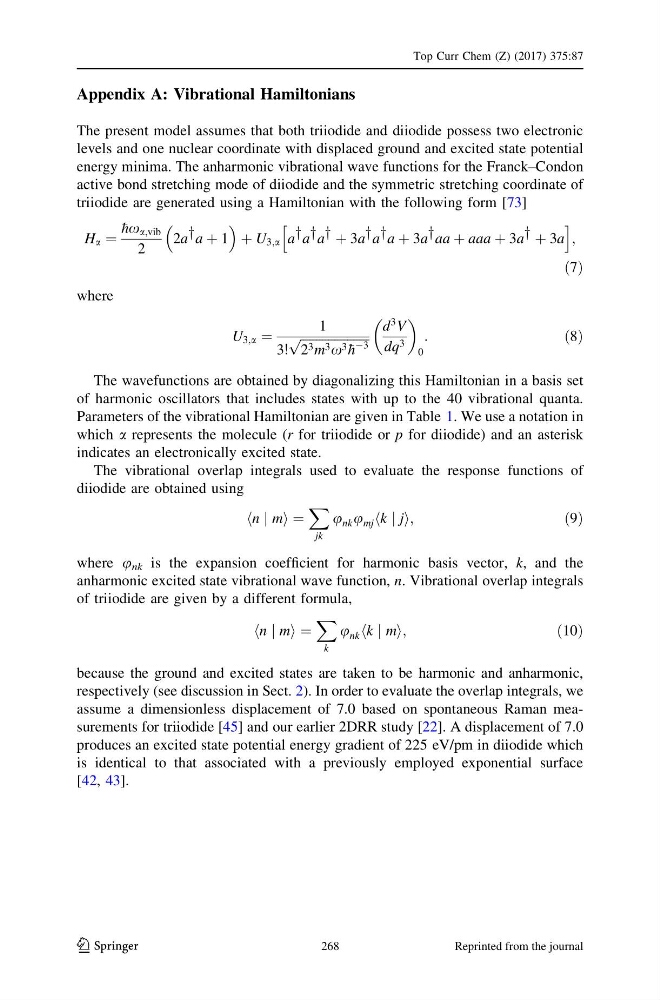
triiodide are generated using a Hamiltonian with the following form [73]
H a ¼
hx a;vib
2
2a y a þ 1
þ U 3;a a y a y a y þ 3a y a y a þ 3a y aa þ aaa þ 3a y þ 3a
h
i
;
ð7Þ
where
U 3;a ¼
1
3!
ffiffiffiffiffiffiffiffiffiffiffiffiffiffiffiffiffiffiffiffiffiffi
2 3 m 3 x 3 h
À3
p
d
3 V
dq 3
0
:
ð8Þ
The wavefunctions are obtained by diagonalizing this Hamiltonian in a basis set
of harmonic oscillators that includes states with up to the 40 vibrational quanta.
Parameters of the vibrational Hamiltonian are given in Table 1. We use a notation in
which a represents the molecule (r for triiodide or p for diiodide) and an asterisk
indicates an electronically excited state.
The vibrational overlap integrals used to evaluate the response functions of
diiodide are obtained using
n j m
h
i¼
X
jk
u nk u mj k j j
h
i;
ð9Þ
where u nk is the expansion coefficient for harmonic basis vector, k, and the
anharmonic excited state vibrational wave function, n. Vibrational overlap integrals
of triiodide are given by a different formula,
n j m
h
i¼
X
k
u nk k j m
h
i;
ð10Þ
because the ground and excited states are taken to be harmonic and anharmonic,
respectively (see discussion in Sect. 2). In order to evaluate the overlap integrals, we
assume a dimensionless displacement of 7.0 based on spontaneous Raman measurements for triiodide [45] and our earlier 2DRR study [22]. A displacement of 7.0
produces an excited state potential energy gradient of 225 eV/pm in diiodide which
is identical to that associated with a previously employed exponential surface
[42, 43].
Top Curr Chem (Z) (2017) 375:87
123
268
Reprinted from the journal
The present model assumes that both triiodide and diiodide possess two electronic
levels and one nuclear coordinate with displaced ground and excited state potential
energy minima. The anharmonic vibrational wave functions for the Franck–Condon
active bond stretching mode of diiodide and the symmetric stretching coordinate of
triiodide are generated using a Hamiltonian with the following form [73]
H a ¼
hx a;vib
2
2a y a þ 1
þ U 3;a a y a y a y þ 3a y a y a þ 3a y aa þ aaa þ 3a y þ 3a
h
i
;
ð7Þ
where
U 3;a ¼
1
3!
ffiffiffiffiffiffiffiffiffiffiffiffiffiffiffiffiffiffiffiffiffiffi
2 3 m 3 x 3 h
À3
p
d
3 V
dq 3
0
:
ð8Þ
The wavefunctions are obtained by diagonalizing this Hamiltonian in a basis set
of harmonic oscillators that includes states with up to the 40 vibrational quanta.
Parameters of the vibrational Hamiltonian are given in Table 1. We use a notation in
which a represents the molecule (r for triiodide or p for diiodide) and an asterisk
indicates an electronically excited state.
The vibrational overlap integrals used to evaluate the response functions of
diiodide are obtained using
n j m
h
i¼
X
jk
u nk u mj k j j
h
i;
ð9Þ
where u nk is the expansion coefficient for harmonic basis vector, k, and the
anharmonic excited state vibrational wave function, n. Vibrational overlap integrals
of triiodide are given by a different formula,
n j m
h
i¼
X
k
u nk k j m
h
i;
ð10Þ
because the ground and excited states are taken to be harmonic and anharmonic,
respectively (see discussion in Sect. 2). In order to evaluate the overlap integrals, we
assume a dimensionless displacement of 7.0 based on spontaneous Raman measurements for triiodide [45] and our earlier 2DRR study [22]. A displacement of 7.0
produces an excited state potential energy gradient of 225 eV/pm in diiodide which
is identical to that associated with a previously employed exponential surface
[42, 43].
Top Curr Chem (Z) (2017) 375:87
123
268
Reprinted from the journal