

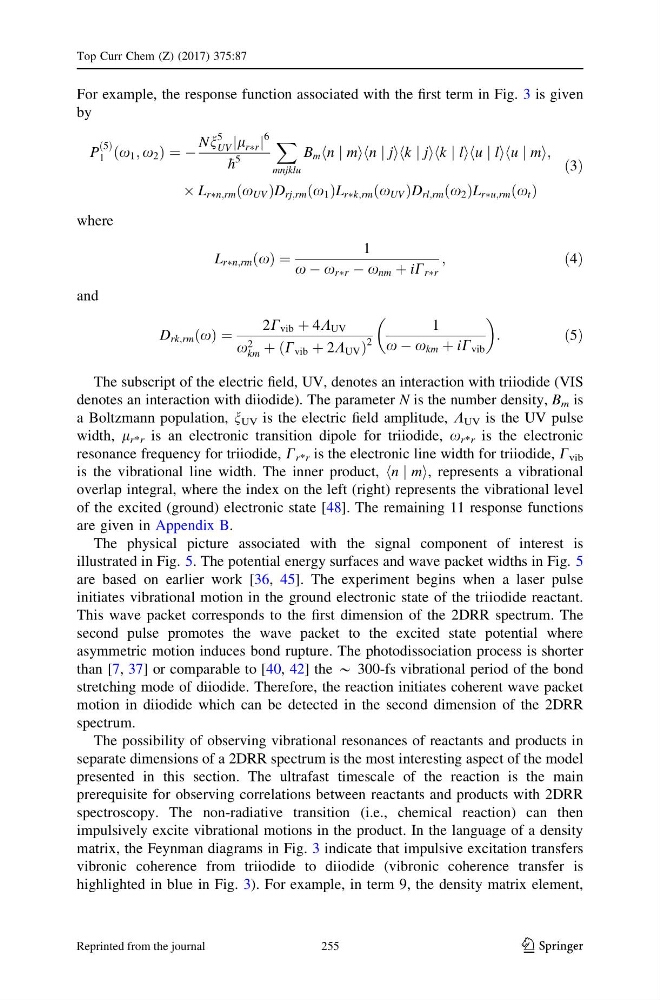
For example, the response function associated with the first term in Fig. 3 is given
by
P
5
ð Þ
1 ðx 1 ; x 2 Þ ¼ À
Nn
5
UV l rÃr
j
j
6
h
5
X
mnjklu
B m n j m
h
i n j j
h
i k j j
h
i k j l
h
i u j l
h
i u j m
h
i;
 L rÃn;rm x UV
ð
ÞD rj;rm x 1
ð ÞL rÃk;rm x UV
ð
ÞD rl;rm x 2
ð ÞL rÃu;rm x t
ð Þ
ð3Þ
where
L rÃn;rm x
ð Þ ¼
1
x À x rÃr À x nm þ iC rÃr
;
ð4Þ
and
D rk;rm x
ð Þ ¼
2C vib þ 4K UV
x 2
km þ C vib þ 2K UV
ð
Þ
2
1
x À x km þ iC vib
:
ð5Þ
The subscript of the electric field, UV, denotes an interaction with triiodide (VIS
denotes an interaction with diiodide). The parameter N is the number density, B m is
a Boltzmann population, n UV is the electric field amplitude, K UV is the UV pulse
width, l r*r is an electronic transition dipole for triiodide, x r*r is the electronic
resonance frequency for triiodide, C r*r is the electronic line width for triiodide, C vib
is the vibrational line width. The inner product, n j m
h
i, represents a vibrational
overlap integral, where the index on the left (right) represents the vibrational level
of the excited (ground) electronic state [48]. The remaining 11 response functions
are given in Appendix B.
The physical picture associated with the signal component of interest is
illustrated in Fig. 5. The potential energy surfaces and wave packet widths in Fig. 5
are based on earlier work [36, 45]. The experiment begins when a laser pulse
initiates vibrational motion in the ground electronic state of the triiodide reactant.
This wave packet corresponds to the first dimension of the 2DRR spectrum. The
second pulse promotes the wave packet to the excited state potential where
asymmetric motion induces bond rupture. The photodissociation process is shorter
than [7, 37] or comparable to [40, 42] the * 300-fs vibrational period of the bond
stretching mode of diiodide. Therefore, the reaction initiates coherent wave packet
motion in diiodide which can be detected in the second dimension of the 2DRR
spectrum.
The possibility of observing vibrational resonances of reactants and products in
separate dimensions of a 2DRR spectrum is the most interesting aspect of the model
presented in this section. The ultrafast timescale of the reaction is the main
prerequisite for observing correlations between reactants and products with 2DRR
spectroscopy. The non-radiative transition (i.e., chemical reaction) can then
impulsively excite vibrational motions in the product. In the language of a density
matrix, the Feynman diagrams in Fig. 3 indicate that impulsive excitation transfers
vibronic coherence from triiodide to diiodide (vibronic coherence transfer is
highlighted in blue in Fig. 3). For example, in term 9, the density matrix element,
Top Curr Chem (Z) (2017) 375:87
123
255
Reprinted from the journal
by
P
5
ð Þ
1 ðx 1 ; x 2 Þ ¼ À
Nn
5
UV l rÃr
j
j
6
h
5
X
mnjklu
B m n j m
h
i n j j
h
i k j j
h
i k j l
h
i u j l
h
i u j m
h
i;
 L rÃn;rm x UV
ð
ÞD rj;rm x 1
ð ÞL rÃk;rm x UV
ð
ÞD rl;rm x 2
ð ÞL rÃu;rm x t
ð Þ
ð3Þ
where
L rÃn;rm x
ð Þ ¼
1
x À x rÃr À x nm þ iC rÃr
;
ð4Þ
and
D rk;rm x
ð Þ ¼
2C vib þ 4K UV
x 2
km þ C vib þ 2K UV
ð
Þ
2
1
x À x km þ iC vib
:
ð5Þ
The subscript of the electric field, UV, denotes an interaction with triiodide (VIS
denotes an interaction with diiodide). The parameter N is the number density, B m is
a Boltzmann population, n UV is the electric field amplitude, K UV is the UV pulse
width, l r*r is an electronic transition dipole for triiodide, x r*r is the electronic
resonance frequency for triiodide, C r*r is the electronic line width for triiodide, C vib
is the vibrational line width. The inner product, n j m
h
i, represents a vibrational
overlap integral, where the index on the left (right) represents the vibrational level
of the excited (ground) electronic state [48]. The remaining 11 response functions
are given in Appendix B.
The physical picture associated with the signal component of interest is
illustrated in Fig. 5. The potential energy surfaces and wave packet widths in Fig. 5
are based on earlier work [36, 45]. The experiment begins when a laser pulse
initiates vibrational motion in the ground electronic state of the triiodide reactant.
This wave packet corresponds to the first dimension of the 2DRR spectrum. The
second pulse promotes the wave packet to the excited state potential where
asymmetric motion induces bond rupture. The photodissociation process is shorter
than [7, 37] or comparable to [40, 42] the * 300-fs vibrational period of the bond
stretching mode of diiodide. Therefore, the reaction initiates coherent wave packet
motion in diiodide which can be detected in the second dimension of the 2DRR
spectrum.
The possibility of observing vibrational resonances of reactants and products in
separate dimensions of a 2DRR spectrum is the most interesting aspect of the model
presented in this section. The ultrafast timescale of the reaction is the main
prerequisite for observing correlations between reactants and products with 2DRR
spectroscopy. The non-radiative transition (i.e., chemical reaction) can then
impulsively excite vibrational motions in the product. In the language of a density
matrix, the Feynman diagrams in Fig. 3 indicate that impulsive excitation transfers
vibronic coherence from triiodide to diiodide (vibronic coherence transfer is
highlighted in blue in Fig. 3). For example, in term 9, the density matrix element,
Top Curr Chem (Z) (2017) 375:87
123
255
Reprinted from the journal