

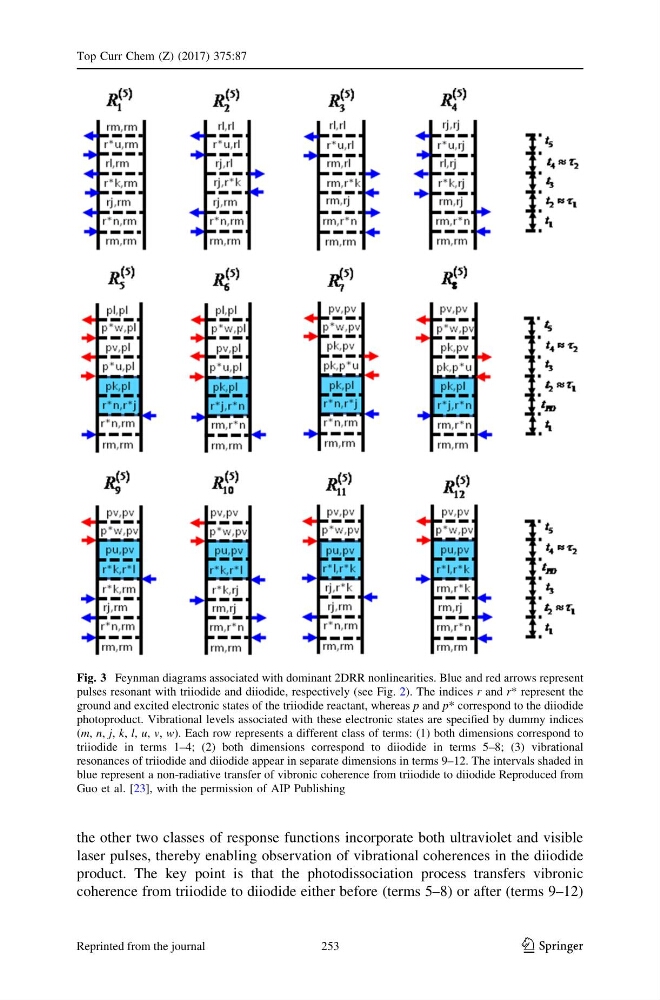
the other two classes of response functions incorporate both ultraviolet and visible
laser pulses, thereby enabling observation of vibrational coherences in the diiodide
product. The key point is that the photodissociation process transfers vibronic
coherence from triiodide to diiodide either before (terms 5–8) or after (terms 9–12)
Fig. 3 Feynman diagrams associated with dominant 2DRR nonlinearities. Blue and red arrows represent
pulses resonant with triiodide and diiodide, respectively (see Fig. 2). The indices r and r* represent the
ground and excited electronic states of the triiodide reactant, whereas p and p* correspond to the diiodide
photoproduct. Vibrational levels associated with these electronic states are specified by dummy indices
(m, n, j, k, l, u, v, w). Each row represents a different class of terms: (1) both dimensions correspond to
triiodide in terms 1–4; (2) both dimensions correspond to diiodide in terms 5–8; (3) vibrational
resonances of triiodide and diiodide appear in separate dimensions in terms 9–12. The intervals shaded in
blue represent a non-radiative transfer of vibronic coherence from triiodide to diiodide Reproduced from
Guo et al. [23], with the permission of AIP Publishing
Top Curr Chem (Z) (2017) 375:87
123
253
Reprinted from the journal
laser pulses, thereby enabling observation of vibrational coherences in the diiodide
product. The key point is that the photodissociation process transfers vibronic
coherence from triiodide to diiodide either before (terms 5–8) or after (terms 9–12)
Fig. 3 Feynman diagrams associated with dominant 2DRR nonlinearities. Blue and red arrows represent
pulses resonant with triiodide and diiodide, respectively (see Fig. 2). The indices r and r* represent the
ground and excited electronic states of the triiodide reactant, whereas p and p* correspond to the diiodide
photoproduct. Vibrational levels associated with these electronic states are specified by dummy indices
(m, n, j, k, l, u, v, w). Each row represents a different class of terms: (1) both dimensions correspond to
triiodide in terms 1–4; (2) both dimensions correspond to diiodide in terms 5–8; (3) vibrational
resonances of triiodide and diiodide appear in separate dimensions in terms 9–12. The intervals shaded in
blue represent a non-radiative transfer of vibronic coherence from triiodide to diiodide Reproduced from
Guo et al. [23], with the permission of AIP Publishing
Top Curr Chem (Z) (2017) 375:87
123
253
Reprinted from the journal