

anharmonicity can be probed, depending on the laser pulse sequence [26]. In this
section, we define signal components associated with a system in which the reactant
and product absorb light in separate spectral regions. The 2DRR response is
discussed in the context of the photodissociation reaction of triiodide to facilitate
discussion of the measurements presented below; however, the principles generalize
to other ultrafast reactions such as energy and electron transfer.
2.1 2DRR Response Function for the Photodissociation Reaction
of Triiodide
Photodissociation of triiodide is initiated by light absorption in the UV spectral
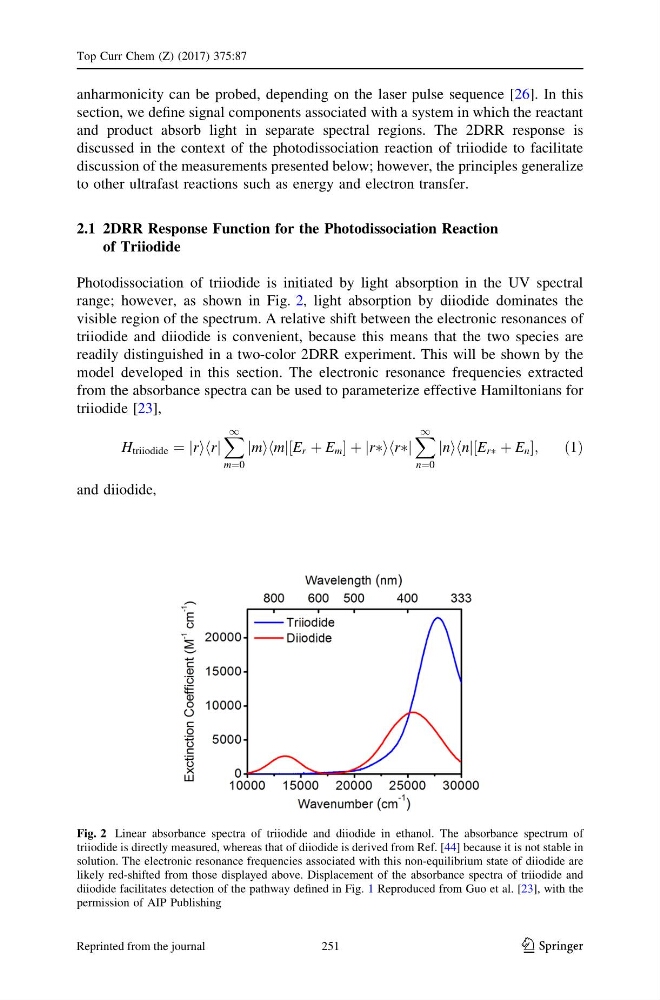
range; however, as shown in Fig. 2, light absorption by diiodide dominates the
visible region of the spectrum. A relative shift between the electronic resonances of
triiodide and diiodide is convenient, because this means that the two species are
readily distinguished in a two-color 2DRR experiment. This will be shown by the
model developed in this section. The electronic resonance frequencies extracted
from the absorbance spectra can be used to parameterize effective Hamiltonians for
triiodide [23],
H triiodide ¼ r
j i r
h j
X 1
m¼0
m
j i m
h j E r þ E m
½
þ rÃ
j i rÃ
h j
X 1
n¼0
n
j i n
h j E rà þ E n
½
;
ð1Þ
and diiodide,
Fig. 2 Linear absorbance spectra of triiodide and diiodide in ethanol. The absorbance spectrum of
triiodide is directly measured, whereas that of diiodide is derived from Ref. [44] because it is not stable in
solution. The electronic resonance frequencies associated with this non-equilibrium state of diiodide are
likely red-shifted from those displayed above. Displacement of the absorbance spectra of triiodide and
diiodide facilitates detection of the pathway defined in Fig. 1 Reproduced from Guo et al. [23], with the
permission of AIP Publishing
Top Curr Chem (Z) (2017) 375:87
123
251
Reprinted from the journal
section, we define signal components associated with a system in which the reactant
and product absorb light in separate spectral regions. The 2DRR response is
discussed in the context of the photodissociation reaction of triiodide to facilitate
discussion of the measurements presented below; however, the principles generalize
to other ultrafast reactions such as energy and electron transfer.
2.1 2DRR Response Function for the Photodissociation Reaction
of Triiodide
Photodissociation of triiodide is initiated by light absorption in the UV spectral
range; however, as shown in Fig. 2, light absorption by diiodide dominates the
visible region of the spectrum. A relative shift between the electronic resonances of
triiodide and diiodide is convenient, because this means that the two species are
readily distinguished in a two-color 2DRR experiment. This will be shown by the
model developed in this section. The electronic resonance frequencies extracted
from the absorbance spectra can be used to parameterize effective Hamiltonians for
triiodide [23],
H triiodide ¼ r
j i r
h j
X 1
m¼0
m
j i m
h j E r þ E m
½
þ rÃ
j i rÃ
h j
X 1
n¼0
n
j i n
h j E rà þ E n
½
;
ð1Þ
and diiodide,
Fig. 2 Linear absorbance spectra of triiodide and diiodide in ethanol. The absorbance spectrum of
triiodide is directly measured, whereas that of diiodide is derived from Ref. [44] because it is not stable in
solution. The electronic resonance frequencies associated with this non-equilibrium state of diiodide are
likely red-shifted from those displayed above. Displacement of the absorbance spectra of triiodide and
diiodide facilitates detection of the pathway defined in Fig. 1 Reproduced from Guo et al. [23], with the
permission of AIP Publishing
Top Curr Chem (Z) (2017) 375:87
123
251
Reprinted from the journal