

1 3
Topics in Current Chemistry (2018) 376:35
As briefly mentioned above, pump-DFWM differs from pump-IVS and FSRS in
the signal detection and the dependence on the molecule concentration in the sample. The pump-DFWM signal is detected in a homodyne configuration. This contrasts to the self-heterodyne detection used in the other two techniques, where the
signal created in the sample is generated in the same direction as the (Raman) probe
beam. (Self-)heterodyne detection offers amplification of weak optical signals (see
the contribution “Introduction to State of the Art Multidimensional Time-resolved
Spectroscopy Methods” in the collection), but its signal-to-noise ratio often suffers
from local oscillator fluctuations, inserting random noise as well as signal distortion that can only be corrected under e.g., specific balanced detection and averaging schemes [30, 61]. Pump-DFWM is not prone to such signal distortions, instead
it may suffer from interferences (see below on the Challenges in Multidimensional
VCS) leading to an ambiguous assignment of (low) frequency modes and artificially
broadened Raman lines [20]. The second major difference between pump-DFWM
and other techniques is the nonlinear concentration dependence: while pump-IVS
and FSRS depend linearly on the probed concentration, pump-DFWM (as any other
homodyne nonlinear technique) shows a quadratic dependence. This nonlinear
dependence leads to a distortion of the evolution of the amplitude of Raman modes
during the T delay, which can only be linearized by using a heterodyne detection
[58]. A major drawback of such nonlinear concentration dependence is the difficulty
of detecting minor components in a multi-component sample, since the contribution
of major component(s) will dominate the signal.
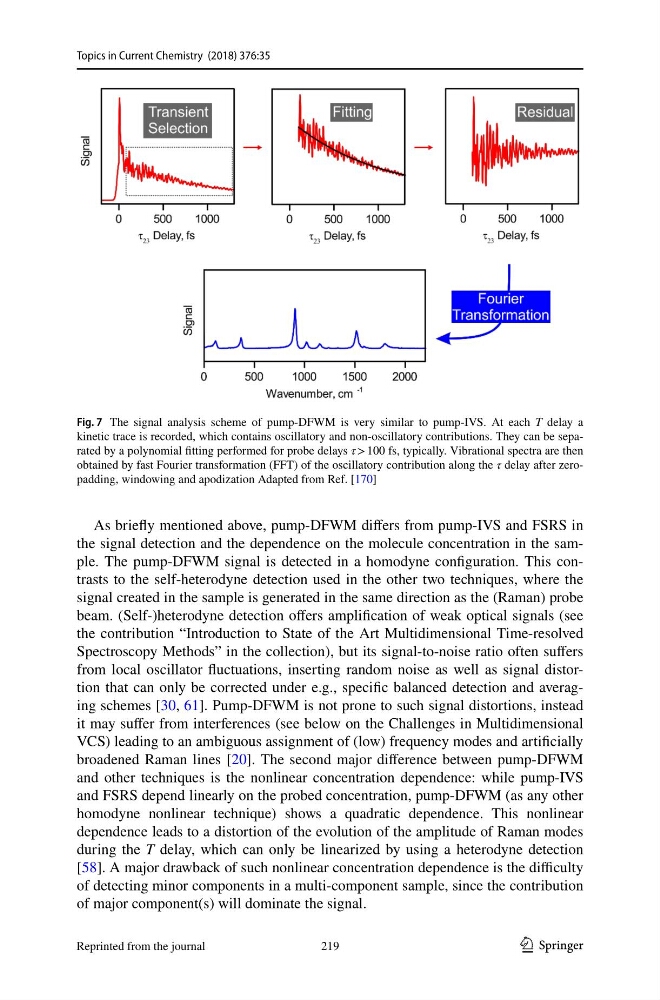
Fig. 7 The signal analysis scheme of pump-DFWM is very similar to pump-IVS. At each T delay a
kinetic trace is recorded, which contains oscillatory and non-oscillatory contributions. They can be separated by a polynomial fitting performed for probe delays τ > 100 fs, typically. Vibrational spectra are then
obtained by fast Fourier transformation (FFT) of the oscillatory contribution along the τ delay after zeropadding, windowing and apodization Adapted from Ref. [170]
219
Reprinted from the journal
Topics in Current Chemistry (2018) 376:35
As briefly mentioned above, pump-DFWM differs from pump-IVS and FSRS in
the signal detection and the dependence on the molecule concentration in the sample. The pump-DFWM signal is detected in a homodyne configuration. This contrasts to the self-heterodyne detection used in the other two techniques, where the
signal created in the sample is generated in the same direction as the (Raman) probe
beam. (Self-)heterodyne detection offers amplification of weak optical signals (see
the contribution “Introduction to State of the Art Multidimensional Time-resolved
Spectroscopy Methods” in the collection), but its signal-to-noise ratio often suffers
from local oscillator fluctuations, inserting random noise as well as signal distortion that can only be corrected under e.g., specific balanced detection and averaging schemes [30, 61]. Pump-DFWM is not prone to such signal distortions, instead
it may suffer from interferences (see below on the Challenges in Multidimensional
VCS) leading to an ambiguous assignment of (low) frequency modes and artificially
broadened Raman lines [20]. The second major difference between pump-DFWM
and other techniques is the nonlinear concentration dependence: while pump-IVS
and FSRS depend linearly on the probed concentration, pump-DFWM (as any other
homodyne nonlinear technique) shows a quadratic dependence. This nonlinear
dependence leads to a distortion of the evolution of the amplitude of Raman modes
during the T delay, which can only be linearized by using a heterodyne detection
[58]. A major drawback of such nonlinear concentration dependence is the difficulty
of detecting minor components in a multi-component sample, since the contribution
of major component(s) will dominate the signal.
Fig. 7 The signal analysis scheme of pump-DFWM is very similar to pump-IVS. At each T delay a
kinetic trace is recorded, which contains oscillatory and non-oscillatory contributions. They can be separated by a polynomial fitting performed for probe delays τ > 100 fs, typically. Vibrational spectra are then
obtained by fast Fourier transformation (FFT) of the oscillatory contribution along the τ delay after zeropadding, windowing and apodization Adapted from Ref. [170]
219
Reprinted from the journal