

excitation dynamics during photochemical reactions of large biological molecules
such as rhodopsins [278] or light-harvesting complexes [146].
4.5.2 2D Electronic-Vibrational (EV) Spectroscopy
Aiming at combining the strengths of electronic [18, 58, 279] and vibrational 2D
spectroscopy [10, 15], Fleming et al. have invented a hybrid technique and
pioneered the field of 2D electronic-vibrational (EV) spectroscopy [280–285].
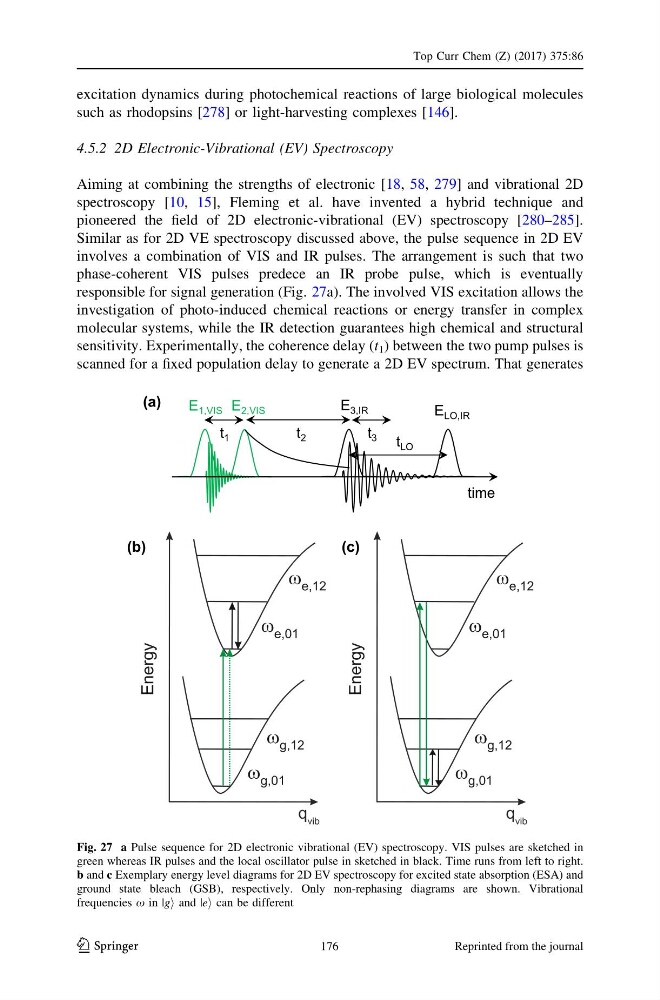
Similar as for 2D VE spectroscopy discussed above, the pulse sequence in 2D EV
involves a combination of VIS and IR pulses. The arrangement is such that two
phase-coherent VIS pulses predece an IR probe pulse, which is eventually
responsible for signal generation (Fig. 27a). The involved VIS excitation allows the
investigation of photo-induced chemical reactions or energy transfer in complex
molecular systems, while the IR detection guarantees high chemical and structural
sensitivity. Experimentally, the coherence delay (t 1 ) between the two pump pulses is
scanned for a fixed population delay to generate a 2D EV spectrum. That generates
E 3,IR
time
E LO,IR
t LO
t 1
t 2
E 1,VIS E 2,VIS
t 3
(a)
(b)
(c)
Fig. 27 a Pulse sequence for 2D electronic vibrational (EV) spectroscopy. VIS pulses are sketched in
green whereas IR pulses and the local oscillator pulse in sketched in black. Time runs from left to right.
b and c Exemplary energy level diagrams for 2D EV spectroscopy for excited state absorption (ESA) and
ground state bleach (GSB), respectively. Only non-rephasing diagrams are shown. Vibrational
frequencies x in |gi and |ei can be different
Top Curr Chem (Z) (2017) 375:86
123
176
Reprinted from the journal
such as rhodopsins [278] or light-harvesting complexes [146].
4.5.2 2D Electronic-Vibrational (EV) Spectroscopy
Aiming at combining the strengths of electronic [18, 58, 279] and vibrational 2D
spectroscopy [10, 15], Fleming et al. have invented a hybrid technique and
pioneered the field of 2D electronic-vibrational (EV) spectroscopy [280–285].
Similar as for 2D VE spectroscopy discussed above, the pulse sequence in 2D EV
involves a combination of VIS and IR pulses. The arrangement is such that two
phase-coherent VIS pulses predece an IR probe pulse, which is eventually
responsible for signal generation (Fig. 27a). The involved VIS excitation allows the
investigation of photo-induced chemical reactions or energy transfer in complex
molecular systems, while the IR detection guarantees high chemical and structural
sensitivity. Experimentally, the coherence delay (t 1 ) between the two pump pulses is
scanned for a fixed population delay to generate a 2D EV spectrum. That generates
E 3,IR
time
E LO,IR
t LO
t 1
t 2
E 1,VIS E 2,VIS
t 3
(a)
(b)
(c)
Fig. 27 a Pulse sequence for 2D electronic vibrational (EV) spectroscopy. VIS pulses are sketched in
green whereas IR pulses and the local oscillator pulse in sketched in black. Time runs from left to right.
b and c Exemplary energy level diagrams for 2D EV spectroscopy for excited state absorption (ESA) and
ground state bleach (GSB), respectively. Only non-rephasing diagrams are shown. Vibrational
frequencies x in |gi and |ei can be different
Top Curr Chem (Z) (2017) 375:86
123
176
Reprinted from the journal