

2D VE spectroscopy appeared only very recently and its full potential has still to
be evaluated in detail. Similar as 2D IR spectroscopy, the temporal window of
observation is limited by vibrational relaxation and thus information about longerlived electronic dynamics cannot easily be obtained. The preliminary experiments
reported so far utilize comparatively narrow bandwidths of the IR pump and NIR/
VIS probe pulses. It can be expected that a significant broadening of the both the x 1
and x 3 spectral axes will allow for much more detailed insight into the different
signal contributions [275–277]. That way a larger range of Franck-Condon
transitions can be detected and the role of anharmonicity on the signals might be
addressable. The spectral broadening of the pump and probe pulses is expected to
also help clarifying the role of ground state vibrational modes in electronic
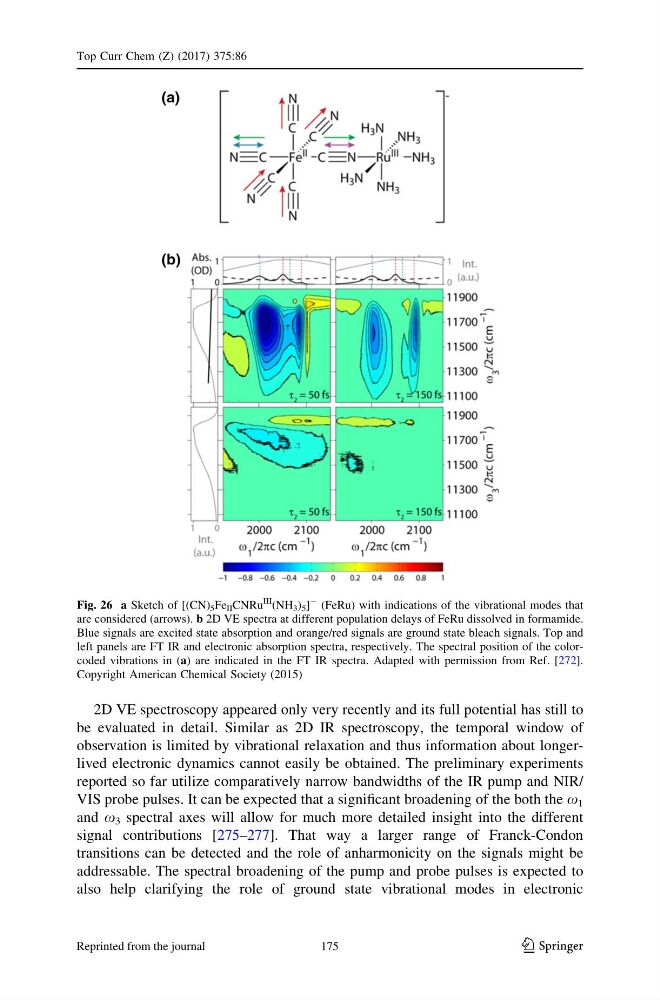
Fig. 26 a Sketch of [(CN) 5 Fe II CNRu
III
(NH 3 ) 5 ]
- (FeRu) with indications of the vibrational modes that
are considered (arrows). b 2D VE spectra at different population delays of FeRu dissolved in formamide.
Blue signals are excited state absorption and orange/red signals are ground state bleach signals. Top and
left panels are FT IR and electronic absorption spectra, respectively. The spectral position of the colorcoded vibrations in (a) are indicated in the FT IR spectra. Adapted with permission from Ref. [272].
Copyright American Chemical Society (2015)
Top Curr Chem (Z) (2017) 375:86
123
175
Reprinted from the journal
be evaluated in detail. Similar as 2D IR spectroscopy, the temporal window of
observation is limited by vibrational relaxation and thus information about longerlived electronic dynamics cannot easily be obtained. The preliminary experiments
reported so far utilize comparatively narrow bandwidths of the IR pump and NIR/
VIS probe pulses. It can be expected that a significant broadening of the both the x 1
and x 3 spectral axes will allow for much more detailed insight into the different
signal contributions [275–277]. That way a larger range of Franck-Condon
transitions can be detected and the role of anharmonicity on the signals might be
addressable. The spectral broadening of the pump and probe pulses is expected to
also help clarifying the role of ground state vibrational modes in electronic
Fig. 26 a Sketch of [(CN) 5 Fe II CNRu
III
(NH 3 ) 5 ]
- (FeRu) with indications of the vibrational modes that
are considered (arrows). b 2D VE spectra at different population delays of FeRu dissolved in formamide.
Blue signals are excited state absorption and orange/red signals are ground state bleach signals. Top and
left panels are FT IR and electronic absorption spectra, respectively. The spectral position of the colorcoded vibrations in (a) are indicated in the FT IR spectra. Adapted with permission from Ref. [272].
Copyright American Chemical Society (2015)
Top Curr Chem (Z) (2017) 375:86
123
175
Reprinted from the journal