

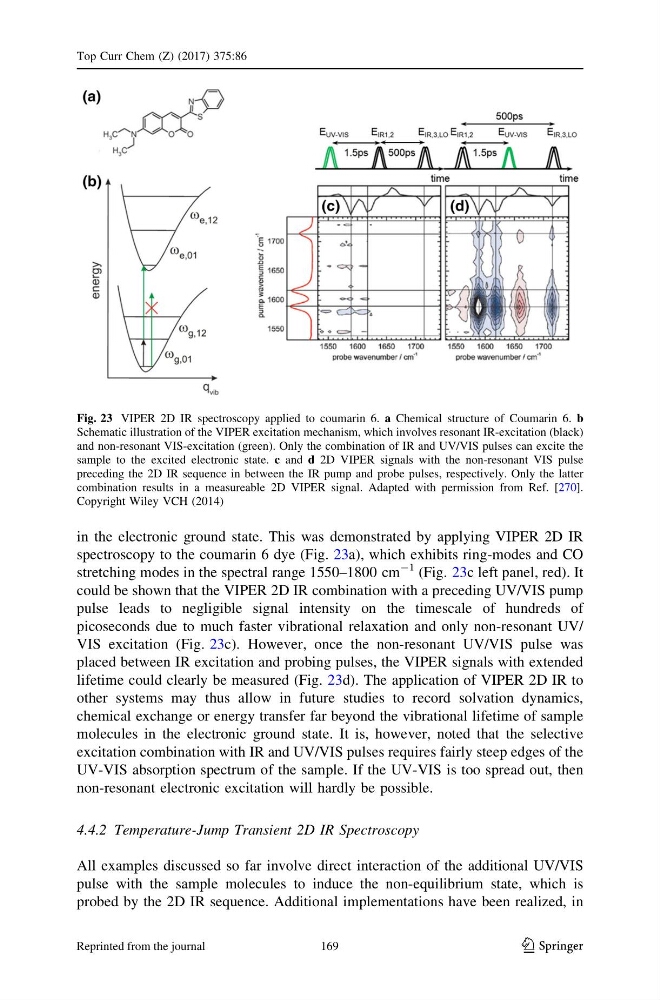
in the electronic ground state. This was demonstrated by applying VIPER 2D IR
spectroscopy to the coumarin 6 dye (Fig. 23a), which exhibits ring-modes and CO
stretching modes in the spectral range 1550–1800 cm
-1 (Fig. 23c left panel, red). It
could be shown that the VIPER 2D IR combination with a preceding UV/VIS pump
pulse leads to negligible signal intensity on the timescale of hundreds of
picoseconds due to much faster vibrational relaxation and only non-resonant UV/
VIS excitation (Fig. 23c). However, once the non-resonant UV/VIS pulse was
placed between IR excitation and probing pulses, the VIPER signals with extended
lifetime could clearly be measured (Fig. 23d). The application of VIPER 2D IR to
other systems may thus allow in future studies to record solvation dynamics,
chemical exchange or energy transfer far beyond the vibrational lifetime of sample
molecules in the electronic ground state. It is, however, noted that the selective
excitation combination with IR and UV/VIS pulses requires fairly steep edges of the
UV-VIS absorption spectrum of the sample. If the UV-VIS is too spread out, then
non-resonant electronic excitation will hardly be possible.
4.4.2 Temperature-Jump Transient 2D IR Spectroscopy
All examples discussed so far involve direct interaction of the additional UV/VIS
pulse with the sample molecules to induce the non-equilibrium state, which is
probed by the 2D IR sequence. Additional implementations have been realized, in
Fig. 23 VIPER 2D IR spectroscopy applied to coumarin 6. a Chemical structure of Coumarin 6. b
Schematic illustration of the VIPER excitation mechanism, which involves resonant IR-excitation (black)
and non-resonant VIS-excitation (green). Only the combination of IR and UV/VIS pulses can excite the
sample to the excited electronic state. c and d 2D VIPER signals with the non-resonant VIS pulse
preceding the 2D IR sequence in between the IR pump and probe pulses, respectively. Only the latter
combination results in a measureable 2D VIPER signal. Adapted with permission from Ref. [270].
Copyright Wiley VCH (2014)
Top Curr Chem (Z) (2017) 375:86
123
169
Reprinted from the journal
spectroscopy to the coumarin 6 dye (Fig. 23a), which exhibits ring-modes and CO
stretching modes in the spectral range 1550–1800 cm
-1 (Fig. 23c left panel, red). It
could be shown that the VIPER 2D IR combination with a preceding UV/VIS pump
pulse leads to negligible signal intensity on the timescale of hundreds of
picoseconds due to much faster vibrational relaxation and only non-resonant UV/
VIS excitation (Fig. 23c). However, once the non-resonant UV/VIS pulse was
placed between IR excitation and probing pulses, the VIPER signals with extended
lifetime could clearly be measured (Fig. 23d). The application of VIPER 2D IR to
other systems may thus allow in future studies to record solvation dynamics,
chemical exchange or energy transfer far beyond the vibrational lifetime of sample
molecules in the electronic ground state. It is, however, noted that the selective
excitation combination with IR and UV/VIS pulses requires fairly steep edges of the
UV-VIS absorption spectrum of the sample. If the UV-VIS is too spread out, then
non-resonant electronic excitation will hardly be possible.
4.4.2 Temperature-Jump Transient 2D IR Spectroscopy
All examples discussed so far involve direct interaction of the additional UV/VIS
pulse with the sample molecules to induce the non-equilibrium state, which is
probed by the 2D IR sequence. Additional implementations have been realized, in
Fig. 23 VIPER 2D IR spectroscopy applied to coumarin 6. a Chemical structure of Coumarin 6. b
Schematic illustration of the VIPER excitation mechanism, which involves resonant IR-excitation (black)
and non-resonant VIS-excitation (green). Only the combination of IR and UV/VIS pulses can excite the
sample to the excited electronic state. c and d 2D VIPER signals with the non-resonant VIS pulse
preceding the 2D IR sequence in between the IR pump and probe pulses, respectively. Only the latter
combination results in a measureable 2D VIPER signal. Adapted with permission from Ref. [270].
Copyright Wiley VCH (2014)
Top Curr Chem (Z) (2017) 375:86
123
169
Reprinted from the journal