

surface could be determined. As a furthermore interesting observation, modes from
random coil motifs that are intrinsically invisible to SFG spectroscopy due to
orientational averaging were shown to be resolvable in 2D SFG data through cross
peak features with SFG-active vibrations. This experimental observation was taken
as a confirmation of earlier theoretical predictions [192].
2D SFG spectroscopy is not exclusively applicable to immobilized molecules at
interfaces. This is due to the intrinsic surface-specificity of the method, which stems
from the fourth-order nonlinear susceptibility that is exploited for signal generation
[15]. Thus, the possibility to measure non- or only weakly adsorbed molecules is the
big advantage of 2D SFG spectroscopy over third-order methods. In that way, a
series of different interfaces can be addressed by 2D SFG, i.e. liquid-liquid or gasliquid, all of which are currently not possible to study in a similarly straightforward
manner with third-order methods. In fact, 2D SFG in different experimental
implementations has been used extensively to study orientation, dynamics and
interactions of molecules at liquid-gas interfaces, in particular for aqueous systems
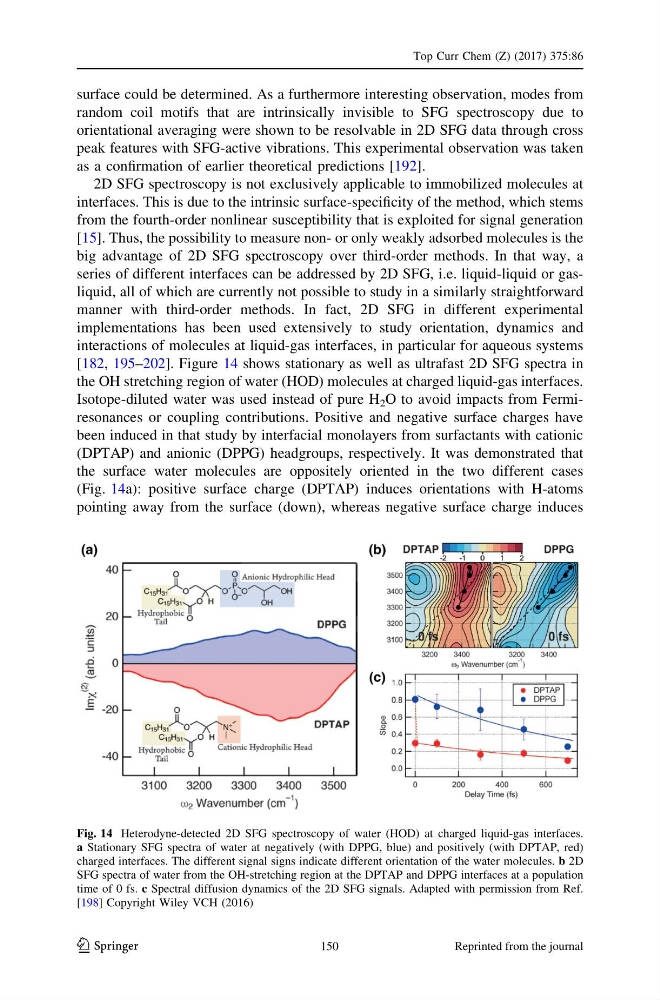
[182, 195–202]. Figure 14 shows stationary as well as ultrafast 2D SFG spectra in
the OH stretching region of water (HOD) molecules at charged liquid-gas interfaces.
Isotope-diluted water was used instead of pure H 2 O to avoid impacts from Fermiresonances or coupling contributions. Positive and negative surface charges have
been induced in that study by interfacial monolayers from surfactants with cationic
(DPTAP) and anionic (DPPG) headgroups, respectively. It was demonstrated that
the surface water molecules are oppositely oriented in the two different cases
(Fig. 14a): positive surface charge (DPTAP) induces orientations with H-atoms
pointing away from the surface (down), whereas negative surface charge induces
Fig. 14 Heterodyne-detected 2D SFG spectroscopy of water (HOD) at charged liquid-gas interfaces.
a Stationary SFG spectra of water at negatively (with DPPG, blue) and positively (with DPTAP, red)
charged interfaces. The different signal signs indicate different orientation of the water molecules. b 2D
SFG spectra of water from the OH-stretching region at the DPTAP and DPPG interfaces at a population
time of 0 fs. c Spectral diffusion dynamics of the 2D SFG signals. Adapted with permission from Ref.
[198] Copyright Wiley VCH (2016)
Top Curr Chem (Z) (2017) 375:86
123
150
Reprinted from the journal
random coil motifs that are intrinsically invisible to SFG spectroscopy due to
orientational averaging were shown to be resolvable in 2D SFG data through cross
peak features with SFG-active vibrations. This experimental observation was taken
as a confirmation of earlier theoretical predictions [192].
2D SFG spectroscopy is not exclusively applicable to immobilized molecules at
interfaces. This is due to the intrinsic surface-specificity of the method, which stems
from the fourth-order nonlinear susceptibility that is exploited for signal generation
[15]. Thus, the possibility to measure non- or only weakly adsorbed molecules is the
big advantage of 2D SFG spectroscopy over third-order methods. In that way, a
series of different interfaces can be addressed by 2D SFG, i.e. liquid-liquid or gasliquid, all of which are currently not possible to study in a similarly straightforward
manner with third-order methods. In fact, 2D SFG in different experimental
implementations has been used extensively to study orientation, dynamics and
interactions of molecules at liquid-gas interfaces, in particular for aqueous systems
[182, 195–202]. Figure 14 shows stationary as well as ultrafast 2D SFG spectra in
the OH stretching region of water (HOD) molecules at charged liquid-gas interfaces.
Isotope-diluted water was used instead of pure H 2 O to avoid impacts from Fermiresonances or coupling contributions. Positive and negative surface charges have
been induced in that study by interfacial monolayers from surfactants with cationic
(DPTAP) and anionic (DPPG) headgroups, respectively. It was demonstrated that
the surface water molecules are oppositely oriented in the two different cases
(Fig. 14a): positive surface charge (DPTAP) induces orientations with H-atoms
pointing away from the surface (down), whereas negative surface charge induces
Fig. 14 Heterodyne-detected 2D SFG spectroscopy of water (HOD) at charged liquid-gas interfaces.
a Stationary SFG spectra of water at negatively (with DPPG, blue) and positively (with DPTAP, red)
charged interfaces. The different signal signs indicate different orientation of the water molecules. b 2D
SFG spectra of water from the OH-stretching region at the DPTAP and DPPG interfaces at a population
time of 0 fs. c Spectral diffusion dynamics of the 2D SFG signals. Adapted with permission from Ref.
[198] Copyright Wiley VCH (2016)
Top Curr Chem (Z) (2017) 375:86
123
150
Reprinted from the journal