

one-exciton Hamiltonian, and to finally relate the 2D IR signals to molecular
structure.
b ij ¼
1
4pe 0
l
~ i Á l
~ j
r
3
ij
À 3
r
~ ij Á l
~ i
À
Á
Á r
~ ij Á l
~ j
À
Á
r
5
ij
"
#
1
4pe 0
j l
~ i
j j l
~ j
r
3
ij
ð4Þ
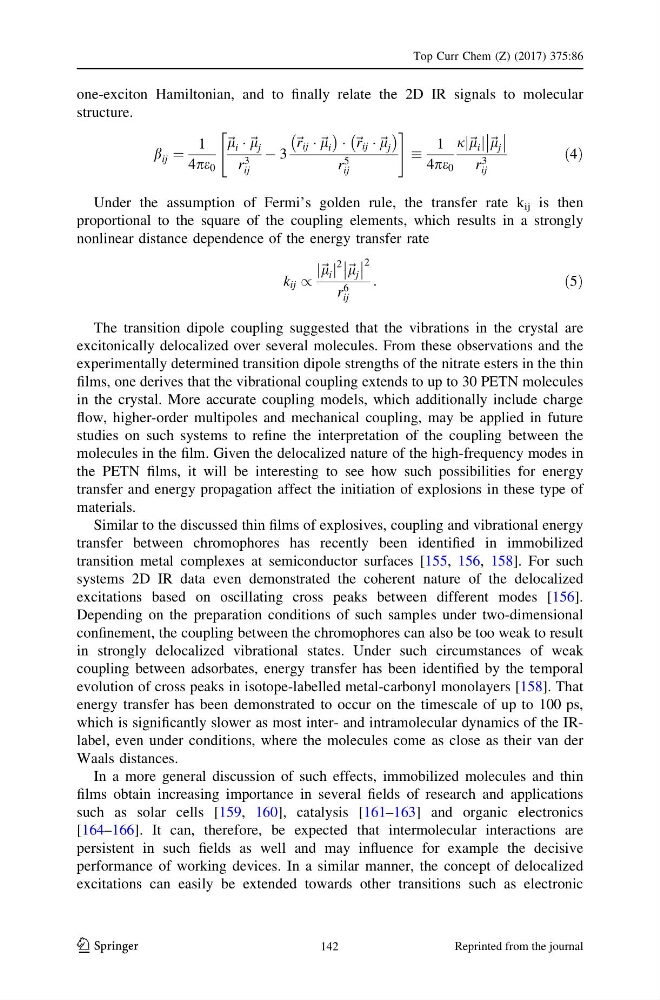
Under the assumption of Fermi’s golden rule, the transfer rate k ij is then
proportional to the square of the coupling elements, which results in a strongly
nonlinear distance dependence of the energy transfer rate
k ij /
l
~ i
j j
2 l
~ j
2
r
6
ij
:
ð5Þ
The transition dipole coupling suggested that the vibrations in the crystal are
excitonically delocalized over several molecules. From these observations and the
experimentally determined transition dipole strengths of the nitrate esters in the thin
films, one derives that the vibrational coupling extends to up to 30 PETN molecules
in the crystal. More accurate coupling models, which additionally include charge
flow, higher-order multipoles and mechanical coupling, may be applied in future
studies on such systems to refine the interpretation of the coupling between the
molecules in the film. Given the delocalized nature of the high-frequency modes in
the PETN films, it will be interesting to see how such possibilities for energy
transfer and energy propagation affect the initiation of explosions in these type of
materials.
Similar to the discussed thin films of explosives, coupling and vibrational energy
transfer between chromophores has recently been identified in immobilized
transition metal complexes at semiconductor surfaces [155, 156, 158]. For such
systems 2D IR data even demonstrated the coherent nature of the delocalized
excitations based on oscillating cross peaks between different modes [156].
Depending on the preparation conditions of such samples under two-dimensional
confinement, the coupling between the chromophores can also be too weak to result
in strongly delocalized vibrational states. Under such circumstances of weak
coupling between adsorbates, energy transfer has been identified by the temporal
evolution of cross peaks in isotope-labelled metal-carbonyl monolayers [158]. That
energy transfer has been demonstrated to occur on the timescale of up to 100 ps,
which is significantly slower as most inter- and intramolecular dynamics of the IRlabel, even under conditions, where the molecules come as close as their van der
Waals distances.
In a more general discussion of such effects, immobilized molecules and thin
films obtain increasing importance in several fields of research and applications
such as solar cells [159, 160], catalysis [161–163] and organic electronics
[164–166]. It can, therefore, be expected that intermolecular interactions are
persistent in such fields as well and may influence for example the decisive
performance of working devices. In a similar manner, the concept of delocalized
excitations can easily be extended towards other transitions such as electronic
Top Curr Chem (Z) (2017) 375:86
123
142
Reprinted from the journal
structure.
b ij ¼
1
4pe 0
l
~ i Á l
~ j
r
3
ij
À 3
r
~ ij Á l
~ i
À
Á
Á r
~ ij Á l
~ j
À
Á
r
5
ij
"
#
1
4pe 0
j l
~ i
j j l
~ j
r
3
ij
ð4Þ
Under the assumption of Fermi’s golden rule, the transfer rate k ij is then
proportional to the square of the coupling elements, which results in a strongly
nonlinear distance dependence of the energy transfer rate
k ij /
l
~ i
j j
2 l
~ j
2
r
6
ij
:
ð5Þ
The transition dipole coupling suggested that the vibrations in the crystal are
excitonically delocalized over several molecules. From these observations and the
experimentally determined transition dipole strengths of the nitrate esters in the thin
films, one derives that the vibrational coupling extends to up to 30 PETN molecules
in the crystal. More accurate coupling models, which additionally include charge
flow, higher-order multipoles and mechanical coupling, may be applied in future
studies on such systems to refine the interpretation of the coupling between the
molecules in the film. Given the delocalized nature of the high-frequency modes in
the PETN films, it will be interesting to see how such possibilities for energy
transfer and energy propagation affect the initiation of explosions in these type of
materials.
Similar to the discussed thin films of explosives, coupling and vibrational energy
transfer between chromophores has recently been identified in immobilized
transition metal complexes at semiconductor surfaces [155, 156, 158]. For such
systems 2D IR data even demonstrated the coherent nature of the delocalized
excitations based on oscillating cross peaks between different modes [156].
Depending on the preparation conditions of such samples under two-dimensional
confinement, the coupling between the chromophores can also be too weak to result
in strongly delocalized vibrational states. Under such circumstances of weak
coupling between adsorbates, energy transfer has been identified by the temporal
evolution of cross peaks in isotope-labelled metal-carbonyl monolayers [158]. That
energy transfer has been demonstrated to occur on the timescale of up to 100 ps,
which is significantly slower as most inter- and intramolecular dynamics of the IRlabel, even under conditions, where the molecules come as close as their van der
Waals distances.
In a more general discussion of such effects, immobilized molecules and thin
films obtain increasing importance in several fields of research and applications
such as solar cells [159, 160], catalysis [161–163] and organic electronics
[164–166]. It can, therefore, be expected that intermolecular interactions are
persistent in such fields as well and may influence for example the decisive
performance of working devices. In a similar manner, the concept of delocalized
excitations can easily be extended towards other transitions such as electronic
Top Curr Chem (Z) (2017) 375:86
123
142
Reprinted from the journal