

Alternative explanations for the origin of the peaks, e.g. chemical exchange
between different conformations, could directly be ruled out for the PETN film by
several control experiments. The first support came from the absence of comparable
cross peaks in bulk solution, where the molecules exhibit significantly larger
structural flexibility. The second support came from time-dependent anisotropy
measurements of both samples, which resulted in faster anisotropy decay for the
films as compared to the solution. Both points supported the assignment of the cross
peaks to intermolecular energy transfer, since the PETN molecules exhibit a
significantly shorter distance in the film. From the experimental results, as well as
theoretical predictions based on the crystal structure of PETN, a detailed
interpretation of the energy transfer could be derived. The two most prominent
exciton transitions were calculated to exhibit a mutual angle of 83°, which agreed
remarkably well with the experimentally determined values from anisotropy
measurements (80°). Using a transition dipole coupling model and the mutual
distances as well as orientations of the nitrate ester groups in the crystal, it could be
shown that the intermolecular coupling constants between adjacent nitrate ester
groups on different molecules are as large as, and partially even larger than the
intramolecular coupling constants. The transition dipole coupling includes pure
electrostatic effects between different units and calculates the coupling constant b ij
between two local modes i and j based on the transition dipole moments l i,j and the
distance vectors between the modes r i,j (Eq. 4). Through these quantities, the
coupling is directly sensitive to intermolecular distances and relative orientations (j
is an orientational factor). Similar as in Sect. 3.1.1, the coupling constant is used to
obtain the normal mode frequencies and eigenvectors from a diagonalization of a
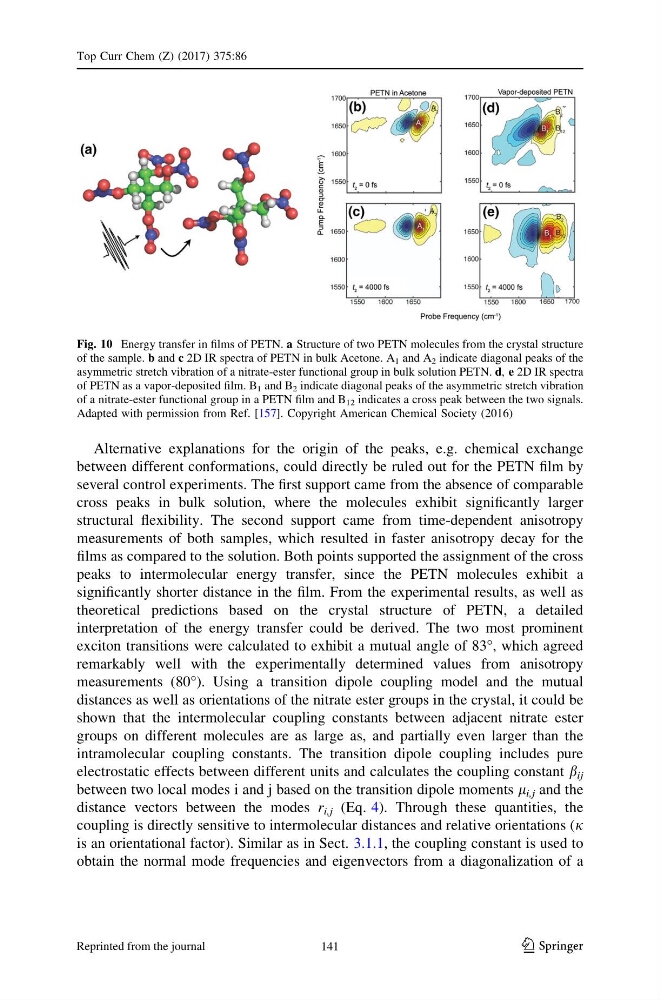
Fig. 10 Energy transfer in films of PETN. a Structure of two PETN molecules from the crystal structure
of the sample. b and c 2D IR spectra of PETN in bulk Acetone. A 1 and A 2 indicate diagonal peaks of the
asymmetric stretch vibration of a nitrate-ester functional group in bulk solution PETN. d, e 2D IR spectra
of PETN as a vapor-deposited film. B 1 and B 2 indicate diagonal peaks of the asymmetric stretch vibration
of a nitrate-ester functional group in a PETN film and B 12 indicates a cross peak between the two signals.
Adapted with permission from Ref. [157]. Copyright American Chemical Society (2016)
Top Curr Chem (Z) (2017) 375:86
123
141
Reprinted from the journal
between different conformations, could directly be ruled out for the PETN film by
several control experiments. The first support came from the absence of comparable
cross peaks in bulk solution, where the molecules exhibit significantly larger
structural flexibility. The second support came from time-dependent anisotropy
measurements of both samples, which resulted in faster anisotropy decay for the
films as compared to the solution. Both points supported the assignment of the cross
peaks to intermolecular energy transfer, since the PETN molecules exhibit a
significantly shorter distance in the film. From the experimental results, as well as
theoretical predictions based on the crystal structure of PETN, a detailed
interpretation of the energy transfer could be derived. The two most prominent
exciton transitions were calculated to exhibit a mutual angle of 83°, which agreed
remarkably well with the experimentally determined values from anisotropy
measurements (80°). Using a transition dipole coupling model and the mutual
distances as well as orientations of the nitrate ester groups in the crystal, it could be
shown that the intermolecular coupling constants between adjacent nitrate ester
groups on different molecules are as large as, and partially even larger than the
intramolecular coupling constants. The transition dipole coupling includes pure
electrostatic effects between different units and calculates the coupling constant b ij
between two local modes i and j based on the transition dipole moments l i,j and the
distance vectors between the modes r i,j (Eq. 4). Through these quantities, the
coupling is directly sensitive to intermolecular distances and relative orientations (j
is an orientational factor). Similar as in Sect. 3.1.1, the coupling constant is used to
obtain the normal mode frequencies and eigenvectors from a diagonalization of a
Fig. 10 Energy transfer in films of PETN. a Structure of two PETN molecules from the crystal structure
of the sample. b and c 2D IR spectra of PETN in bulk Acetone. A 1 and A 2 indicate diagonal peaks of the
asymmetric stretch vibration of a nitrate-ester functional group in bulk solution PETN. d, e 2D IR spectra
of PETN as a vapor-deposited film. B 1 and B 2 indicate diagonal peaks of the asymmetric stretch vibration
of a nitrate-ester functional group in a PETN film and B 12 indicates a cross peak between the two signals.
Adapted with permission from Ref. [157]. Copyright American Chemical Society (2016)
Top Curr Chem (Z) (2017) 375:86
123
141
Reprinted from the journal