

1 3
Topics in Current Chemistry (2018) 376:28
can be either electronic, vibronic, vibrational or rotational in nature, dependent on
the spectral region of investigation, but also dependent on the bandwidth of excitation. Induction of coherence can require for example one short, or two (at least
approximately) simultaneous excitations of the sample with multiple frequencies.
Coherences between vibrational states can be directly induced in this way in the
electronic excited- as well as ground-state, e.g., by a spectrally broadband excitation
pulse via a stimulated Raman-type process [47, 48]. As the bandwidth of excitation
spectrum provided by the laser light and the time-dependence of the associated electric field are related by a Fourier transformation [49], the possibility to observe such
coherences is strongly dependent on the temporal duration of the laser pulses. This
effect has motivated an everlasting race in the field of light source development for
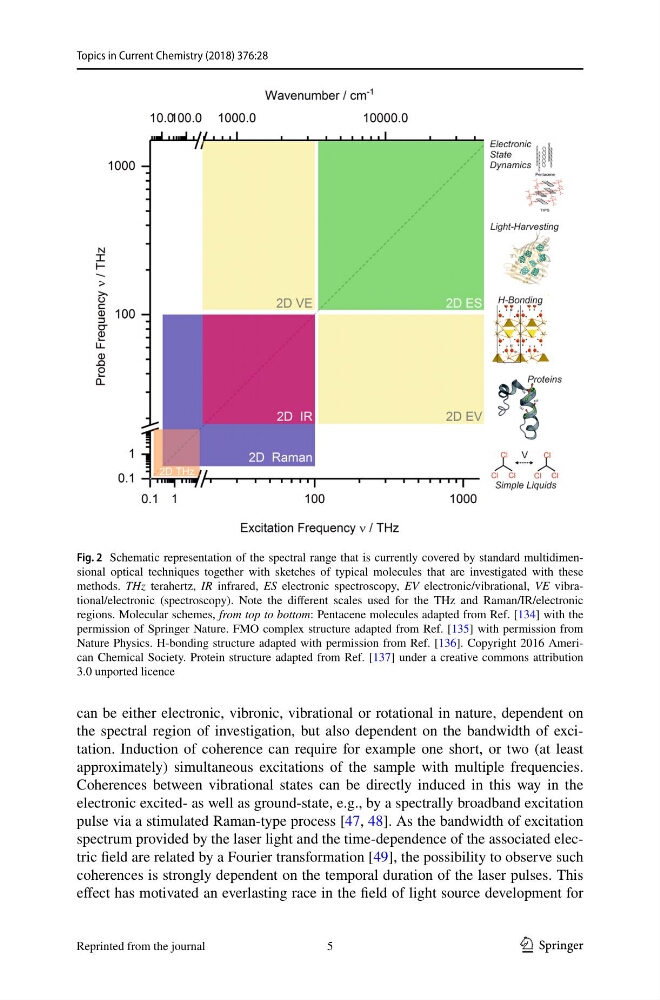
Fig. 2 Schematic representation of the spectral range that is currently covered by standard multidimensional optical techniques together with sketches of typical molecules that are investigated with these
methods. THz terahertz, IR infrared, ES electronic spectroscopy, EV electronic/vibrational, VE vibrational/electronic (spectroscopy). Note the different scales used for the THz and Raman/IR/electronic
regions. Molecular schemes, from top to bottom: Pentacene molecules adapted from Ref. [134] with the
permission of Springer Nature. FMO complex structure adapted from Ref. [135] with permission from
Nature Physics. H-bonding structure adapted with permission from Ref. [136]. Copyright 2016 American Chemical Society. Protein structure adapted from Ref. [137] under a creative commons attribution
3.0 unported licence
5
Reprinted from the journal
Topics in Current Chemistry (2018) 376:28
can be either electronic, vibronic, vibrational or rotational in nature, dependent on
the spectral region of investigation, but also dependent on the bandwidth of excitation. Induction of coherence can require for example one short, or two (at least
approximately) simultaneous excitations of the sample with multiple frequencies.
Coherences between vibrational states can be directly induced in this way in the
electronic excited- as well as ground-state, e.g., by a spectrally broadband excitation
pulse via a stimulated Raman-type process [47, 48]. As the bandwidth of excitation
spectrum provided by the laser light and the time-dependence of the associated electric field are related by a Fourier transformation [49], the possibility to observe such
coherences is strongly dependent on the temporal duration of the laser pulses. This
effect has motivated an everlasting race in the field of light source development for
Fig. 2 Schematic representation of the spectral range that is currently covered by standard multidimensional optical techniques together with sketches of typical molecules that are investigated with these
methods. THz terahertz, IR infrared, ES electronic spectroscopy, EV electronic/vibrational, VE vibrational/electronic (spectroscopy). Note the different scales used for the THz and Raman/IR/electronic
regions. Molecular schemes, from top to bottom: Pentacene molecules adapted from Ref. [134] with the
permission of Springer Nature. FMO complex structure adapted from Ref. [135] with permission from
Nature Physics. H-bonding structure adapted with permission from Ref. [136]. Copyright 2016 American Chemical Society. Protein structure adapted from Ref. [137] under a creative commons attribution
3.0 unported licence
5
Reprinted from the journal